 Back
BackCh 15: General and Special Senses: Structure, Function, and Pathways
Study Guide - Smart Notes
 Tailored notes based on your materials, expanded with key definitions, examples, and context.
General and Special Senses
Overview of Sensory Systems
The human sensory system is divided into general senses and special senses. General senses are distributed throughout the body and have simple receptors, while special senses are localized to specific organs and have complex structures. Both types are essential for detecting and interpreting environmental stimuli.
General Senses: Include temperature, pain, touch, pressure, vibration, and proprioception. Most information is processed in the spinal cord or brainstem.
Special Senses: Include olfaction (smell), vision (sight), gustation (taste), equilibrium (balance), and hearing. These are processed in specialized organs and interpreted in the brain.
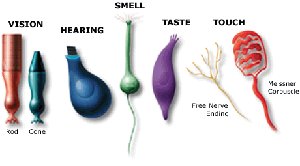
Classification of Sensory Receptors
Types of Sensory Receptors
Sensory receptors are specialized cells or nerve endings that detect specific types of stimuli. They are classified based on the type of stimulus they detect:
Nociceptors: Detect pain from mechanical, thermal, or chemical damage.
Thermoreceptors: Detect changes in temperature.
Mechanoreceptors: Detect physical distortion such as touch, pressure, vibration, and stretch.
Chemoreceptors: Detect chemical changes, such as pH, CO2, and O2 levels.
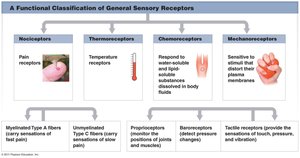
General Sensory Receptors
Receptive Fields and Sensory Detection
Each sensory receptor monitors a specific area called its receptive field. The size of the receptive field affects the ability to localize stimuli; smaller fields allow for more precise localization.
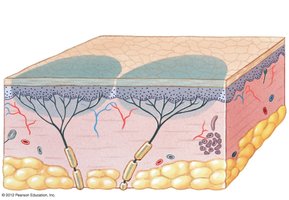
Adaptation of Sensory Receptors
Adaptation refers to the reduction in sensitivity to a constant stimulus. There are two main types of receptors based on their adaptation properties:
Tonic receptors: Always active, adapt slowly, and provide information about the duration of a stimulus (e.g., pain receptors).
Phasic receptors: Normally inactive, adapt quickly, and provide information about changes in stimulus intensity (e.g., touch receptors).
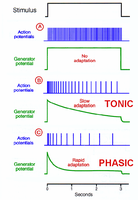
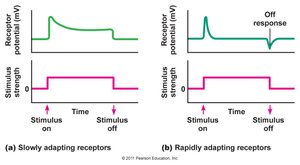
Types of Mechanoreceptors
Overview of Mechanoreceptors
Mechanoreceptors respond to mechanical forces that distort their plasma membranes. They include tactile receptors, baroreceptors, and proprioceptors.
Tactile receptors: Detect touch, pressure, and vibration.
Baroreceptors: Detect pressure changes in blood vessels and internal organs.
Proprioceptors: Monitor the position of joints and muscles.
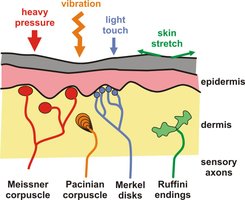
Tactile Receptors
Tactile receptors are found in the skin and include several types:
Free nerve endings: Sensitive to touch and pressure, located between epidermal cells.
Root hair plexus: Detect hair movement, adapt rapidly.
Merkel cells (tactile discs): Detect fine touch and pressure, have small receptive fields.
Meissner's corpuscles (tactile corpuscles): Detect fine touch, pressure, and low-frequency vibration, adapt quickly.
Pacinian corpuscles (lamellated corpuscles): Detect deep pressure and high-frequency vibration, adapt rapidly.
Ruffini corpuscles: Detect skin stretch and pressure, adapt slowly.
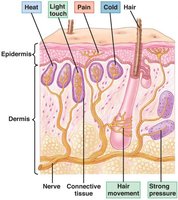
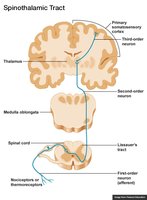
Nociceptors and Thermoreceptors
Nociceptors (Pain Receptors)
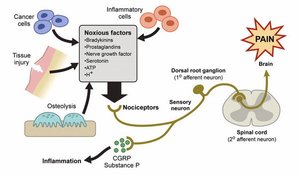
Nociceptors are free nerve endings with large receptive fields, found in the skin and around blood vessels. They detect pain from temperature extremes, mechanical damage, and chemicals released by injured cells. There are two types of axons: Type A (fast pain) and Type C (slow pain).
Thermoreceptors (Temperature Receptors)
Thermoreceptors are free nerve endings located in the dermis, skeletal muscles, liver, and hypothalamus. They share pathways with nociceptors and transmit signals via the spinothalamic tract to the brain.
Baroreceptors and Proprioceptors
Baroreceptors
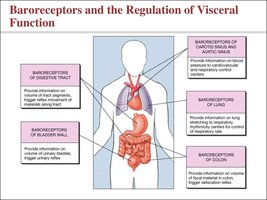
Baroreceptors monitor changes in pressure within blood vessels and internal organs. They adapt rapidly and are essential for regulating cardiovascular and respiratory functions.
Proprioceptors
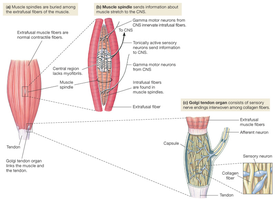
Proprioceptors provide information about the position of joints, tension in tendons and ligaments, and the state of muscular contraction. Major types include muscle spindles, Golgi tendon organs, and receptors in joint capsules.
Chemoreceptors
Function and Location
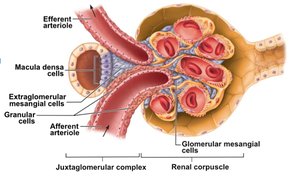
Chemoreceptors monitor the chemical composition of body fluids. They are found in the carotid bodies, aortic bodies, macula densa of the nephron, and the small intestine. These receptors help regulate respiratory and cardiovascular activity by detecting changes in pH, CO2, and O2 levels.
Sensory Pathways (Afferent Pathways)
Organization of Sensory Pathways
Sensory information is transmitted to the brain via three main neurons:
First-order neuron: Delivers sensory information from the receptor to the CNS (cell body in dorsal root or cranial nerve ganglion).
Second-order neuron: Located in the spinal cord or brainstem; axon crosses to the opposite side.
Third-order neuron: Located in the thalamus; relays information to the sensory cortex.
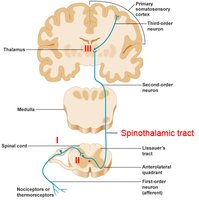
Main Sensory Pathways
Spinothalamic pathway: Carries pain and temperature sensations.
Posterior column pathway (Dorsal Column-Medial Lemniscus): Carries fine touch, vibration, and proprioception.
Spinocerebellar pathway: Carries proprioceptive information to the cerebellum for coordination.
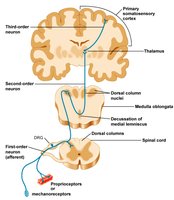
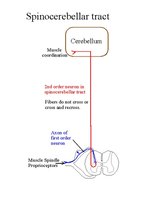
Somatic Motor Pathways (Descending Pathways)
Somatic vs Autonomic Motor Systems
The motor division of the nervous system is divided into the Somatic Nervous System (SNS) and the Autonomic Nervous System (ANS):
SNS: Controls voluntary skeletal muscle contractions.
ANS: Controls involuntary actions of smooth muscle, cardiac muscle, and glands.
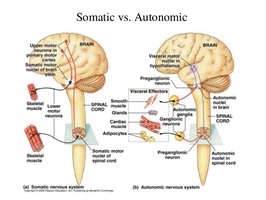
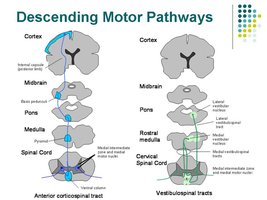
Somatic Motor Pathways
Somatic motor pathways always involve at least two motor neurons:
Upper motor neuron: Cell body in the CNS, synapses on the lower motor neuron.
Lower motor neuron: Cell body in the brainstem or spinal cord, innervates skeletal muscle.
Major pathways include the corticospinal, medial, and lateral pathways. These pathways control voluntary and involuntary muscle movements.
Summary Table: General vs Special Senses
General Senses | Special Senses |
|---|---|
Widely distributed throughout the body | Localized in specific organs |
Simple receptor structures | Complex receptor structures |
Touch, pressure, pain, temperature, proprioception | Vision, hearing, equilibrium, taste, smell |
Processed in spinal cord/brainstem | Processed in specialized brain regions |
Key Takeaways
General senses are distributed throughout the body and detect a variety of stimuli, while special senses are localized and highly specialized.
Sensory pathways involve three neurons and relay information to the sensory cortex via the thalamus.
Motor pathways involve two neurons and control voluntary and involuntary muscle actions.
