 Back
BackGeneral Principles of Sensory Processing: Sensation, Perception, and Neural Coding
Study Guide - Smart Notes
 Tailored notes based on your materials, expanded with key definitions, examples, and context.
General Principles of Sensory Processing
Introduction to Sensation and Perception
Sensory processing is the means by which organisms detect, transduce, and interpret environmental and internal stimuli. This process involves specialized organs and cells that convert various forms of energy into neural signals, which are then processed by the nervous system to produce conscious perception and guide behavior.
Sensation: The detection of physical stimuli by sensory organs and their receptor cells.
Perception: The organization, interpretation, and conscious experience of sensory information.
Sensory transduction: The conversion of stimulus energy (e.g., light, sound, pressure) into a change in membrane potential in a receptor cell.
Bottom-up processing: Perceptions are built from sensory input.
Top-down processing: Perceptions are influenced by prior knowledge, experience, and expectations.
Sensory Receptor Organs and Cells
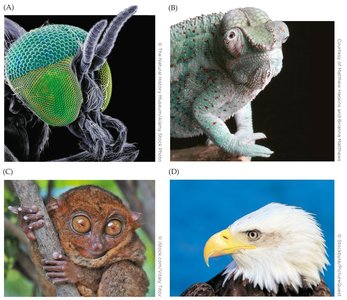
Sensory receptor organs are specialized to detect specific types of stimuli, reflecting evolutionary adaptations to an organism's environment. Within these organs, receptor cells transduce physical or chemical energy into electrical signals.
Adequate stimulus: The specific type of stimulus to which a receptor is most sensitive (e.g., photic energy for the eye).
Different species have varying ranges of responsiveness (e.g., hearing frequency ranges).
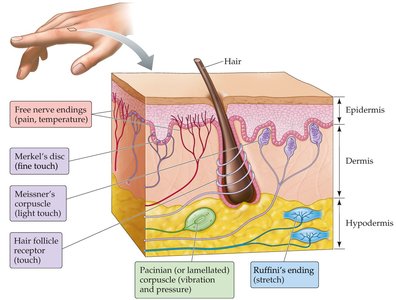
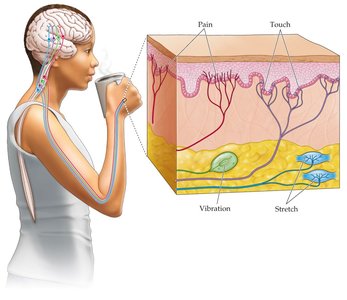
Receptor cells can be classified by the type of energy they detect: mechanoreceptors (touch), nociceptors (pain), thermoreceptors (temperature), chemoreceptors (chemical composition), and proprioceptors (body position).
Sensory Transduction and Potentials
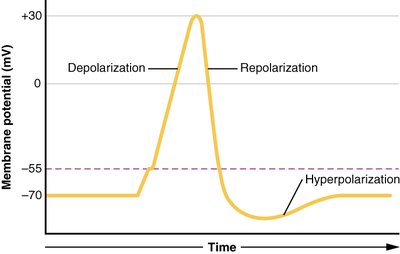
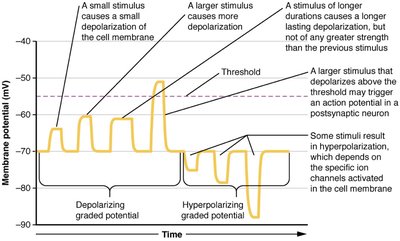
All sensory systems use action potentials to communicate with the brain, but the initial response to a stimulus is a graded change in membrane potential.
Graded potentials: Local changes in membrane potential in response to a stimulus.
Generator potentials: Graded potentials that, if large enough, trigger action potentials in the same cell (e.g., touch receptors).
Receptor potentials: Graded potentials that cause the release of neurotransmitters onto adjacent sensory neurons (e.g., taste cells, photoreceptors).
Example: Pacinian Corpuscle
The Pacinian corpuscle is a mechanoreceptor that detects vibration and pressure. Vibration deforms the corpuscle, leading to a graded potential proportional to stimulus strength. If the potential reaches threshold, an action potential is generated.
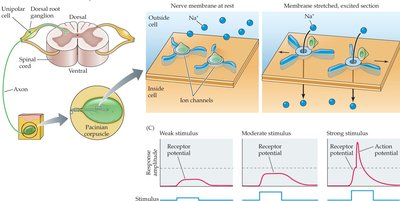
Encoding Stimulus Intensity and Location
The nervous system encodes information about stimulus intensity and location through patterns of action potentials.
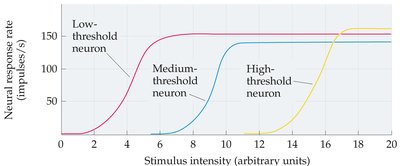
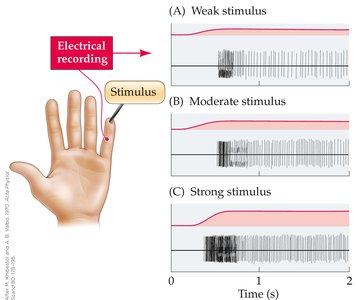
Stimulus intensity is encoded by the frequency of action potentials (rate law) and by recruiting additional neurons as intensity increases (population coding).
Range fractionation: Different neurons have different thresholds, allowing the system to encode a wide range of intensities.
Stimulus location is determined by the spatial arrangement of activated receptors and maintained through labeled-line coding.
Labeled-Line and Population Coding
Distinct senses are recognized because action potentials travel along separate nerve tracts (labeled lines). However, population coding also plays a role, where the pattern of activity across many neurons encodes complex features (e.g., color vision).
Adaptation and Suppression
Adaptation is the progressive loss of receptor response to a constant stimulus. Receptors can be classified as:
Phasic receptors: Rapidly adapt and signal changes in stimulus (change detectors).
Tonic receptors: Adapt slowly or not at all, signaling steady pressure or ongoing stimuli.
Suppression of sensory input can occur via accessory structures (e.g., eyelids) or top-down processing from higher brain centers.
Sensory Pathways and Hierarchical Processing
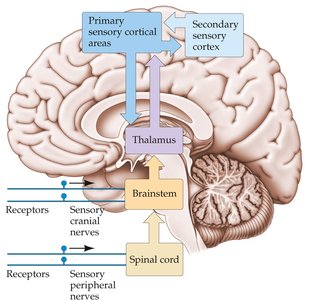
Sensory information travels from peripheral receptors to the central nervous system, often passing through the thalamus before reaching the primary sensory cortex. Olfaction is a notable exception, projecting directly to the cortex.
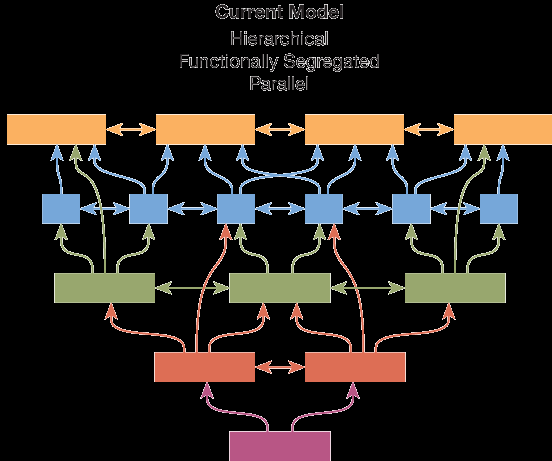
Hierarchical organization: Information flows through brain structures of increasing complexity.
Functional segregation: Different brain regions specialize in different types of analysis.
Parallel processing: Information is processed simultaneously along multiple pathways.
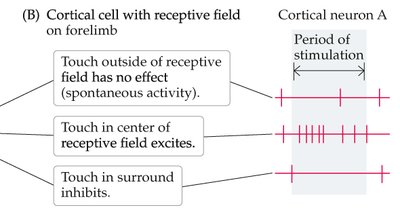
Receptive Fields and Lateral Inhibition
A receptive field is the area in which a stimulus will alter a neuron's firing rate. Receptive fields can have center-surround organization, and lateral inhibition enhances contrast at edges or points of stimulation.
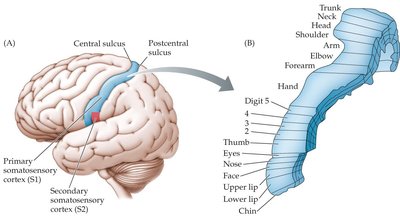
Somatosensory Cortex Organization
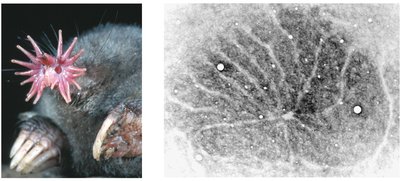
The primary somatosensory cortex (S1) receives touch information from the opposite side of the body, while the secondary somatosensory cortex (S2) integrates information from both sides. The representation of body parts in the cortex (somatotopy) varies by species and reflects the importance of different regions.
Attention and Multimodal Processing
Attention is the process by which specific stimuli are selected for enhanced processing. It can be guided by sensory input (bottom-up) or by cognitive processes (top-down). Key brain regions involved include the posterior parietal lobe and cingulate cortex.
Multimodal processing occurs in association cortex, where inputs from different senses are integrated. Polymodal cells allow for intersensory interactions, and phenomena such as synesthesia illustrate atypical sensory integration.
Summary Table: Key Concepts in Sensory Processing
Concept | Definition | Example |
|---|---|---|
Sensation | Detection of physical stimulus | Touch, light, sound |
Perception | Interpretation of sensory input | Recognizing a face |
Transduction | Conversion of stimulus energy to neural signal | Photoreceptors converting light |
Adaptation | Decrease in response to constant stimulus | Not feeling clothes after a while |
Receptive field | Area where stimulus affects neuron | Touch on skin |
Labeled-line coding | Specific pathway for each sense | Pain fibers |
Population coding | Pattern of activity across many neurons | Color vision |
