 Back
BackGeneral Senses and Sensory Pathways: Human Anatomy & Physiology I (Chapter 15)
Study Guide - Smart Notes
 Tailored notes based on your materials, expanded with key definitions, examples, and context.
General Senses and Sensory Pathways
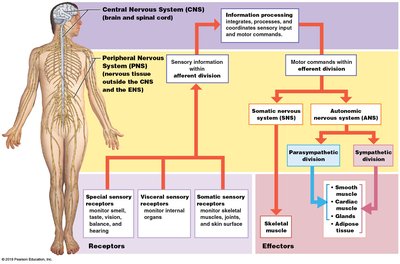
Overview of Sensory Pathways
The sensory pathways are responsible for transmitting information from sensory receptors throughout the body to the central nervous system (CNS), where it is processed and interpreted. Sensory input is essential for perception, reflexes, and maintaining homeostasis.
Afferent sensory pathways carry information from receptors to the CNS via peripheral nerves.
Most sensory input is processed subconsciously; only a small fraction reaches conscious awareness.
Sensory responses occur only if receptors sensitive to the stimulus exist (e.g., humans cannot detect ultraviolet light).
Sensory Receptor Classification
Sensory receptors are specialized cells or cell processes that detect specific types of stimuli and convert them into electrical signals for the nervous system.
Receptor specificity: Each receptor responds only to certain types of stimuli.
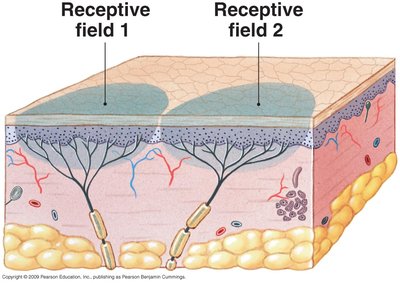
Receptive field: The area monitored by a single sensory receptor. The larger the receptive field, the less precise the localization of the stimulus.
Transduction and Sensory Coding
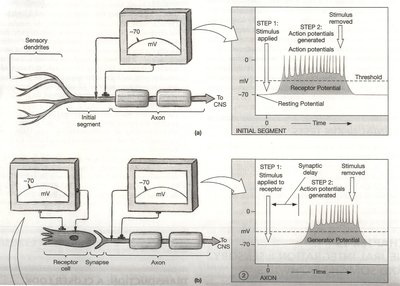
Transduction is the process by which sensory receptors convert external stimuli into bioelectrical activity (receptor potentials) in the nervous system.
Stimulus changes membrane ion permeability, producing a receptor potential (graded potential).
The frequency of action potentials (APs) generated at the initiation site provides the CNS with information about stimulus intensity.
Interpretation of Sensory Information
The CNS interprets sensory information through sensation and perception, using labeled lines and sensory coding to identify stimulus type, location, and intensity.
Sensation: Information arriving from a stimulus.
Perception: Conscious awareness of a sensation.
Labeled line: Identifies the type (modality) of stimulus and the body location of the receptor.
Sensory coding: The pattern of APs conveys information about the strength, duration, and variation of the stimulus.
Adaptation and Sensitivity to Stimuli
Adaptation is a reduction in sensitivity in the presence of a constant stimulus, which can occur at the receptor level (peripheral adaptation) or within the CNS (central adaptation).
Tonic receptors: Always active; the rate of AP generation changes with the level of stimulation.
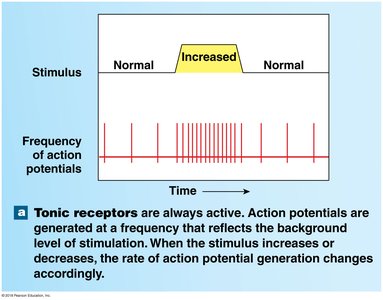
Phasic receptors: Normally inactive; produce APs only in response to changes in stimulation (fast-adapting).
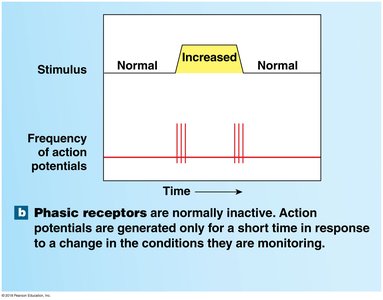
Peripheral adaptation: Reduces the amount of information reaching the CNS (mainly via phasic receptors).
Central adaptation: Inhibition along sensory pathways restricts information reaching the cortex and conscious awareness.
Reticular Activating System: Modulates awareness of arriving sensations.
Types of General Sensory Receptors
Nociceptors (Pain Receptors)
Nociceptors are free nerve endings sensitive to damaging or potentially damaging stimuli, including extremes of temperature, mechanical damage, and chemicals released by injured cells.
Abundant in superficial skin, joint capsules, bone periosteum, and blood vessel walls; sparse in deep tissues and visceral organs.
Large receptive fields result in poor localization of pain.
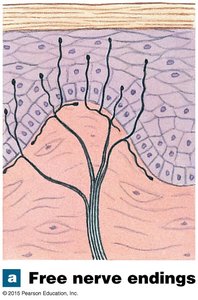
Fast pain: Sharp, localized pain carried by myelinated type A fibers.
Slow pain: Dull, aching pain carried by unmyelinated type C fibers; poorly localized.
Adaptation: Nociceptors are tonic receptors with little peripheral adaptation; central adaptation can occur via inhibitory neurotransmitters (endorphins).
Thermoreceptors
Thermoreceptors are free nerve endings that detect changes in temperature. They are more sensitive to cold than to warmth and are rapidly adapting (phasic) receptors.
Located in the dermis, skeletal muscle, liver, and hypothalamus.
Warm receptors respond to temperatures above 25°C (77°F) and are unresponsive above 45°C (113°F).
Cold receptors respond to temperatures between 10°C (50°F) and 20°C (68°F).
Pain receptors are activated by temperatures below 10°C or above 45°C.
Chemoreceptors
Chemoreceptors detect changes in pH, CO2, and O2 levels in body fluids. They are rapidly adapting and play a role in reflex control of respiration and cardiovascular function.
Located in the brainstem (cerebrospinal fluid) and in arterial blood (carotid and aortic bodies).
No direct pathways to the cortex; do not produce conscious awareness.
Mechanoreceptors
Mechanoreceptors are sensitive to physical distortion of the cell membrane, such as stretching, compression, or vibration. Mechanically gated ion channels open in response to these stimuli.
Baroreceptors: Detect pressure changes in blood vessels and hollow organs.
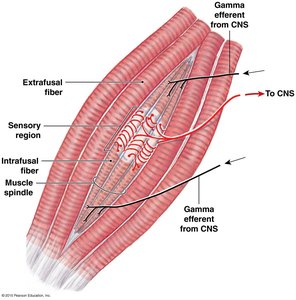
Proprioceptors: Monitor the position of joints and muscles.
Tactile receptors: Detect touch, pressure, and vibration.
Processing of Sensory Information
Sensory Coding and Somatotopic Organization
Sensory coding involves the pattern of APs arriving at the CNS, conveying information about the strength, duration, and variation of the stimulus. The CNS is organized somatotopically, meaning there is an orderly representation of body regions in the sensory cortex.
Most sensory information crosses over to contralateral areas of the brain.
The amount of cortical space devoted to a body region is proportional to the number of sensory receptors it contains, not its size.
Summary Table: Types of General Sensory Receptors
Receptor Type | Stimulus Detected | Location | Adaptation |
|---|---|---|---|
Nociceptors | Pain (mechanical, thermal, chemical) | Superficial skin, joints, periosteum, vessel walls | Tonic (little adaptation) |
Thermoreceptors | Temperature changes | Dermis, muscle, liver, hypothalamus | Phasic (rapid adaptation) |
Chemoreceptors | pH, CO2, O2 | Brainstem, carotid/aortic bodies | Phasic (rapid adaptation) |
Mechanoreceptors | Physical distortion (touch, pressure, vibration, stretch) | Skin, vessels, muscles, joints | Varies (some tonic, some phasic) |
Additional info: This guide expands on the provided notes with definitions, examples, and a summary table for clarity and completeness.
