 Back
BackGlycolysis: The First Stage of Cellular Respiration
Study Guide - Smart Notes
 Tailored notes based on your materials, expanded with key definitions, examples, and context.
Glycolysis
Introduction to Glycolysis
Glycolysis is the first step in cellular respiration, where glucose is broken down to extract energy for cellular metabolism. This process occurs in the cytoplasm of the cell and does not require oxygen, making it an anaerobic pathway. Glycolysis consists of 10 enzyme-catalyzed steps and results in the production of pyruvate, ATP, and NADH.
Definition: Glycolysis is the catabolic pathway that converts one molecule of glucose (6C) into two molecules of pyruvate (3C each).
Location: Cytoplasm of the cell.
Net Reaction:
Net Yield: 2 ATP, 2 NADH, 2 pyruvate per glucose molecule.
Stages: Divided into an energy-requiring phase and an energy-releasing phase (5 steps each).
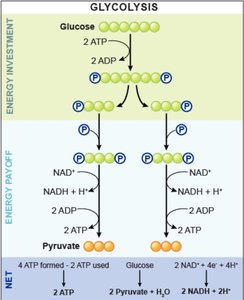
Stage 1: The Energy-Requiring Phase
This phase prepares glucose for breakdown by using ATP to add phosphate groups, making the molecule more reactive and easier to split. The first five steps are involved in this phase.
Step 1: ATP donates a phosphate to glucose, forming glucose-6-phosphate (enzyme: hexokinase).
Step 2: Glucose-6-phosphate is isomerized to fructose-6-phosphate (enzyme: isomerase).
Step 3: Another ATP adds a phosphate, forming fructose-1,6-bisphosphate (enzyme: phosphofructokinase, a key regulatory enzyme).
Step 4: Fructose-1,6-bisphosphate splits into two three-carbon isomers: dihydroxyacetone phosphate (DHAP) and glyceraldehyde-3-phosphate (G3P).
Step 5: DHAP is converted into G3P (enzyme: triosephosphate isomerase), resulting in two G3P molecules.
Stage 2: The Energy-Releasing Phase
This phase generates ATP and NADH by oxidizing G3P and transferring phosphate groups to ADP. The last five steps are involved in this phase.
Step 6: G3P is oxidized, reducing NAD+ to NADH and forming 1,3-bisphosphoglycerate (enzyme: glyceraldehyde 3-phosphate dehydrogenase).
Step 7: 1,3-bisphosphoglycerate donates a phosphate to ADP, forming ATP (substrate-level phosphorylation) and 3-phosphoglycerate.
Step 8: 3-phosphoglycerate is converted to its isomer, 2-phosphoglycerate (enzyme: mutase).
Step 9: 2-phosphoglycerate loses water, forming phosphoenolpyruvate (PEP), a high-energy molecule.
Step 10: PEP donates its phosphate to ADP, forming another ATP and pyruvate (enzyme: pyruvate kinase).
Fate of Pyruvate and NADH
After glycolysis, the fate of pyruvate and NADH depends on the availability of oxygen:
With Oxygen (Aerobic): Pyruvate enters the mitochondria for further breakdown in the citric acid cycle; NADH donates electrons to the electron transport chain, regenerating NAD+.
Without Oxygen (Anaerobic): Fermentation occurs to regenerate NAD+ so glycolysis can continue.

Fermentation
Fermentation is an anaerobic process that allows glycolysis to continue by recycling NAD+ from NADH. It does not produce additional ATP beyond the 2 ATP from glycolysis.
Lactic Acid Fermentation: Occurs in muscle cells; pyruvate is reduced to lactic acid.
Alcoholic Fermentation: Occurs in yeast; pyruvate is converted to ethanol and CO2.
Key Point: Fermentation keeps glycolysis running by regenerating NAD+.
Summary Table: Glycolysis Overview
Phase | Main Events | ATP Used | ATP Produced | NADH Produced | End Product |
|---|---|---|---|---|---|
Energy Investment | Phosphorylation of glucose, splitting into two 3C sugars | 2 | 0 | 0 | G3P |
Energy Payoff | Oxidation of G3P, substrate-level phosphorylation | 0 | 4 | 2 | Pyruvate |
Net | 2 | 4 | 2 | 2 Pyruvate |
