 Back
BackGuided Study: Atomic Structure and Figure 2.2
Study Guide - Smart Notes
 Tailored notes based on your materials, expanded with key definitions, examples, and context.
Q17. What is the atomic number of the atom in Figure 2.2?
Background
Topic: Atomic Structure
This question tests your understanding of atomic structure, specifically how to determine the atomic number of an atom based on the number of protons in its nucleus.
Key Terms and Formulas
Atomic Number (Z): The number of protons in the nucleus of an atom. It determines the element's identity.
Proton (p+): A positively charged subatomic particle found in the nucleus.
Neutron (n0): A neutrally charged subatomic particle found in the nucleus.
Electron (e-): A negatively charged subatomic particle found in electron shells around the nucleus.
Key formula:
Step-by-Step Guidance
Examine the nucleus of the atom in Figure 2.2. Identify the number of protons () shown in the nucleus.
Recall that the atomic number is defined as the number of protons in the nucleus of an atom.
Match the number of protons to the atomic number using the formula above.
Check the periodic table (mentally or with a reference) to see which element corresponds to this atomic number, if needed.
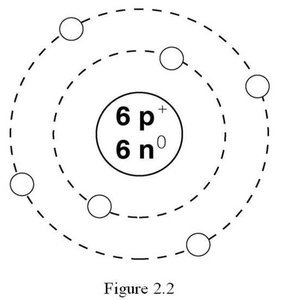
Try solving on your own before revealing the answer!
Final Answer: 6
The atom in Figure 2.2 has 6 protons in its nucleus, so its atomic number is 6. This means the atom is carbon.
