 Back
Guided Study for ANP College Course: Virus Structure, Bacteriophage Life Cycle, and Enzyme Regulation
Study Guide - Smart Notes
 Tailored notes based on your materials, expanded with key definitions, examples, and context.
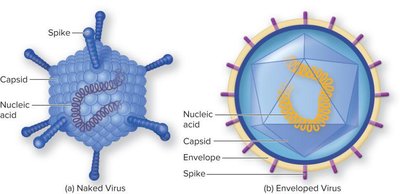
Q2. Generalized Structure of Viruses - Identify Viral Structures: Capsid, Nucleic acid, Envelope
Background
Topic: Viral Structure
This question tests your understanding of the basic components that make up viruses, including their protective protein coat (capsid), genetic material (nucleic acid), and, in some cases, an envelope derived from the host cell.
Key Terms:
Capsid: Protein shell that surrounds and protects the viral nucleic acid.
Nucleic acid: Genetic material of the virus, either DNA or RNA.
Envelope: Lipid membrane surrounding some viruses, acquired from the host cell.
Step-by-Step Guidance
Examine the diagram of both naked and enveloped viruses to identify the capsid, nucleic acid, and envelope.
Note that the capsid is the protein structure forming the outer layer in naked viruses, while enveloped viruses have an additional lipid envelope.
Locate the nucleic acid inside the capsid in both types of viruses.
Observe the envelope in enveloped viruses, which is not present in naked viruses.
Try solving on your own before revealing the answer!
Final Answer:
The capsid is the protein shell, the nucleic acid is the genetic material inside, and the envelope is the lipid membrane found in enveloped viruses. The diagram clearly shows these structures.
Q10. Bacteriophage Life Cycle - Identify Lysogenic cycle
Background
Topic: Bacteriophage Life Cycle
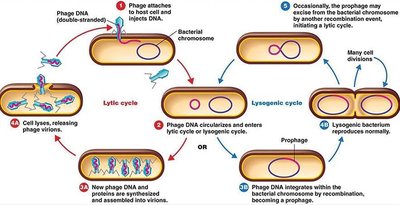
This question focuses on the lysogenic cycle of bacteriophages, where viral DNA integrates into the host genome and replicates along with it, rather than immediately destroying the host cell.
Key Terms:
Lysogenic cycle: Viral DNA is incorporated into the host cell's chromosome and replicates passively.
Prophage: The integrated viral DNA within the bacterial chromosome.
Lytic cycle: Viral DNA directs the production of new viruses, leading to cell lysis.
Step-by-Step Guidance
Review the diagram showing the two possible pathways after phage DNA enters the host cell: lytic and lysogenic.
Identify the steps where phage DNA integrates into the bacterial chromosome, forming a prophage.
Observe how the prophage is replicated as the host cell divides, without immediate destruction of the cell.
Note that the lysogenic cycle can eventually switch to the lytic cycle under certain conditions.
Try solving on your own before revealing the answer!
Final Answer:
The lysogenic cycle involves integration of phage DNA into the host chromosome, forming a prophage, which is replicated with the host cell. The diagram illustrates these steps.
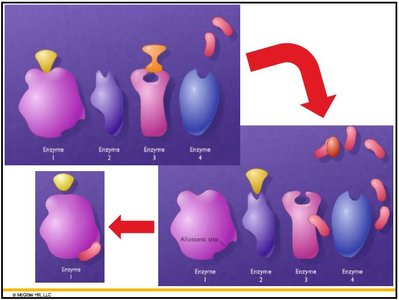
Q31. Identify the process in the diagram (will be similar to below):
Background
Topic: Enzyme Regulation
This question tests your ability to recognize and describe the process of enzyme regulation, specifically allosteric regulation, where molecules bind to an enzyme at a site other than the active site, affecting its activity.
Key Terms:
Enzyme: Protein that catalyzes biochemical reactions.
Allosteric site: A site on the enzyme other than the active site where regulatory molecules can bind.
Allosteric regulation: Regulation of enzyme activity by binding of an effector molecule at the allosteric site.
Step-by-Step Guidance
Examine the diagram showing the enzyme and the binding of molecules at sites other than the active site.
Identify the allosteric site and the regulatory molecule binding to it.
Observe how the binding at the allosteric site changes the enzyme's shape and activity.
Consider how this regulation can either inhibit or activate the enzyme's function.
Try solving on your own before revealing the answer!
Final Answer:
The process shown is allosteric regulation, where a molecule binds to the allosteric site of an enzyme, altering its activity. The diagram demonstrates this mechanism.
