 Back
BackGuided Study for ANP: Homeostasis, Membrane Transport, and Epithelial Tissue
Study Guide - Smart Notes
 Tailored notes based on your materials, expanded with key definitions, examples, and context.
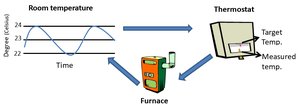
Q1. What is the temperature range within the house over the time period shown?
Background
Topic: Homeostasis and Feedback Systems
This question is testing your ability to interpret a graph showing how a home heating system maintains temperature within a certain range, illustrating the concept of homeostasis.
Key Terms and Concepts:
Homeostasis: The maintenance of a stable internal environment.
Feedback Loop: A system that uses sensors, a control center, and effectors to maintain a variable within a set range.
Temperature Range: The difference between the highest and lowest temperatures recorded over a period of time.
Step-by-Step Guidance
Examine the graph on the left side of the image. Identify the highest and lowest points of the room temperature curve over time.
Read the y-axis to determine the temperature values at these points. The y-axis is labeled in degrees Celsius.
Subtract the lowest temperature value from the highest temperature value to determine the range.
Try solving on your own before revealing the answer!
Final Answer: The temperature range is 2°C (from 22°C to 24°C).
The graph shows that the room temperature fluctuates between 22°C and 24°C, so the range is 2°C.
Q2. What two values are used by the thermostat in its functioning?
Background
Topic: Control Systems in Homeostasis
This question is about understanding how a thermostat regulates temperature by comparing two key values.
Key Terms and Concepts:
Thermostat: A device that regulates temperature by comparing measured and target values.
Set Point (Target Temperature): The desired value the system tries to maintain.
Measured Temperature: The current value detected by the thermostat's sensor.
Step-by-Step Guidance
Look at the diagram of the thermostat in the image. Notice the arrows pointing to two different values.
Identify what each arrow is labeling. One is the target (set point) temperature, and the other is the measured (actual) temperature.
Understand that the thermostat compares these two values to decide whether to turn the furnace on or off.
Try solving on your own before revealing the answer!
Final Answer: Target temperature and measured temperature.
The thermostat uses the set point (target) and the current measured temperature to regulate the furnace.
Q7. What are the three components required for a negative feedback loop, and what are their functions?
Background
Topic: Negative Feedback Loops in Physiology
This question asks you to identify and describe the three essential components of a negative feedback loop, which is a fundamental concept in physiology for maintaining homeostasis.
Key Terms and Concepts:
Sensor (Receptor): Detects changes in the variable being regulated.
Control Center (Integrator): Compares the detected value to the set point and decides on a response.
Effector: Carries out the response to bring the variable back toward the set point.
Step-by-Step Guidance
Refer to the diagram labeled "Model 2A" in the image. Identify the three main components: sensor, control center, and effector.
For each component, write down its function in the feedback loop (e.g., the sensor detects changes, the control center processes information, the effector acts to correct the variable).
Apply these components to the examples given (e.g., in the heating system: the thermometer is the sensor, the thermostat is the control center, and the furnace is the effector).
Try solving on your own before revealing the answer!
Final Answer:
Sensor (Receptor): Detects changes in the variable (e.g., thermometer).
Control Center (Integrator): Compares to set point and decides response (e.g., thermostat).
Effector: Acts to correct the variable (e.g., furnace).
Each component plays a specific role in maintaining homeostasis by forming a feedback loop.
