Back
Guided Study for NURS1022: Human Anatomy and Physiology - Week 1 Workbook
Study Guide - Smart Notes
 Tailored notes based on your materials, expanded with key definitions, examples, and context.
Q1. What are the main organ systems of the human body, their major organs, and their general functions?
Background
Topic: Human Organ Systems
This question tests your ability to identify and describe the major organ systems, their main organs, and their functions, which is foundational for understanding human anatomy and physiology.
Key Terms:
Organ system: A group of organs working together to perform complex functions.
Major organs: The primary structures within each system responsible for its main functions.
Function: The role each system plays in maintaining homeostasis.
Step-by-Step Guidance
Review the list of organ systems in your textbook or lecture notes. There are typically eleven major systems.
For each system, identify the main organs associated with it (e.g., heart for cardiovascular, lungs for respiratory).
Summarize the general function of each system (e.g., the cardiovascular system transports blood and nutrients).
Organize your findings in a table format for clarity, listing system, major organs, and function.
Try solving on your own before revealing the answer!
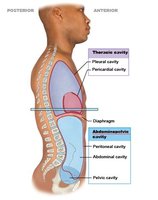
Q2. What are the major body cavities, their associated membranes, and the organs found within each cavity?
Background
Topic: Body Cavities and Membranes
This question assesses your understanding of the anatomical organization of the body, including the location of major cavities, the membranes that line them, and the organs they contain.
Key Terms:
Body cavity: A space within the body that contains organs.
Serous membrane: A double-layered membrane lining body cavities.
Viscera: The internal organs within the cavities.
Step-by-Step Guidance
Identify the main body cavities: thoracic, abdominopelvic, pelvic, and cerebrospinal.
For each cavity, list the organs found within (e.g., heart and lungs in the thoracic cavity).
Describe the membranes associated with each cavity (e.g., pleural membrane for lungs, pericardial for heart).
Explain the function of serous membranes, such as reducing friction and protecting organs.
Try solving on your own before revealing the answer!
Q3. How do tissues differ from organs? Give one example of a tissue and an organ.
Background
Topic: Levels of Structural Organization
This question tests your understanding of the hierarchy of biological organization, specifically the distinction between tissues and organs.
Key Terms:
Tissue: A group of similar cells performing a specific function.
Organ: A structure composed of two or more tissue types working together for complex functions.
Step-by-Step Guidance
Define what a tissue is and provide an example (e.g., muscle tissue).
Define what an organ is and provide an example (e.g., heart).
Explain how organs are made up of multiple tissue types, while tissues are collections of similar cells.
Try solving on your own before revealing the answer!
Q4. What are anatomical and directional terms, and how are they used to describe the location of body structures?
Background
Topic: Anatomical Terminology
This question is about the scientific language used to describe the position and relation of body parts, which is essential for clear communication in health sciences.
Key Terms:
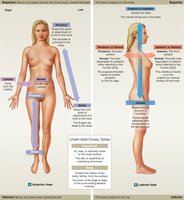
Directional terms: Words like anterior, posterior, superior, inferior, distal, proximal, lateral, medial.
Anatomical position: The standard reference position for the body.
Step-by-Step Guidance
Review the definitions of key directional terms.
Practice labeling a diagram of the human body in anatomical position with these terms.
Apply these terms to describe the location of specific structures (e.g., the ear is lateral to the nose).
Try solving on your own before revealing the answer!
Q5. What are the three main planes of the body, and how do they divide the body?
Background
Topic: Sectional Anatomy
This question tests your knowledge of anatomical planes, which are used to describe cross-sections and imaging perspectives.
Key Terms:
Frontal (coronal) plane: Divides the body into anterior and posterior parts.
Sagittal plane: Divides the body into left and right parts.
Transverse plane: Divides the body into superior and inferior parts.
Step-by-Step Guidance
Define each anatomical plane and its orientation.
Describe how each plane divides the body or an organ.
Practice identifying these planes on diagrams or models.
Try solving on your own before revealing the answer!
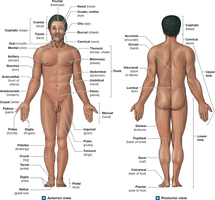
Q6. How are the nine abdominal regions and four quadrants named and located?
Background
Topic: Anatomical Body Regions
This question is about the descriptive names and locations of the abdominal regions and quadrants, which are important for clinical assessment and communication.
Key Terms:
Abdominal regions: Specific areas of the abdomen used for anatomical and clinical reference.
Quadrants: Four sections of the abdomen (right/left upper, right/left lower).
Step-by-Step Guidance
Review the names and locations of the nine abdominal regions (e.g., right hypochondriac, epigastric).
Identify the four quadrants and their boundaries.
Practice labeling a diagram with these regions and quadrants.
Try solving on your own before revealing the answer!