 Back
BackGuided Study: Homeostatic Control Diagram and Related Concepts
Study Guide - Smart Notes
 Tailored notes based on your materials, expanded with key definitions, examples, and context.
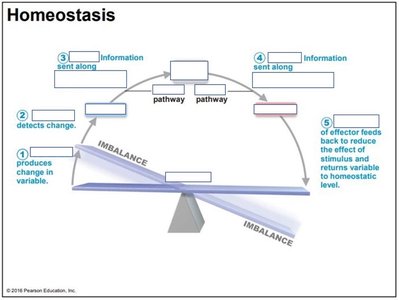
Q1. Complete the diagram below for homeostatic control.
Background
Topic: Homeostasis and Feedback Mechanisms
This question is testing your understanding of the steps involved in homeostatic regulation, including how the body detects and responds to changes in internal conditions to maintain balance.
Key Terms:
Homeostasis: The body's ability to maintain stable internal conditions despite external changes.
Stimulus: A change in the environment that disrupts homeostasis.
Receptor: Detects the change (stimulus).
Control Center: Receives information from the receptor and decides how to respond.
Effector: Carries out the response to restore balance.
Feedback: The process by which the response influences the original stimulus.
Step-by-Step Guidance
Start by identifying the variable that changes, which triggers the homeostatic process (e.g., temperature, pH, glucose level).
Recognize that a receptor detects this change and sends information along an afferent pathway to the control center.
The control center processes the information and determines the appropriate response, sending instructions along an efferent pathway to the effector.
The effector acts to counteract the change, helping to restore the variable to its normal range.
Feedback occurs, which can be negative (reducing the effect of the stimulus) or positive (enhancing the effect), depending on the mechanism.
Try solving on your own before revealing the answer!
Final Answer: Homeostatic Control Diagram Steps
1. Stimulus produces change in variable. 2. Receptor detects change. 3. Information sent along afferent pathway to control center. 4. Information sent along efferent pathway to effector. 5. Effector feeds back to reduce the effect of stimulus and returns variable to homeostatic level.
This sequence illustrates how the body maintains internal balance through a series of steps involving detection, communication, and response.
