 Back
BackGuided Study: Layers and Structures of the Skin
Study Guide - Smart Notes
 Tailored notes based on your materials, expanded with key definitions, examples, and context.
Q1. Identify the layers and structures of the skin in the provided diagrams.
Background
Topic: Integumentary System (Skin Anatomy)
This question tests your understanding of the anatomical organization of the skin, including the epidermis, dermis, and hypodermis, as well as associated structures such as hair follicles, glands, and blood vessels. Recognizing these layers and their features is fundamental in anatomy and physiology (ANP) courses.
Key Terms and Concepts:
Epidermis: The outermost layer of the skin, primarily composed of keratinized stratified squamous epithelium.
Dermis: The middle layer, containing connective tissue, blood vessels, nerves, and accessory structures.
Hypodermis (Subcutaneous Layer): The deepest layer, mainly composed of adipose tissue.
Accessory Structures: Hair follicles, sebaceous (oil) glands, sweat glands, and sensory receptors.

Step-by-Step Guidance
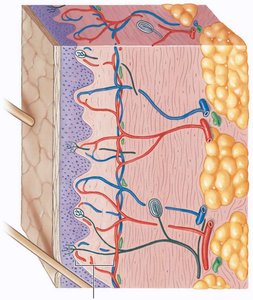
Examine the diagram and locate the three main layers: the thin outer layer (epidermis), the thicker middle layer (dermis), and the deepest layer with yellowish clusters (hypodermis).
Identify the boundary between the epidermis and dermis. Notice the wavy interface, which increases surface area for attachment and nutrient exchange.
Look for accessory structures: hair follicles (tubular invaginations), sebaceous glands (clustered near hair follicles), and sweat glands (coiled tubular structures).
Observe the blood vessels (red and blue lines) and nerves (black lines) within the dermis, and note their absence in the epidermis.
Pay attention to the adipose tissue in the hypodermis, which appears as large, yellowish clusters.

Try solving on your own before revealing the answer!
Final Answer:
The three main layers are: epidermis (outer), dermis (middle), and hypodermis (deepest). The accessory structures include hair follicles, sebaceous glands, sweat glands, blood vessels, and nerves. The epidermis is avascular, while the dermis contains most of the skin's blood supply and sensory receptors. The hypodermis is primarily adipose tissue, providing insulation and cushioning.
