Back
Guided Study: The Integumentary System (ANP College Level)
Study Guide - Smart Notes
 Tailored notes based on your materials, expanded with key definitions, examples, and context.
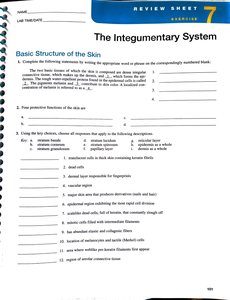
Q1. What are the two basic tissues that compose the skin, and what are their roles?
Background
Topic: Structure of the Skin
This question tests your understanding of the main tissue types that make up the skin and their functional significance in the epidermis and dermis.
Key Terms and Concepts:
Epidermis: The outermost layer of the skin, primarily composed of epithelial tissue.
Dermis: The deeper layer beneath the epidermis, made up of connective tissue.
Dense Irregular Connective Tissue: Provides strength and elasticity to the skin.
Step-by-Step Guidance
Recall the two main layers of the skin: the epidermis (outer) and dermis (inner).
Identify the type of tissue that forms the epidermis (think about the type of cells that provide a protective barrier).
Identify the type of tissue that forms the dermis (consider what gives the skin its strength and flexibility).
Think about the functional roles of each tissue type in protecting and supporting the body.
Try solving on your own before revealing the answer!
Q2. What is the tough, water-repellent protein found in epidermal cells?
Background
Topic: Epidermal Cell Structure
This question focuses on the protein that gives the skin its protective, waterproof qualities.
Key Terms and Concepts:
Keratin: A fibrous protein that strengthens and waterproofs the skin.
Step-by-Step Guidance
Recall which protein is abundant in the outer layers of the epidermis.
Think about the function of this protein in preventing water loss and providing protection.
Try solving on your own before revealing the answer!
Q3. Which pigments contribute to skin color, and what is a localized concentration of melanin called?
Background
Topic: Skin Pigmentation
This question tests your knowledge of the pigments responsible for skin color and the terminology for pigment concentrations.
Key Terms and Concepts:
Melanin: Pigment produced by melanocytes, responsible for brown/black coloration.
Carotene: Yellow-orange pigment found in the skin.
Hemoglobin: Red pigment in blood, also influences skin color.
Freckle: A localized concentration of melanin.
Step-by-Step Guidance
List the main pigments found in the skin.
Identify which pigment is responsible for brown/black coloration and which for yellow/orange.
Recall the term for a spot with a high concentration of melanin.
Try solving on your own before revealing the answer!
Q4. List four protective functions of the skin.
Background
Topic: Functions of the Integumentary System
This question asks you to recall the various ways the skin protects the body from environmental hazards.
Key Terms and Concepts:
Protection from mechanical damage
Barrier to pathogens
Prevention of water loss
UV radiation protection
Step-by-Step Guidance
Think about how the skin acts as a physical barrier.
Consider how the skin prevents dehydration.
Recall how the skin protects against infection and UV light.
List any other protective roles you can think of (e.g., temperature regulation, sensation).
Try solving on your own before revealing the answer!
Q5. Match the skin layers and regions to their descriptions (stratum basale, stratum corneum, etc.).
Background
Topic: Layers of the Skin
This question tests your ability to identify the different layers of the epidermis and dermis and their specific characteristics.
Key Terms and Concepts:
Stratum basale: Deepest epidermal layer, site of cell division.
Stratum corneum: Outermost layer, dead keratinized cells.
Stratum granulosum: Layer where keratinization begins.
Stratum lucidum: Present only in thick skin.
Stratum spinosum: Layer with spiny-shaped cells.
Papillary layer: Upper dermal region, forms fingerprints.
Reticular layer: Deep dermal region, contains dense connective tissue.
Epidermis as a whole: All layers above the dermis.
Dermis as a whole: Papillary and reticular layers together.
Step-by-Step Guidance
Read each description carefully and recall which layer or region it matches.
Use your knowledge of the order and function of the skin layers to guide your choices.
Remember that some descriptions may apply to more than one layer or region.
Double-check your matches for accuracy.
Try solving on your own before revealing the answer!