 Back
Head and Neck Anatomical Regions Study Guide
Study Guide - Smart Notes
 Tailored notes based on your materials, expanded with key definitions, examples, and context.
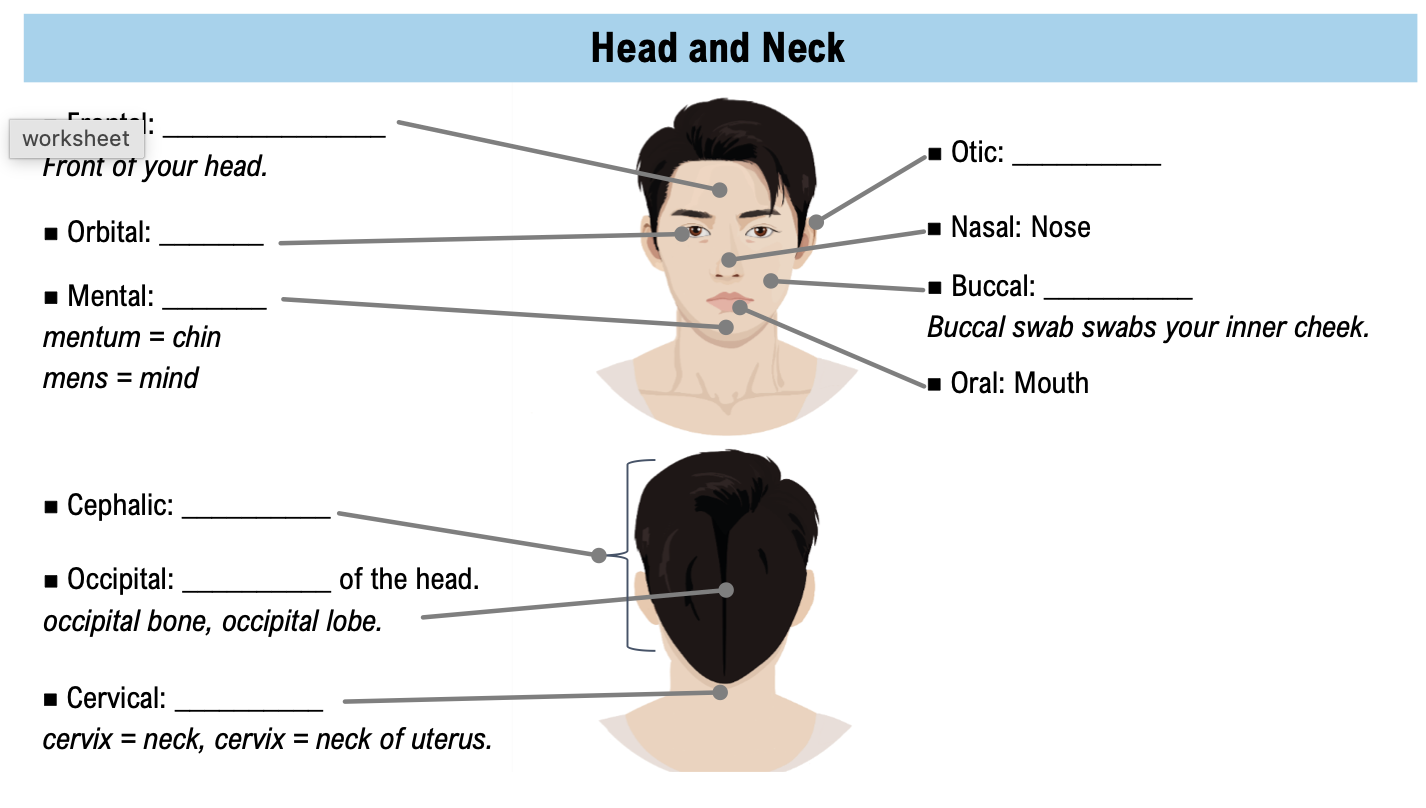
Q1. Fill in the blanks for the anatomical regions of the head and neck:
Background
Topic: Anatomical Terminology – Head and Neck Regions
This question tests your knowledge of anatomical terms used to describe specific regions of the head and neck. Understanding these terms is foundational for anatomy and physiology (ANP) courses, as they are used to describe locations, procedures, and clinical findings.
Key Terms:
Frontal: Refers to the front part of the head, typically the forehead.
Orbital: Pertains to the eye socket or area around the eyes.
Mental: Refers to the chin region (mentum = chin).
Otic: Pertains to the ear.
Buccal: Refers to the cheek area.
Oral: Refers to the mouth.
Cephalic: Refers to the head as a whole.
Occipital: Refers to the back of the head (occipital bone/lobe).
Cervical: Refers to the neck region.
Step-by-Step Guidance
Review the definitions and root words for each anatomical term listed above. For example, "frontal" relates to the forehead, and "mental" relates to the chin.
Look at the diagram and match each blank with the correct anatomical term based on its location and the clues provided (e.g., "Buccal swab swabs your inner cheek" helps you identify the buccal region).
Use the context clues from the worksheet, such as "mentum = chin" and "occipital bone, occipital lobe," to help you fill in the blanks accurately.
Check your answers by comparing the location of each label on the diagram with your knowledge of anatomical regions.
Try solving on your own before revealing the answer!
Final Answers:
Frontal: Forehead
Orbital: Eye
Mental: Chin
Otic: Ear
Buccal: Cheek
Cephalic: Head
Occipital: Back of the head
Cervical: Neck
These terms are essential for describing locations and procedures in anatomy. Make sure you can identify each region both in diagrams and in clinical context!
