Back
BackHomeostasis, Autonomic Nervous System, and Endocrine System: Structured Study Notes
Study Guide - Smart Notes
 Tailored notes based on your materials, expanded with key definitions, examples, and context.
Homeostasis: Introduction to ANS & Endocrine System
Survival Needs
For life to be sustained, certain survival needs must be met within an acceptable range. These include:
Nutrients: Chemicals required for energy and cell building.
Oxygen: Essential for energy release via ATP production.
Water: Necessary for chemical reactions, secretion, and excretion.
Normal body temperature: Maintains the rate of chemical reactions.
Appropriate atmospheric pressure: Required for adequate breathing and gas exchange in the lungs.
Definition of Homeostasis
Homeostasis is the ability of the body to maintain relatively stable internal conditions despite continuous changes in the external environment. This concept, introduced by Walter Cannon, involves:
Maintenance of equilibrium among many systems.
Adjustment of blood levels, water, nutrients, and temperature as needed.
Maintenance of a steady-state.
Homeostatic Control
Homeostatic control involves a feedback system that regulates internal variables. The process includes:
Receptor: Detects changes in the environment.
Control Center: Receives input and determines the response.
Effector: Executes the response to restore balance.
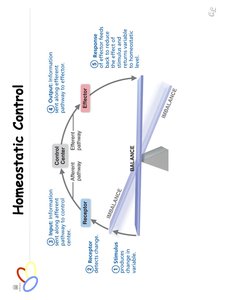
How Does the Body Keep Its Internal State in Balance?
The body maintains balance through constant monitoring and regulation of variables. Communication for monitoring and regulation is achieved via the nervous and endocrine systems.
Negative Feedback
Most feedback mechanisms in the body are negative, meaning they reduce or shut off the original stimulus. Examples include:
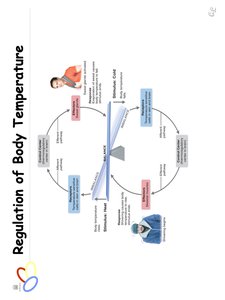
Regulation of body temperature (nervous system mechanism).
Regulation of blood volume by ADH (endocrine system mechanism).
Regulation of Body Temperature
Body temperature is regulated through negative feedback, involving sensors, control centers, and effectors to maintain balance.
Positive Feedback
Positive feedback mechanisms enhance or exaggerate the original stimulus, often resulting in a cascade or amplifying effect. These usually control infrequent events that do not require continuous adjustment, such as:
Enhancement of labor contractions by oxytocin.
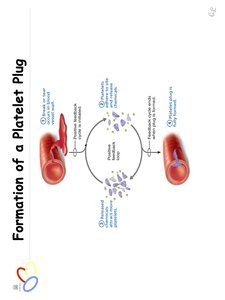
Platelet plug formation and blood clotting.
Formation of a Platelet Plug
Platelet plug formation is an example of positive feedback, where platelets release chemicals that attract more platelets, amplifying the response.
Homeostatic Response
Feedforward (anticipatory) responses occur in anticipation of a change to the internal environment. For example, the smell of food can trigger the release of saliva and digestive juices before ingestion.
Homeostatic Imbalance
Homeostatic imbalance increases the risk of disease and causes changes associated with aging, as control systems become less efficient.
Autonomic Nervous System (ANS)
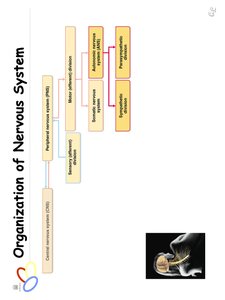
Organization of Nervous System
The nervous system is organized into the central nervous system (CNS) and peripheral nervous system (PNS), with further subdivisions for sensory and motor functions.
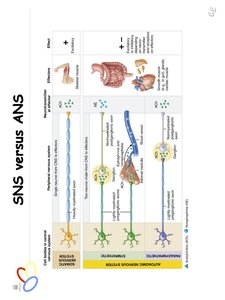
SNS versus ANS
The somatic nervous system (SNS) and autonomic nervous system (ANS) differ in their control of voluntary and involuntary functions, respectively. The SNS regulates skeletal muscles, while the ANS regulates smooth and cardiac muscles and glands.
Cooperation of SNS and ANS
Higher brain centers regulate and coordinate both systems. Most spinal and cranial nerves contain both somatic and autonomic fibers, and adaptations usually involve both skeletal muscles and visceral organs.
Autonomic Nervous System
The ANS consists of motor neurons that innervate smooth and cardiac muscle and glands. It operates without conscious awareness and is also called the involuntary or general visceral motor system.
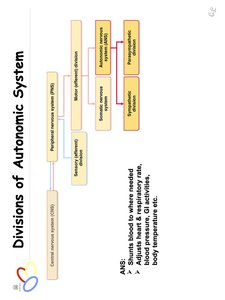
Divisions of Autonomic System
The ANS is divided into sympathetic and parasympathetic divisions, each with distinct functions:
Adjusts heart rate, respiratory rate, blood pressure, GI activities, and body temperature.
Role of Parasympathetic Division
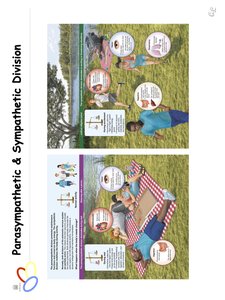
The parasympathetic division is active in non-stressful situations (rest and digest system), promoting housekeeping activities such as digestion and diuresis. It is associated with relaxation, low blood pressure, heart and respiratory rates, and constricted pupils.
Role of Sympathetic Division
The sympathetic division mobilizes the body during activity (fight-or-flight system), increasing heart rate, shunting blood to skeletal muscles and heart, and causing liver to release glucose. It is associated with dilated pupils, dry mouth, cold and sweaty skin.
Parasympathetic & Sympathetic Division
These divisions work together to maintain homeostasis, with the parasympathetic division dominating during rest and the sympathetic division during stress or activity.
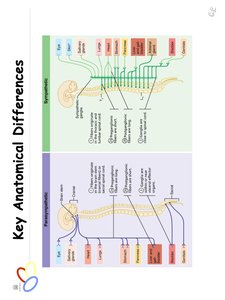
Key Anatomical Differences
Sympathetic and parasympathetic divisions differ in their anatomical organization, including the origin of fibers and the location of ganglia.
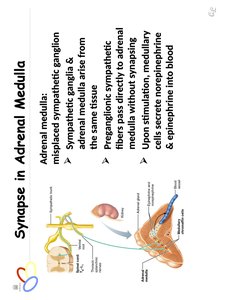
Synapse in Adrenal Medulla
The adrenal medulla acts as a mislocated sympathetic ganglion. Preganglionic sympathetic fibers pass directly to the adrenal medulla, which secretes norepinephrine and epinephrine into the blood upon stimulation.
Sympathetic & Parasympathetic Interaction
Most visceral organs have dual innervation, allowing dynamic interaction for precise control of visceral activity. The sympathetic division increases heart and respiratory rates and inhibits digestion, while the parasympathetic division slows heart and respiratory rates and promotes digestion.
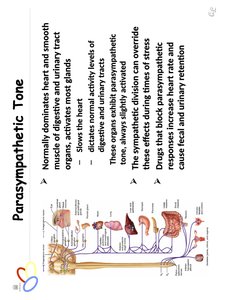
Parasympathetic Tone
The parasympathetic division normally dominates the heart and smooth muscle of digestive and urinary tracts, slowing the heart and dictating normal activity levels. The sympathetic division can override these effects during stress.
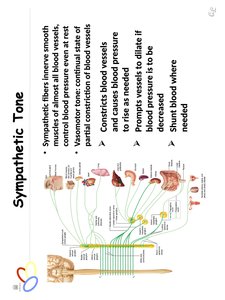
Sympathetic Tone
Sympathetic fibers innervate smooth muscle in blood vessels, controlling blood pressure even at rest. Vasomotor tone is the continual state of partial constriction of blood vessels.
Sympathetic Unique Role
Some organs receive only sympathetic fibers, such as the adrenal medulla, sweat glands, and blood vessels. The sympathetic division is responsible for thermoregulation, release of renin from kidneys, and metabolic effects.
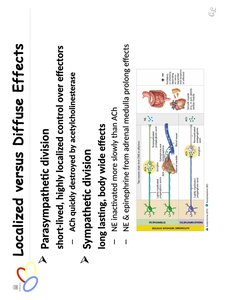
Localized versus Diffuse Effects
The parasympathetic division has short-lived, highly localized control over effectors, while the sympathetic division has long-lasting, body-wide effects due to slower inactivation of neurotransmitters.
Control of Autonomic Function
Autonomic function is controlled by the brainstem, spinal cord, hypothalamus, and cerebral cortex. The hypothalamus is the main integrative center for ANS activity.
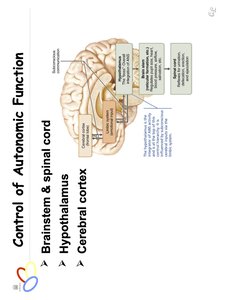
Brainstem & Spinal Cord Control
The brainstem reticular formation exerts the most direct influence over the ANS, regulating heart rate, blood vessel diameter, and gastrointestinal activities.
Hypothalamus Control
The hypothalamus directs parasympathetic and sympathetic functions, controlling heart activity, blood pressure, body temperature, water balance, and endocrine activity. Emotional responses can activate the sympathetic division.
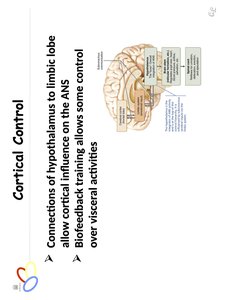
Cortical Control
Connections of the hypothalamus to the limbic lobe allow cortical influence on the ANS. Biofeedback training can allow some control over visceral activities.
Endocrine System
Endocrine System Overview
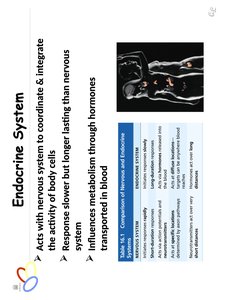
The endocrine system acts with the nervous system to coordinate and integrate the activity of body cells. Its response is slower but longer lasting than the nervous system, influencing metabolism through hormones transported in blood.
Endocrine vs Exocrine
Endocrine glands secrete hormones directly into the blood, while exocrine glands have ducts that carry secretions to membrane surfaces, producing non-hormonal substances.
Endocrine Function
The endocrine system controls and integrates:
Growth and development
Maintenance of electrolyte, water, and nutrient balance
Regulation of cellular metabolism and energy balance
Mobilization of body defenses
Reproduction
Where are Hormones Produced?
Hormones are produced by various endocrine glands, including the pituitary, thyroid, parathyroid, adrenal, pancreas, and gonads. Other organs such as the thymus, heart, and kidneys also produce hormones.
What is Hormone?
A hormone is a chemical messenger released to regulate the metabolic activity of other cells in the body. Long-distance chemical signals travel in blood or lymph.
Types of Hormones
Hormones are classified based on their chemistry:
Amino acid-based hormones: Includes amino acid derivatives, peptides, and proteins.
Steroids: Synthesized from cholesterol, including gonadal and adrenocortical hormones.
What Determines Cell Response?
Cell response to hormones depends on the presence of specific receptors. Only target cells with receptors for a specific hormone are affected.
Plasma Membrane Receptors
Many hormones act via plasma membrane receptors, often using second messengers such as cAMP. The process involves:
Hormone (first messenger) binds to receptor.
Receptor activates G protein.
G protein activates adenylate cyclase.
Adenylate cyclase converts ATP to cAMP (second messenger).
cAMP activates protein kinases that phosphorylate proteins.
Second Messenger cAMP
The cAMP pathway is a common mechanism for hormone action, amplifying the signal and resulting in cellular responses.