 Back
Homeostasis: Principles and Pathways in Human Physiology
Study Guide - Smart Notes
 Tailored notes based on your materials, expanded with key definitions, examples, and context.
Homeostasis: Principles and Pathways
Introduction to Homeostasis
Homeostasis is the process by which multicellular organisms maintain stable internal conditions necessary for cell survival and optimal function. This stability is crucial for preserving gradients, energy production, signaling, and the structure–function relationships that underpin physiological processes. Homeostasis integrates concepts from cell biology, physiology, and systems biology to coordinate responses across tissues and organ systems in the face of constant internal and external challenges.
Definition: Homeostasis is the active regulation of the internal environment to maintain conditions within a narrow, life-sustaining range.
Importance: Ensures survival by defending variables such as temperature, pH, and blood glucose against fluctuations.
Integration: Involves cell membranes, gradients, energy use, organizational levels, and cell–cell communication.
The Universal Homeostatic Pathway
The homeostatic pathway describes the sequence of events that detect and correct deviations from the optimal range of a regulated variable. This pathway ensures that physiological variables remain within their defended limits through negative feedback mechanisms.
Perturbation: An event that threatens stability but is not directly sensed.
Stimulus: The detectable change in a regulated variable caused by the perturbation.
Sensors: Detect the stimulus and convert it into a biological signal.
Afferent (Input) Pathway: Carries information from sensors to the control center.
Control/Integration Center: Compares input to the defended range and generates an error signal.
Efferent (Output) Pathway: Delivers commands to effectors.
Effectors: Tissues or organs that change their activity in response to efferent signals.
Response: The physiological change produced by effectors, which reduces the stimulus.
Negative Feedback: The response diminishes the original stimulus, stabilizing the regulated variable.
Regulated vs. Controlled Variables
Understanding the distinction between regulated and controlled variables is essential for analyzing physiological control systems.
Regulated Variables: Directly sensed and actively defended within a narrow range (e.g., arterial pressure, plasma glucose, PaO2, PaCO2, pH, temperature, osmolality).
Controlled Variables: Adjusted to defend regulated variables but not themselves directly sensed as targets (e.g., heart rate, ventilation, vascular resistance, hormone secretion rates).
Continuous and Graded Regulation: Responses scale with the size and direction of deviation from the set point.
Sensors and Error Signals
Sensors detect changes in regulated variables and generate signals that reflect both the magnitude and direction of deviation from the optimal range.
Sensor Properties: Operate over defined ranges, with characteristic gain, thresholds, and saturation points.
Tonic Activity: Sensors generate baseline activity and adjust output as the regulated variable shifts.
Error Signal: Encodes the direction (above or below range) and magnitude of deviation, guiding the strength and duration of the response.
Control and Integration
The control center integrates afferent signals, compares them to the defended range, and determines the appropriate output. Integration allows for coordination, prioritization, and graded responses, especially when multiple stimuli are present.
Coordination: Multiple signals are integrated to prioritize variables critical for immediate survival (e.g., perfusion and O2 delivery to the brain and heart).
Trade-offs: Defending one variable may temporarily compromise others.
Output Routes: Neural, Endocrine, and Neuroendocrine
Homeostatic responses are executed via neural, endocrine, or neuroendocrine pathways, each with distinct characteristics and examples.
Route | Afferent (Input) | Efferent (Output) | Characteristics | Example |
|---|---|---|---|---|
Neural | Sensory nerves | Motor or Autonomic nerves | Fast, precise, and highly targeted | Arterial blood pressure |
Endocrine | Regulated variable: carried by the blood, sensed and integrated by endocrine cells | Hormone | Slower but longer-lasting and broader in scope | Blood glucose |
Neuroendocrine Route 1 | Sensory nerve | Hormone | Central integration of multiple signals + coordinated, widespread, and sustained effects | Plasma osmolality |
Route 2 | Sensory nerve | Sequence: Autonomic nerve → hormone | Hypotension (reinforce neural control) | |
Route 3 | Sensory nerve | Autonomic nerve and hormone (in parallel) | Cold exposure |
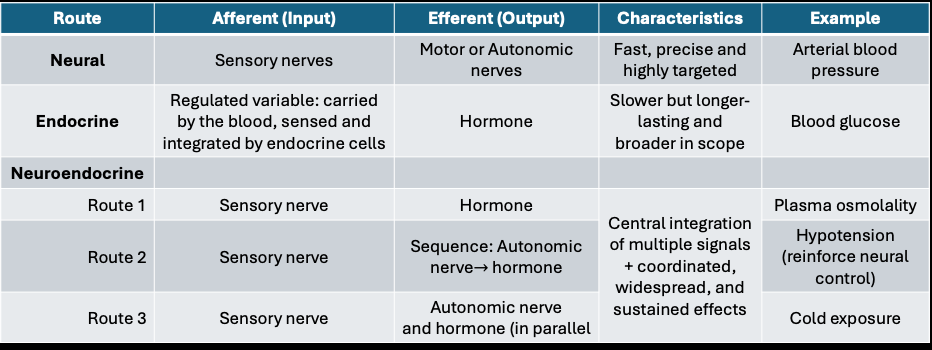
Neural: Fast, precise, and short-lived responses (e.g., baroreflex control of blood pressure).
Endocrine: Slower, widespread, and longer-lasting responses (e.g., insulin regulation of blood glucose).
Neuroendocrine: Central integration with hormonal delivery for coordinated, system-wide control (e.g., antidiuretic hormone release in response to plasma osmolality).
Effectors and Responses
Effectors are tissues or organs that receive efferent signals and alter their activity to restore homeostasis. The response is the measurable physiological change in controlled variables produced by effectors.
Graded Responses: The magnitude and timing of the response reflect the strength of efferent output, not simple on/off behavior.
Negative vs. Positive Feedback
Feedback mechanisms are central to homeostatic regulation.
Negative Feedback: The dominant mechanism; responses reduce the stimulus and stabilize regulated variables (e.g., thermoregulation, blood glucose control).
Positive Feedback: Rare; amplifies deviations to force completion of processes with built-in endpoints (e.g., blood clotting, childbirth).
Networks, Hierarchy, and Cost of Homeostasis
Homeostasis operates as a network of interacting feedback loops, with hierarchical control and physiological costs.
Networked Control: Multiple pathways may defend a single regulated variable; multiple variables are often challenged simultaneously.
Hierarchy: Variables critical for immediate survival are prioritized over others.
Cost: Adjusting controlled variables can reduce function in some tissues; discomfort often signals active homeostatic control, not failure.
