 Back
BackHorizontal Gene Transfer in Prokaryotes: Mechanisms and Significance
Study Guide - Smart Notes
 Tailored notes based on your materials, expanded with key definitions, examples, and context.
Horizontal Gene Transfer in Prokaryotes
Introduction to Genetic Recombination
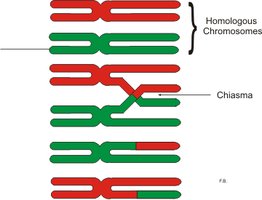
Genetic recombination is the process by which nucleotide sequences are exchanged between two DNA molecules, resulting in new combinations of genetic material. In eukaryotes, this typically occurs during meiosis through crossing over, but in prokaryotes, recombination is closely linked to horizontal gene transfer mechanisms.
Homologous recombination: Exchange of similar or identical DNA sequences between two DNA molecules.
Example: Crossing over during meiosis in eukaryotes forms gametes (sperm and egg).
Vertical vs. Horizontal Gene Transfer
Gene transfer can occur in two fundamental ways:
Vertical gene transfer: Genes are passed from parent to offspring, as seen in traditional inheritance.
Horizontal gene transfer (HGT): Genes are transferred laterally between organisms of the same generation, leading to genetic recombination in prokaryotes. This process is a major driver of genetic diversity and adaptation, such as the spread of antibiotic resistance.
In HGT, a donor cell transfers genetic material to a recipient cell, which becomes a recombinant.
Mechanisms of Horizontal Gene Transfer in Prokaryotes
Transformation
Transformation is the uptake of free DNA fragments from the environment by a recipient bacterial cell. This DNA often originates from the lysis of a donor cell. If the DNA is homologous to the recipient's genome, it can be integrated by recombination.
Key steps:
Donor cell dies and releases DNA fragments into the environment.
Recipient cell takes up these DNA fragments.
DNA is integrated into the recipient's chromosome by recombination.
Significance: Transformation can spread traits such as antibiotic resistance among bacterial populations.
Conjugation
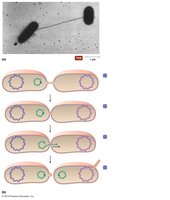
Conjugation is the direct transfer of DNA from one bacterial cell (donor) to another (recipient) via a physical connection called a pilus. This process requires the presence of a fertility plasmid (F plasmid) in the donor cell, which encodes the genes necessary for pilus formation and DNA transfer.
Key steps:
Donor cell attaches to recipient cell using a pilus.
Pilus draws the cells together.
One strand of the F plasmid DNA is transferred to the recipient.
Both cells synthesize complementary strands, resulting in two F+ cells capable of further conjugation.
Significance: Conjugation is a major mechanism for the spread of antibiotic resistance genes among bacteria.
Transduction
Transduction is the process by which bacterial DNA is transferred from one cell to another by a bacteriophage (a virus that infects bacteria). During the assembly of new phage particles, fragments of the host bacterial DNA may be mistakenly packaged into a phage particle. When this phage infects a new host, it injects the donor DNA, which can then be incorporated into the recipient's genome by recombination.
Key steps:
Phage infects donor bacterial cell and injects its DNA.
Host DNA is degraded, and new phages are assembled.
Some phages mistakenly package host DNA (transducing phage).
Transducing phage infects a new recipient cell, injecting donor DNA.
Donor DNA is incorporated into the recipient's chromosome by recombination.
Significance: Transduction can transfer genes such as those conferring antibiotic resistance. For the phage, this is a dead end, but it can be beneficial for the bacteria.
Summary Table: Mechanisms of Horizontal Gene Transfer
Mechanism | Key Feature | Genetic Material Transferred | Significance |
|---|---|---|---|
Transformation | Uptake of free DNA from environment | DNA fragments | Spread of traits like antibiotic resistance |
Conjugation | Direct cell-to-cell transfer via pilus | Plasmid DNA (e.g., F plasmid) | Rapid spread of plasmid-encoded traits |
Transduction | Phage-mediated DNA transfer | Bacterial chromosomal DNA | Gene transfer, including resistance genes |
Conclusion
Horizontal gene transfer is a fundamental process in prokaryotic genetics, enabling rapid adaptation and evolution. Understanding these mechanisms is crucial for fields such as microbiology, medicine, and biotechnology, especially in the context of antibiotic resistance.
