 Back
BackHormone Action and Interaction: Endocrine System Study Notes
Study Guide - Smart Notes
 Tailored notes based on your materials, expanded with key definitions, examples, and context.
Hormone Receptors and Target Cell Activation
Hormone Receptor Specificity
For a cell to respond to a hormone, it must possess specific receptor proteins either on its plasma membrane or within its interior. These receptors bind to the hormone, enabling the cell to perform gene-determined functions. For example, adrenocorticotropic hormone (ACTH) receptors are found only in certain adrenal cortex cells, while thyroxine receptors are present in nearly all body cells.
Hormones act as molecular triggers rather than informational molecules.
Target cell activation depends on:
Blood levels of the hormone
Number of receptors for the hormone on/in target cells
Affinity (strength) of hormone-receptor binding
High-affinity receptors and high receptor numbers amplify hormonal effects.
Low-affinity or fewer receptors reduce response or cause dysfunction.
Receptor Regulation
Receptors are dynamic and can change in response to hormone levels:
Up-regulation: Low hormone levels cause cells to produce more receptors, increasing sensitivity.
Down-regulation: High hormone levels decrease receptor numbers, desensitizing cells and preventing overreaction.
Receptors may also be uncoupled from signaling mechanisms, altering response sensitivity.
Hormones can influence the number of receptors for other hormones:
Progesterone down-regulates estrogen receptors in the uterus, antagonizing estrogen actions.
Estrogens up-regulate progesterone receptors, enhancing response to progesterone.
Half-Life, Onset, and Duration of Hormone Activity
Hormone Circulation and Removal
Hormones are potent chemicals, exerting effects at low concentrations. They circulate in blood either free or bound to protein carriers:
Lipid-soluble hormones (steroids and thyroid hormone) are not water soluble and travel bound to plasma proteins.
Water-soluble hormones circulate freely in plasma.
The concentration of a hormone in blood depends on:
Rate of release
Speed of inactivation and removal (by enzymes, kidneys, or liver)
Half-life: The time for a hormone's blood level to decrease by half. Water-soluble hormones have shorter half-lives due to rapid removal by kidneys.
Onset and Duration of Action
Some hormones act immediately; others (especially steroids) take hours to days.
Some hormones are secreted in inactive forms and activated in target cells.
Duration of action ranges from seconds to hours, depending on hormone type and blood levels.
Precise control of hormone levels is essential for body function.
Hormone solubility (water vs. lipid) affects half-life, onset, and duration of action.
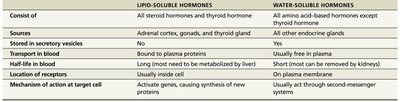
Comparison of Lipid-Soluble and Water-Soluble Hormones
The following table summarizes key differences between lipid-soluble and water-soluble hormones:
LIPID-SOLUBLE HORMONES | WATER-SOLUBLE HORMONES | |
|---|---|---|
Consist of | All steroid hormones and thyroid hormone | All amino acid-based hormones except thyroid hormone |
Sources | Adrenal cortex, gonads, and thyroid gland | All other endocrine glands |
Stored in secretory vesicles | No | Yes |
Transport in blood | Bound to plasma proteins | Usually free in plasma |
Half-life in blood | Long (most need to be metabolized by liver) | Short (most can be removed by kidneys) |
Location of receptors | Usually inside cell | On plasma membrane |
Mechanism of action at target cell | Activate genes, causing synthesis of new proteins | Usually act through second-messenger systems |
Interaction of Hormones at Target Cells
Types of Hormone Interaction
Multiple hormones can act on the same target cells simultaneously, resulting in complex interactions:
Permissiveness: One hormone cannot exert its full effects without another hormone present. Example: Thyroid hormone is necessary for normal reproductive development.
Synergism: Two or more hormones produce the same effect, and their combined effects are amplified. Example: Glucagon and epinephrine together cause greater glucose release from the liver than either alone.
Antagonism: One hormone opposes the action of another. Example: Insulin lowers blood glucose, while glucagon raises it. Antagonism can occur by competition for receptors, different metabolic pathways, or down-regulation of receptors.
Summary Table: Hormone Interaction Types
Interaction Type | Description | Example |
|---|---|---|
Permissiveness | One hormone requires another to exert full effect | Thyroid hormone for reproductive development |
Synergism | Combined effect of hormones is greater than individual effects | Glucagon + epinephrine = amplified glucose release |
Antagonism | One hormone opposes the action of another | Insulin vs. glucagon on blood glucose |
Key Terms and Concepts
Receptor: Protein that binds a hormone and initiates cellular response.
Up-regulation: Increase in receptor number in response to low hormone levels.
Down-regulation: Decrease in receptor number in response to high hormone levels.
Half-life: Time for hormone concentration in blood to decrease by half.
Permissiveness, Synergism, Antagonism: Types of hormone interaction at target cells.
Example: If thyroid hormone is absent, reproductive hormones cannot fully stimulate development of reproductive organs (permissiveness).
Formula for hormone half-life:
Where is the half-life and is the rate constant for hormone removal.
Additional info: Hormone action is tightly regulated to maintain homeostasis and prevent dysfunction. The interplay between hormone concentration, receptor dynamics, and interaction types is fundamental to endocrine physiology.
