 Back
BackHormone Action Mechanisms: Second Messengers and Gene Activation
Study Guide - Smart Notes
 Tailored notes based on your materials, expanded with key definitions, examples, and context.
Hormone Action Mechanisms
Overview of Hormone-Target Cell Interactions
Hormones are chemical messengers that circulate throughout the body but only affect specific target cells that possess the appropriate receptors. The response of a target cell to a hormone depends on the cell type and the nature of the hormone. Hormones can alter cellular activity by changing membrane permeability, stimulating protein synthesis, activating or deactivating enzymes, inducing secretion, or stimulating mitosis.
Target Cells: Cells with specific receptors for a given hormone.
Hormone Effects: Vary depending on the target cell and receptor type.
Example: Epinephrine causes contraction in smooth muscle cells of blood vessels but has different effects in other cell types.
Mechanisms of Hormone Action
Water-Soluble vs. Lipid-Soluble Hormones
The mechanism by which a hormone acts depends on its chemical nature and the location of its receptor. Hormones are classified as water-soluble (most amino acid–based hormones) or lipid-soluble (steroid and thyroid hormones).
Water-Soluble Hormones: Bind to receptors on the plasma membrane and act via second messengers (e.g., cAMP, Ca2+).
Lipid-Soluble Hormones: Diffuse through the plasma membrane and bind to intracellular receptors, directly activating genes.
Second Messenger Systems
Cyclic AMP (cAMP) Signaling Mechanism
Most amino acid–based hormones (except thyroid hormone) use second messenger systems to exert their effects. The cAMP pathway is a classic example, involving a hormone receptor, a G protein, and the effector enzyme adenylate cyclase.
Hormone binds receptor: The hormone (first messenger) binds to its receptor on the plasma membrane.
Receptor activates G protein: The receptor changes shape and activates a nearby G protein by exchanging GDP for GTP.
G protein activates adenylate cyclase: The activated G protein binds to and activates adenylate cyclase.
Adenylate cyclase converts ATP to cAMP: Adenylate cyclase catalyzes the conversion of ATP to cyclic AMP (cAMP), the second messenger.
cAMP activates protein kinases: cAMP activates protein kinases, which phosphorylate various proteins, leading to cellular responses.
This cascade amplifies the signal, allowing a single hormone molecule to generate millions of product molecules. The effect of cAMP depends on the specific protein kinases and substrates present in the target cell.
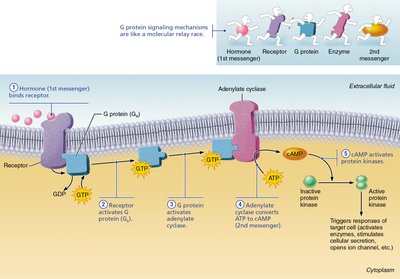
Termination: cAMP is rapidly degraded by phosphodiesterase, ensuring the response is brief and tightly regulated.
Example: In thyroid cells, increased cAMP triggers thyroxine synthesis; in liver cells, it activates enzymes that release glucose.
Other Second Messenger Systems
Some hormones use other second messengers, such as calcium ions (Ca2+) or cyclic GMP (cGMP). In the Ca2+ signaling mechanism, phospholipase C splits a membrane phospholipid into diacylglycerol (DAG) and inositol trisphosphate (IP3), both of which act as second messengers. IP3 increases intracellular Ca2+, which can activate enzymes via calmodulin.
DAG: Activates protein kinase C.
IP3: Releases Ca2+ from intracellular stores, which then activates calmodulin-dependent enzymes.
cGMP: Used as a second messenger by some hormones.
Direct Activation: Some receptors, such as the insulin receptor, are themselves enzymes (tyrosine kinases) and do not use second messengers.
Intracellular Receptors and Direct Gene Activation
Mechanism of Lipid-Soluble Hormones
Lipid-soluble hormones (steroids and thyroid hormone) diffuse through the plasma membrane and bind to intracellular receptors. The hormone-receptor complex then enters the nucleus and binds to specific DNA regions, activating gene transcription to produce mRNA. The mRNA is translated into proteins that mediate the hormone's effects.
Hormone diffuses through membrane and binds intracellular receptor.
Hormone-receptor complex enters nucleus and binds DNA.
Binding initiates transcription of gene to mRNA.
mRNA directs protein synthesis in the cytoplasm.
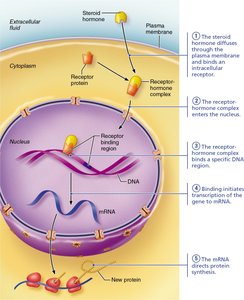
Example: Steroid hormones promote synthesis of enzymes or structural proteins, or proteins to be exported from the cell.
Summary Table: Hormone Mechanisms of Action
Hormone Type | Receptor Location | Mechanism | Examples |
|---|---|---|---|
Water-soluble (amino acid–based, except thyroid hormone) | Plasma membrane | Second messenger systems (e.g., cAMP, Ca2+) | Epinephrine, insulin, glucagon |
Lipid-soluble (steroids, thyroid hormone) | Intracellular (cytoplasm or nucleus) | Direct gene activation | Cortisol, estrogen, thyroxine |
Check Your Understanding
Which class of hormones consists entirely of lipid-soluble hormones? Name the only hormone in the other chemical class that is lipid soluble.
Draw and label a cell showing receptors for lipid-soluble and water-soluble hormones in their correct locations. State what happens as a result of hormone binding to each receptor.
Additional info: Lipid-soluble hormones include all steroid hormones and thyroid hormone (the only amino acid–based hormone that is lipid soluble). Water-soluble hormones include all other amino acid–based hormones.
