 Back
BackHormones, Hypothalamus, Sleep, and Biological Rhythms: ANP Study Guide
Study Guide - Smart Notes
 Tailored notes based on your materials, expanded with key definitions, examples, and context.
Hormones and the Endocrine System
Hormonal Signaling and Feedback Loops
Hormones are chemical messengers secreted by glands that regulate physiological processes throughout the body. They cooperate with neural signaling to maintain homeostasis, but differ in their speed and method of transmission.
Neural signaling: Fast, uses synapses.
Hormonal signaling: Slower, uses bloodstream.
Feedback loops: Hypothalamus releases neurohormones → stimulates pituitary → pituitary releases hormones → endocrine glands release hormones → feedback to brain.
Functions: Affect sex organs, physical appearance, neurotransmitter function, and gene expression.
Example: Hormones like oxytocin and vasopressin regulate childbirth, lactation, and water balance.
Classes of Hormones
Steroid hormones: Synthesized from cholesterol, lipid-soluble, act on DNA (e.g., testosterone, cortisol).
Peptide hormones: Made by cellular DNA, bind to cell membrane receptors (e.g., insulin, growth hormone).
Types of Hormonal Functions
Homeostatic hormones: Maintain internal balance (e.g., mineralocorticoids).
Gonadal hormones: Control reproductive functions (e.g., estrogen, testosterone).
Glucocorticoids: Manage stress response (e.g., cortisol).
Blood Sugar Regulation
Insulin lowers blood glucose by promoting storage as glycogen.
Glucagon raises blood glucose by releasing it from glycogen stores.
Diabetes mellitus: Failure to release enough insulin, leading to hyperglycemia or hypoglycemia.
Anabolic-Androgenic Steroids
Synthetic hormones related to testosterone.
Used clinically for hormone replacement, but misuse can cause health risks (e.g., reduced fertility, aggression, organ damage).
Hypothalamus: Structure and Function
Anatomy of the Hypothalamus
The hypothalamus is a central brain region that integrates neural and hormonal signals to regulate homeostasis and motivated behaviors.
Three zones (coronal view): Periventricular, medial, lateral.
Four regions (horizontal view): Preoptic area, supraoptic region, tuberal region, mammillary region.
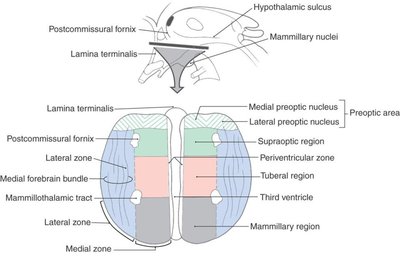
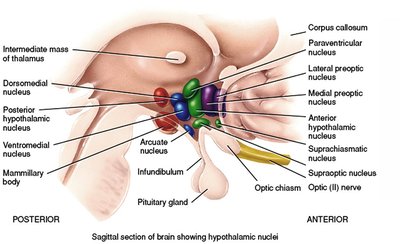
Example: The lateral hypothalamus is involved in hunger, while the ventromedial nucleus regulates satiety.
Homeostatic Functions of the Hypothalamus
Circadian rhythm: Suprachiasmatic nucleus (SCN) receives light signals, controls melatonin release.
Thirst: Osmoreceptors detect blood osmolality, trigger ADH release for water reabsorption.
Hunger: Ghrelin stimulates hunger, leptin and insulin signal satiety.
Hypothalamic Hormone Regulation
Posterior pituitary: Stores and releases oxytocin and vasopressin.
Anterior pituitary: Releases TSH, ACTH, FSH/LH, prolactin, growth hormone.
Regulation involves feedback loops, neural regulation, and experience-based responses.
Biological Rhythms and Sleep
Circadian Rhythms
Circadian rhythms are daily cycles regulated by the SCN, influencing sleep, body temperature, hormone release, and other physiological parameters.
Diurnal: Active during day.
Nocturnal: Active during night.
Crepuscular: Active during twilight.
Sleep Regulation: Homeostatic and Circadian Processes
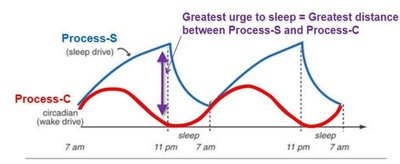
Sleep is regulated by two interacting processes:
Process-S (Sleep drive): Builds up with wakefulness, increases urge to sleep.
Process-C (Circadian wake drive): Promotes wakefulness, regulated by light and SCN.
The greatest urge to sleep occurs when Process-S is high and Process-C is low.
Sleep Stages and EEG Characteristics
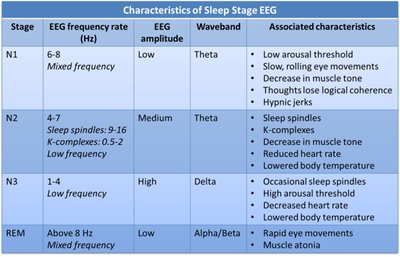
Sleep consists of NREM (N1–N3) and REM stages, each with distinct EEG patterns and physiological features.
Stage | EEG Frequency (Hz) | EEG Amplitude | Waveband | Associated Characteristics |
|---|---|---|---|---|
N1 | 6-8 (Mixed frequency) | Low | Theta | Low arousal threshold, slow eye movements, decreased muscle tone, hypnic jerks |
N2 | 4-7 (Sleep spindles 9-16, K-complexes 0.5-2) | Medium | Theta | Sleep spindles, K-complexes, decreased muscle tone, lowered body temperature |
N3 | 1-4 (Low frequency) | High | Delta | Occasional sleep spindles, high arousal threshold, decreased heart rate, lowered body temperature |
REM | Above 8 (Mixed frequency) | Low | Alpha/Beta | Rapid eye movements, muscle atonia |
Motivated Behavior and Neuroanatomy
Regulatory vs. Non-Regulatory Behaviors
Regulatory behaviors: Controlled by homeostatic mechanisms (e.g., eating, drinking, temperature regulation).
Non-regulatory behaviors: Not essential for survival (e.g., sexual, parenting, curiosity).
Adaptive vs. Non-Adaptive Behaviors
Adaptive: Enhance reproductive success and survival.
Non-adaptive: Do not contribute to survival or reproduction.
Hypothalamic Integration of Motivated Behavior
The hypothalamus receives input from all major subdivisions of the nervous system and integrates adaptive behaviors. It organizes cerebral input and produces feedback loops for homeostasis and motivated behavior.
Papez Circuit and Memory
Papez Circuit
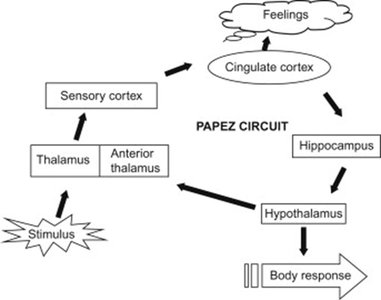
The Papez circuit is a neural pathway involved in memory consolidation and emotional processing. It connects the hippocampus, mammillary bodies, thalamus, cingulate cortex, and hypothalamus.
Function: Memory consolidation, emotional regulation.
Clinical relevance: Damage to the circuit is associated with Alzheimer's and Parkinson's disease.
Summary Table: Hypothalamic Nuclei and Functions
Nucleus | Function |
|---|---|
Suprachiasmatic | Circadian rhythm regulation |
Ventromedial | Satiety, female sexual behaviors |
Dorsomedial | Aggression, rage |
Arcuate | Leptin/ghrelin, releasing hormones |
Mamillary | Memory, exploration |
Lateral | Hunger, arousal, wakefulness |
Anterior | Cooling, sweating |
Posterior | Heat conservation, blood pressure |
Preoptic | Thermoregulation, reproductive behaviors |
Supraoptic | Oxytocin, ADH |
Equations and Formulas
Hormonal feedback loop:
Circadian rhythm transcription-translation-feedback loop:
Additional info: Academic context was added to clarify hormone classes, hypothalamic anatomy, sleep regulation, and the Papez circuit. Tables and diagrams were recreated for clarity and completeness.
