 Back
BackHuman Anatomy & Physiology I: Course Overview, History of Anatomy, and Study Strategies
Study Guide - Smart Notes
 Tailored notes based on your materials, expanded with key definitions, examples, and context.
Course Overview
Course Structure and Logistics
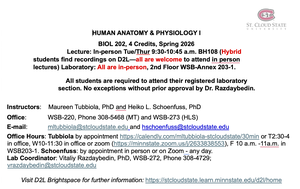
This course, BIOL 202: Human Anatomy & Physiology I, is designed to introduce students to the foundational concepts of human anatomy and physiology. It covers the structure and function of the human body, emphasizing the relationship between anatomical form and physiological function. The course includes in-person lectures, laboratory sessions, and exams scheduled throughout the semester.
Lecture Schedule: In-person, Tue/Thur 9:30-10:45 a.m., BH108
Laboratory: All sessions are in-person, 2nd Floor WSB-Annex 203-1
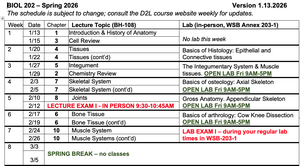
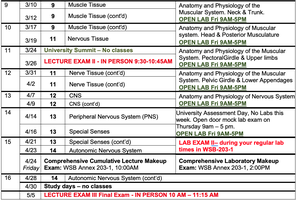
Exams: Three lecture exams and two lab exams administered in person
Instructors: Contact information and office hours provided for course faculty
Student Learning Outcomes
Upon successful completion of the course, students will be able to:
Compare and contrast positive and negative feedback in human physiology
Explain the location and function of body structures using appropriate terminology
Describe the relationships between cells, tissues, organs, and organ systems
Discuss how different organ systems maintain homeostasis and the consequences of homeostatic imbalance
Required Textbooks & Supplies
Anatomy & Physiology by Marieb & Hoehn, Pearson, 2020, 7th Edition
Lab manual and additional resources available online
Course Conduct and Expectations
Professionalism and Respect
Students are expected to demonstrate a desire to learn, professionalism, and respect for peers, instructors, and cadaver donors. The use of cadavers is a privilege, and students should approach this aspect of the course with sensitivity and gratitude.
Cheating and dishonesty are strictly prohibited
Attendance and preparation are essential for success
Communication should be professional and in standard written English
Preparation, Attendance, and Review Strategies
Effective study habits are crucial for mastering course material. Students are encouraged to:
Read the textbook and lab manual before class
Complete pre-quizzes to gauge understanding
Attend lectures and labs, take quality notes, and participate actively
Review notes, re-read materials, and work through problem sets
Study in groups and utilize online resources for additional practice
Course Schedule
Lecture and Lab Topics
The course follows a structured schedule, covering the following chapters and topics:
Ch. 1: Introduction & History of Anatomy
Ch. 3: Cell Review
Ch. 4: Tissue
Ch. 5: Integumentary System
Ch. 6: Bones & Skeletal Tissues
Ch. 7: Skeleton
Ch. 8: Joints
Ch. 9: Muscles & Muscle Tissue
Ch. 10: Muscular System
Ch. 11: Nervous System & Nervous Tissue
Ch. 12: Central Nervous System
Ch. 13: Peripheral Nervous System
Ch. 15: Special Senses
Ch. 14: Autonomic Nervous System
History of Anatomy
Pre-scientific and Early Scientific Periods
The study of anatomy has evolved through various cultural and scientific periods. Early anatomical knowledge was recorded in ancient Egyptian scrolls, such as the Edwin Smith Surgical Papyrus and the Ebers Papyrus. Greek philosophers like Socrates, Plato, and Hippocrates contributed foundational ideas, including the concept of disease originating in the body and the dualism of body and soul.
Pre-Hellenistic Societies: Early anatomical drawings and observations
Egyptian Period: Surgical papyri documenting anatomical procedures
Athenian Period: Philosophical justification for dissection and medical inquiry
Roman Period and Galen's Influence
During the Roman period, the focus shifted to applied science, particularly medicine and engineering. Galen of Pergamum, a prominent physician, conducted animal dissections and established medical dogma that persisted for over a millennium.
Galen's Dogma: Dominated European medicine during the Dark Ages
Roman Engineering: Integration of anatomical knowledge in practical applications
Islamic Golden Age and the House of Wisdom
While Europe experienced the Dark Ages, the Islamic Empire advanced scientific knowledge by translating and expanding upon Greek, Hindu, and Persian texts. The House of Wisdom in Baghdad became a center for research and discovery, with scholars like al-Kindi, al-Khwarizma, and Ibn Sina making significant contributions to medicine and mathematics.
al-Kindi: Introduced the Hindu decimal system
al-Khwarizma: Authored foundational works in number theory
Ibn Sina: Wrote "The Canon of Medicine," questioning Galen's texts
Summary Table: Course Topics and Historical Periods
Course Chapter | Main Topic | Historical Period | Key Figures |
|---|---|---|---|
1 | Introduction & History of Anatomy | Pre-scientific, Egyptian, Greek, Roman, Islamic | Socrates, Plato, Hippocrates, Galen, Ibn Sina |
3-15 | Cells, Tissues, Organ Systems | Modern Scientific Period | Various scientists and medical practitioners |
Additional Info
These study notes provide a comprehensive overview of the course structure, expectations, and the historical development of anatomical science. Students are encouraged to approach the material with curiosity and respect, utilizing all available resources for success.
