 Back
BackHuman Cadaver Exploration: Anatomy as Science – Study Guide
Study Guide - Smart Notes
 Tailored notes based on your materials, expanded with key definitions, examples, and context.
Human Cadaver Exploration: Anatomy as Science
Introduction
This section introduces the scientific study of human anatomy, emphasizing the importance of cadaver exploration for understanding the structure and function of the human body. The focus is on developing skills in observation, identification, and analysis of anatomical features, which are foundational for advanced studies in anatomy and physiology.
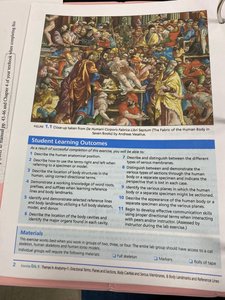
Student Learning Outcomes
Upon completion of this module, students will be able to:
Describe the human body’s orientation: Understand anatomical position, directional terms, and planes of section.
Identify major body cavities and their contents: Recognize the locations and functions of the cranial, thoracic, abdominal, and pelvic cavities.
Distinguish between different tissue types: Learn to identify epithelial, connective, muscle, and nervous tissues based on structure and function.
Describe the location of specific body structures: Use anatomical landmarks to locate organs, bones, and muscles.
Apply scientific observation skills: Develop proficiency in observing and recording anatomical features during cadaver exploration.
Compare and contrast anatomical structures: Analyze similarities and differences between organs, tissues, and systems.
Explain the relationship between structure and function: Understand how anatomical features relate to physiological roles.
Use proper anatomical terminology: Communicate findings using correct terms for orientation, location, and description.
Describe and distinguish between the different types of tissues: Recognize the four basic tissue types and their subtypes.
Identify the location of the body cavities and their contents: Map out the major cavities and list their primary organs.
Develop skills in scientific observation and learning anatomy visually: Practice visual identification and documentation of anatomical features.
Develop collaborative skills: Work effectively in teams to explore and discuss anatomical findings.
Apply the scientific method: Formulate hypotheses, collect data, and draw conclusions based on anatomical evidence.
Key Concepts in Human Anatomy
Anatomical Position: The standard reference position for the body; standing upright, facing forward, arms at sides, palms facing forward.
Directional Terms: Terms such as superior, inferior, anterior, posterior, medial, lateral, proximal, and distal are used to describe locations and relationships between body parts.
Body Planes: Imaginary lines used to divide the body: sagittal (left/right), coronal (front/back), and transverse (top/bottom).
Body Cavities: Spaces within the body that house organs. Major cavities include:
Cranial cavity: Contains the brain.
Thoracic cavity: Contains heart and lungs.
Abdominal cavity: Contains digestive organs.
Pelvic cavity: Contains reproductive and some excretory organs.
Tissue Types: The four basic types are:
Epithelial tissue: Covers surfaces and lines cavities.
Connective tissue: Supports and binds other tissues.
Muscle tissue: Responsible for movement.
Nervous tissue: Conducts electrical impulses.
Scientific Observation and Method in Anatomy
Observation is a key skill in anatomy, involving careful examination and documentation of structures. The scientific method is applied by forming hypotheses about anatomical relationships, collecting data through dissection and observation, and drawing evidence-based conclusions.
Steps of the Scientific Method:
Ask a question about anatomical structure or function.
Formulate a hypothesis.
Collect data through observation or dissection.
Analyze data and draw conclusions.
Collaborative Learning in Anatomy
Teamwork is essential in cadaver exploration, allowing students to share observations, discuss findings, and learn from each other. Collaborative skills include effective communication, respectful discussion, and joint problem-solving.
Materials for Cadaver Exploration
Human cadaver specimens
Dissection tools
Personal protective equipment (PPE)
Reference texts and anatomical atlases
Example: Application of Anatomical Terminology
When describing the location of the heart, use terms such as "medial to the lungs," "superior to the diaphragm," and "anterior to the vertebral column." This precise language facilitates clear communication in clinical and academic settings.
Table: Major Body Cavities and Their Contents
Body Cavity | Main Organs |
|---|---|
Cranial | Brain |
Thoracic | Heart, Lungs |
Abdominal | Stomach, Liver, Intestines |
Pelvic | Bladder, Reproductive Organs |
Example Equation: Surface Area Calculation
Surface area is an important concept in anatomy, especially for organs like the lungs and intestines. The formula for surface area (for a rectangular shape) is:
Relevant Image
The following image visually reinforces the collaborative and observational nature of anatomical study, as well as the importance of learning outcomes in anatomy:
Additional info: The learning outcomes and materials listed are directly relevant to the foundational chapters of an anatomy and physiology (ANP) college course, including orientation, tissues, body cavities, and scientific method.
