 Back
BackHuman Cardiovascular Physiology: Blood Pressure and Pulse Determinations
Study Guide - Smart Notes
 Tailored notes based on your materials, expanded with key definitions, examples, and context.
Human Cardiovascular Physiology—Blood Pressure and Pulse Determinations
Introduction
This study guide covers the essential concepts and laboratory techniques related to human cardiovascular physiology, focusing on blood pressure and pulse determinations. Understanding these physiological measurements is crucial for interpreting cardiovascular health and function.
The Cardiac Cycle
Definition and Phases
The cardiac cycle refers to the sequence of events in one complete heartbeat, including both contraction and relaxation of the atria and ventricles.
Systole: Contraction phase, usually referring to ventricular contraction.
Diastole: Relaxation phase, usually referring to ventricular relaxation.
During the cardiac cycle, both atria contract simultaneously, followed by ventricular contraction.
Blood flows passively into the atria and ventricles during relaxation; atrial contraction forces remaining blood into the ventricles.
Ventricular systole increases pressure, closing the AV valves and opening the semilunar valves when pressure exceeds that in the arteries.
After ventricular contraction, the semilunar valves close, and the cycle repeats.
The average cardiac cycle lasts about 0.8 seconds (for a heart rate of 70–76 beats/min).

Additional info: The cardiac cycle is closely linked to the electrical activity of the heart, as seen in the ECG (P wave: atrial depolarization, QRS: ventricular depolarization, T wave: ventricular repolarization).
Valve Function and Pressure Changes
AV valves (tricuspid and bicuspid/mitral): Open during ventricular diastole, closed during ventricular systole.
Semilunar valves (aortic and pulmonary): Open during ventricular systole, closed during ventricular diastole.
Pressure is highest during ventricular systole and lowest during ventricular diastole.
Heart Sounds
Origin and Clinical Significance
Two distinct heart sounds are heard during each cardiac cycle:
First sound ("lub"): Closure of AV valves at the beginning of systole; longer and louder.
Second sound ("dup"): Closure of semilunar valves at the end of systole; shorter and sharper.
Abnormal heart sounds (murmurs) may indicate valve deformities or conduction abnormalities.
The Pulse
Definition and Measurement
The pulse is the alternating expansion and recoil of an artery with each beat of the left ventricle. Pulse rate typically equals heart rate (70–76 beats/min at rest).
Apical pulse: Measured at the heart's apex using a stethoscope.
Radial pulse: Measured at the wrist; may be slightly lower than apical due to pulse deficit.
Pulse deficit: Difference between apical and radial pulse rates; may indicate cardiac dysfunction.
Superficial Pulse Points
Pulse can be palpated at various superficial arteries:
Common carotid artery (neck)
Superficial temporal artery (anterior to ear)
Facial artery (anterior to masseter muscle)
Brachial artery (antecubital fossa)
Radial artery (wrist)
Femoral artery (groin)
Popliteal artery (back of knee)
Posterior tibial artery (above medial malleolus)
Dorsalis pedis artery (dorsum of foot)
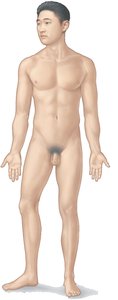
The amplitude of the pulse is greatest at the carotid artery and least at the dorsalis pedis artery, reflecting distance from the heart.
Blood Pressure Determinations
Definition and Measurement
Blood pressure (BP) is the force exerted by blood against vessel walls, measured in mm Hg. Two values are recorded:
Systolic pressure: Peak pressure during ventricular contraction (e.g., 120 mm Hg).
Diastolic pressure: Lowest pressure during ventricular relaxation (e.g., 80 mm Hg).
BP is measured using a sphygmomanometer (blood pressure cuff) and the auscultatory method, listening for Korotkoff sounds over the brachial artery.

Factors Affecting Blood Pressure
BP is directly proportional to cardiac output (CO) and peripheral resistance (PR):
Increased vessel diameter decreases BP; increased viscosity, cardiac output, or arteriosclerosis increases BP.
BP is highest when reclining, lowest when standing due to gravity and compensatory vasoconstriction.
Exercise increases both BP and pulse due to increased cardiac output.
Cardiovascular Responses to Posture and Exercise
Posture
BP and pulse are measured in different positions (sitting, reclining, standing) to observe circulatory adjustments.
Standing causes an initial drop in BP, which normalizes after a few minutes due to baroreceptor-mediated vasoconstriction.
Exercise
Exercise increases cardiac output, raising systolic BP and pulse rate.
Well-conditioned individuals have a lower resting pulse and recover more quickly after exercise due to higher stroke volume.
Physical fitness can be estimated using the Harvard Step Test:
Scores: <55 = poor, 55–62 = low average, 63–71 = average, 72–79 = high average, 80–89 = good, ≥90 = excellent.
Skin Color as an Indicator of Local Circulatory Dynamics
Factors Affecting Skin Color
Skin color reflects local blood flow and oxygenation.
Constriction of skin vessels (e.g., during hemorrhage) causes pallor and coolness.
Vasodilation (e.g., after ischemia or injury) causes redness due to increased blood flow.
Mechanical stimulation can cause a red streak (flare) due to local inflammatory mediators.
Clinical Application: Observing skin color changes can help assess circulatory adequacy and detect local or systemic issues.
Summary Table: Key Terms and Concepts
Term | Definition |
|---|---|
Systole | Contraction of the ventricles |
Diastole | Relaxation of the ventricles |
Cardiac Cycle | Events of one complete heartbeat |
Pulse | Alternating surges of pressure in an artery with each heartbeat |
Blood Pressure | Pressure exerted by blood on vessel walls |
Sphygmomanometer | Instrument to measure blood pressure |
Korotkoff Sounds | Sounds heard during BP measurement indicating resumption of blood flow |
Conclusion
Understanding the cardiac cycle, heart sounds, pulse, and blood pressure is fundamental for assessing cardiovascular health. Laboratory techniques such as auscultation, palpation, and sphygmomanometry provide practical skills for clinical evaluation. Observing physiological responses to posture, exercise, and local factors enhances comprehension of cardiovascular dynamics and homeostasis.
