Back
Human Physiology Exam Review – Osmosis, Neuron Structure, Action Potentials, Skeletal Muscle, and Endocrine Pathways
Study Guide - Smart Notes
 Tailored notes based on your materials, expanded with key definitions, examples, and context.
Q1. What is the % of water outside the cell?
Background
Topic: Osmosis and Solution Concentration
This question tests your understanding of how solute concentration (glucose) relates to water percentage in a solution.
Key Terms:
Solute: The substance dissolved in a solution (here, glucose).
Solvent: The substance doing the dissolving (here, water).
Percent composition: The percentage of each component in the solution.
Step-by-Step Guidance
Look at the diagram: Outside the cell, the solution is labeled as 80% glucose.
Recall that the total percentage of all components must add up to 100%.
Subtract the percentage of glucose from 100% to find the percentage of water outside the cell.
Try solving on your own before revealing the answer!
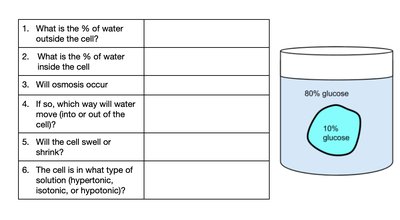
Q2. What is the % of water inside the cell?
Background
Topic: Osmosis and Solution Concentration
This question is similar to Q1, but focuses on the internal environment of the cell.
Key Terms:
Intracellular: Inside the cell.
Solute and solvent percentages must add up to 100%.
Step-by-Step Guidance
Inside the cell, the diagram shows 10% glucose.
Subtract the percentage of glucose from 100% to find the percentage of water inside the cell.
Try solving on your own before revealing the answer!
Q3. Will osmosis occur?
Background
Topic: Osmosis
This question tests your understanding of whether water movement will occur across the cell membrane due to concentration differences.
Key Terms:
Osmosis: Movement of water across a semipermeable membrane from an area of higher water concentration to lower water concentration.
Semipermeable membrane: Allows water but not solute to pass.
Step-by-Step Guidance
Compare the water concentration inside and outside the cell.
If there is a difference, osmosis will occur.
Try solving on your own before revealing the answer!
Q4. If so, which way will water move (into or out of the cell)?
Background
Topic: Direction of Osmosis
This question tests your ability to predict the direction of water movement based on concentration gradients.
Key Terms:
Water moves from high concentration to low concentration.
Compare water percentages inside and outside the cell.
Step-by-Step Guidance
Identify which side (inside or outside) has a higher water percentage.
Water will move toward the side with lower water concentration.
Try solving on your own before revealing the answer!
Q5. Will the cell swell or shrink?
Background
Topic: Effects of Osmosis on Cell Volume
This question tests your understanding of how water movement affects cell size.
Key Terms:
Swelling: Water enters the cell.
Shrinking: Water leaves the cell.
Step-by-Step Guidance
Recall the direction of water movement from Q4.
If water moves into the cell, it swells; if water moves out, it shrinks.
Try solving on your own before revealing the answer!
Q6. The cell is in what type of solution (hypertonic, isotonic, or hypotonic)?
Background
Topic: Tonicity
This question tests your ability to classify the solution based on solute concentration relative to the cell.
Key Terms:
Hypertonic: Higher solute concentration outside the cell.
Hypotonic: Lower solute concentration outside the cell.
Isotonic: Equal solute concentration inside and outside.
Step-by-Step Guidance
Compare the glucose concentration inside (10%) and outside (80%).
Determine which term (hypertonic, hypotonic, isotonic) applies based on the relative concentrations.
Try solving on your own before revealing the answer!
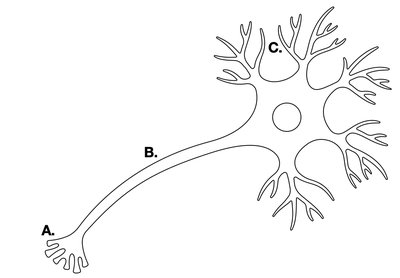
Q7. Identify which segment (A, B, or C) the following channels/pumps will be located on the neuron.
Background
Topic: Neuron Structure and Function
This question tests your knowledge of where specific ion channels and pumps are found on a neuron.
Key Terms:
Voltage-gated channels: Open in response to changes in membrane potential.
Chemical-gated channels: Open in response to binding of a chemical (e.g., neurotransmitter).
Segments: A (axon terminal), B (axon), C (cell body/dendrites).
Step-by-Step Guidance
Recall the function of each channel type (e.g., voltage-gated potassium channels are involved in repolarization).
Match each channel type to the segment where it is most active (e.g., voltage-gated sodium channels are found along the axon).
Use the diagram to help visualize the locations.
Try solving on your own before revealing the answer!
Q8. Indicate the direction of ion movement for each channel (ECF → ICF or ICF → ECF).
Background
Topic: Ion Movement Across Membranes
This question tests your understanding of how ions move through channels during neuronal signaling.
Key Terms:
ECF: Extracellular fluid
ICF: Intracellular fluid
Direction depends on the channel and phase of action potential.
Step-by-Step Guidance
Recall which ions move in which direction during depolarization and repolarization.
For each channel, determine if ions move into or out of the cell.
Try solving on your own before revealing the answer!
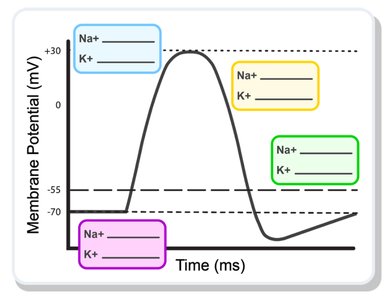
Q9. Write the state of voltage-gated Na+ and K+ channels during each main phase of the action potential.
Background
Topic: Action Potential Phases
This question tests your understanding of how sodium and potassium channels behave during different phases of the action potential.
Key Terms:
Depolarization: Na+ channels open, Na+ enters.
Repolarization: K+ channels open, K+ exits.
Resting: Most channels closed.
Step-by-Step Guidance
Identify the phases on the graph: resting, depolarization, repolarization, hyperpolarization.
For each phase, determine which channels are open or closed and the direction of ion movement.
Use the graph to visualize the timing of channel activity.
Try solving on your own before revealing the answer!
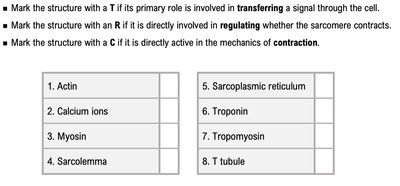
Q10. Mark the structure with a T if its primary role is transferring a signal, R if it regulates contraction, or C if it is directly active in contraction.
Background
Topic: Skeletal Muscle Structure and Function
This question tests your ability to classify muscle components based on their function in contraction.
Key Terms:
Transferring: Structures involved in signal transmission (e.g., T tubule).
Regulating: Structures that control contraction (e.g., troponin).
Contracting: Structures directly involved in contraction (e.g., actin, myosin).
Step-by-Step Guidance
Review the list of structures and recall their primary function.
Assign T, R, or C based on whether the structure transfers signals, regulates contraction, or is active in contraction.
Try solving on your own before revealing the answer!
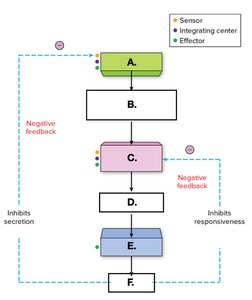
Q11. Identify each labeled component (A–F) of the hypothalamus-pituitary endocrine control pathway.
Background
Topic: Endocrine Physiology
This question tests your knowledge of the hypothalamus-pituitary axis and the feedback mechanisms involved.
Key Terms:
Hypothalamus: Integrating center.
Pituitary gland: Sensor and effector roles.
Negative feedback: Regulation of hormone secretion.
Step-by-Step Guidance
Examine the diagram and identify the role of each labeled box (A–F).
Recall the sequence: hypothalamus → pituitary → target organ → hormone effects.
Use the feedback arrows to help identify regulatory steps.
Try solving on your own before revealing the answer!