 Back
BackHuman Physiology: The Renal System and Fluid & Electrolyte Balance
Study Guide - Smart Notes
 Tailored notes based on your materials, expanded with key definitions, examples, and context.
The Renal System and Water/Ion Balance
Integration of Function
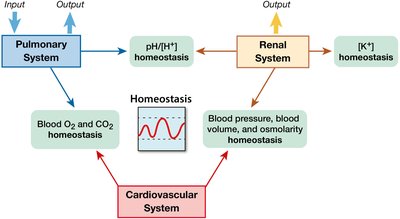
The renal system plays a central role in maintaining homeostasis by regulating blood pressure, blood volume, osmolarity, pH, and ion concentrations. It interacts closely with the pulmonary and cardiovascular systems to achieve these functions.
Homeostasis: The balance of internal conditions, including blood O2, CO2, pH, and ion concentrations.
Renal System Outputs: Regulation of blood pressure, blood volume, osmolarity, pH, and potassium balance.
Cardiovascular System: Delivers blood to the kidneys and responds to changes in blood volume and pressure.
Osmolarity, Osmosis, and Tonicity
Definitions and Concepts
Osmolarity and tonicity are key concepts in understanding water movement across membranes and the effects of different solutions on cells.
Osmolarity: The number of osmoles (particles) per liter of solution. It determines the water gradient across membranes.
Osmolality: Osmoles per kilogram of solvent.
Tonicity: The ability of a solution to affect cell volume, depending on the permeability of solutes.
Isosmotic: Solutions with equal osmolarity.
Hyposmotic: Lower osmolarity than another solution.
Hyperosmotic: Higher osmolarity than another solution.
Example: 150 mM NaCl is 300 mOsm (Na+ and Cl- both contribute), while 300 mM urea is isosmotic but hypotonic because urea can cross cell membranes.
Ion and Water Balance in Animals
Homeostatic Processes
Animals regulate their internal environment through three main processes: osmotic regulation, ionic regulation, and nitrogen excretion. These processes are essential for survival in diverse environments.
Osmotic Regulation: Control of water and solute concentrations.
Ionic Regulation: Maintenance of specific ion concentrations.
Nitrogen Excretion: Removal of nitrogenous wastes.
Osmotic and Ionic Regulation Strategies
Different animal groups employ various strategies to cope with environmental challenges.
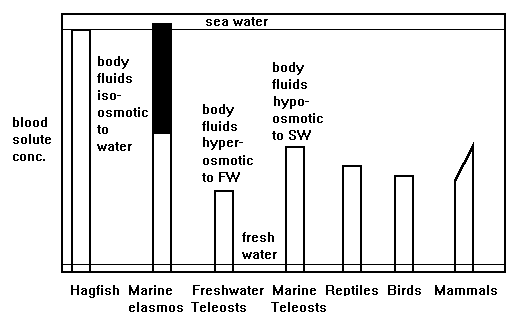
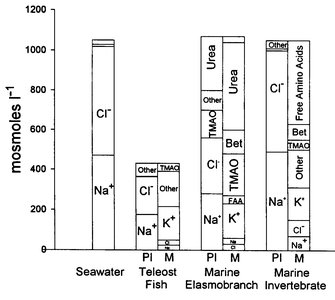
Osmoconformers: Internal osmolarity matches external environment (e.g., marine invertebrates).
Osmoregulators: Maintain constant internal osmolarity regardless of external changes (e.g., teleost fish, mammals).
Ionoconformers: Little control over ion profile; typically marine species.
Ionoregulators: Actively regulate ion concentrations in extracellular fluid.
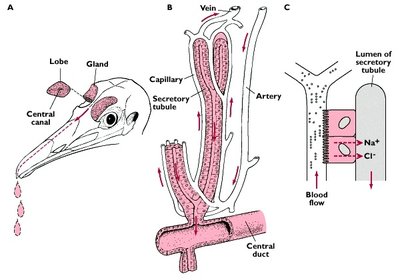
Salt Glands in Reptiles and Birds
Excretion of Hyperosmotic Solutions
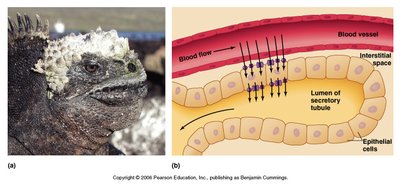
Some reptiles and birds possess specialized salt glands that excrete hyperosmotic solutions of Na+ and Cl-, allowing them to survive in marine environments.
Location: Near the eyes, draining into ducts near the nostrils.
Function: Remove excess salt from the body.
Anatomy and Function of the Urinary System
Overview
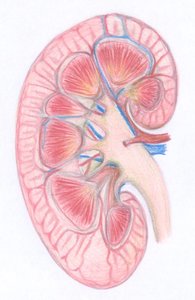
The urinary system consists of paired kidneys, ureters, urinary bladder, and urethra. Its primary function is to filter blood, remove waste, and regulate fluid and electrolyte balance.
Kidneys: Filter plasma and produce urine.
Ureters: Transport urine to the bladder.
Bladder: Stores urine until excretion.
Urethra: Conducts urine out of the body.


Kidney Structure and Function
Roles in Homeostasis
Vertebrate kidneys perform multiple roles in maintaining homeostasis:
Ion balance
Osmotic balance
Blood pressure regulation
pH balance
Excretion of metabolic wastes
Hormone production (e.g., erythropoietin, renin)
Gluconeogenesis during fasting
Nephron: The Functional Unit of the Kidney
Structure and Processes
Each kidney contains about one million nephrons, which are responsible for filtration, reabsorption, secretion, and excretion.
Filtration: Movement of fluid from blood into nephron lumen.
Reabsorption: Return of filtered substances to blood.
Secretion: Active transport of substances from blood into nephron.
Excretion: Removal of waste and excess substances as urine.


Filtration Fraction and Glomerular Filtration Rate (GFR)
Filtration Fraction
Only about 20% of plasma entering the glomerulus is filtered; less than 1% is excreted as urine. The rest is reabsorbed.
Filtration Fraction: Ratio of filtered plasma to total plasma entering the glomerulus.

Glomerular Filtration Rate (GFR)
GFR is the volume of fluid filtered per unit time and is influenced by net filtration pressure and the filtration coefficient.
Net Filtration Pressure: Determined by capillary blood pressure, capillary colloid osmotic pressure, and capsule fluid pressure.
Filtration Coefficient: Depends on surface area and permeability of glomerular capillaries.
Equation:

Autoregulation of GFR
Mechanisms
GFR is maintained relatively constant by three mechanisms:
Myogenic Response: Vascular smooth muscle responds to pressure changes.
Tubuloglomerular Feedback: Macula densa cells detect NaCl and signal granular cells to release renin.
Hormonal and Neural Regulation: Sympathetic innervation and hormones (e.g., angiotensin II, prostaglandins) alter arteriole resistance and filtration coefficient.
Reabsorption and Secretion in the Nephron
Reabsorption
Reabsorption can be active or passive, involving transepithelial transport or paracellular pathways.
Active Transport: Sodium reabsorption creates gradients for other ions and water.
Secondary Active Transport: Symport with sodium moves glucose and amino acids.
Passive Reabsorption: Urea follows concentration gradients.
Endocytosis: Plasma proteins are reabsorbed via receptor-mediated endocytosis.
Secretion
Secretion is the active movement of molecules from extracellular fluid into the nephron lumen, important for homeostatic regulation.
Organic Anion Transporters (OATs): Broad specificity, substrates compete for binding.
Competition: Decreases secretion of some drugs (e.g., penicillin).
Osmolarity Changes Through the Nephron
Concentration and Dilution of Urine
The nephron creates concentrated or dilute urine by varying permeability and active transport of solutes.
Descending Loop of Henle: Water is reabsorbed, increasing osmolarity.
Ascending Loop of Henle: Solutes are actively transported out, decreasing osmolarity.
Distal Tubule and Collecting Duct: Permeability to water is regulated by hormones (e.g., vasopressin).

Countercurrent Mechanisms
Loop of Henle and Vasa Recta
The loop of Henle acts as a countercurrent multiplier, creating a gradient for water reabsorption. The vasa recta removes water and maintains the gradient.
Countercurrent Multiplier: Active transport of solutes in the ascending limb increases medullary osmolarity.
Vasa Recta: Capillaries that remove water and maintain osmotic balance.
Hormonal Regulation of Water and Sodium Balance
Vasopressin (ADH)
Vasopressin increases water reabsorption in the collecting duct by stimulating aquaporin insertion. Its secretion is regulated by blood volume and osmolarity.
Graded Effect: Matches urine concentration to body needs.
Circadian Pattern: Less urine produced at night.
Clinical Application: Bed-wetting in children can be treated with vasopressin derivatives.
Aldosterone
Aldosterone is a steroid hormone produced in the adrenal cortex that increases sodium reabsorption and potassium secretion in the distal tubule and collecting duct.
Stimuli: Low blood pressure, high extracellular potassium.
Targets: Principal cells in the distal tubule.
Mechanism: Increases activity and synthesis of ENaC and ROMK channels and Na+/K+-ATPase pumps.
Renin-Angiotensin System (RAS)
The RAS pathway regulates blood pressure and sodium balance. Renin is released by juxtaglomerular cells in response to low blood pressure, leading to production of angiotensin II, which stimulates aldosterone and vasopressin release.
Effects: Vasoconstriction, increased thirst, increased sodium reabsorption.
Clinical Relevance: ACE inhibitors and ARBs are used to treat hypertension.
Natriuretic Peptides
Atrial and brain natriuretic peptides promote sodium and water excretion, decreasing blood volume and pressure.
Produced by: Atrial and ventricular myocardial cells.
Actions: Dilate afferent arterioles, decrease sodium reabsorption, suppress RAS.
Potassium Balance
Regulation and Clinical Significance
Plasma potassium is tightly regulated, primarily by aldosterone. Disturbances can lead to muscle weakness or cardiac arrhythmias.
Hypokalemia: Low plasma potassium; causes muscle weakness.
Hyperkalemia: High plasma potassium; can cause arrhythmias.
Integrated Control of Volume, Osmolarity, and Blood Pressure
Homeostatic Compensation
Dehydration triggers compensatory responses involving cardiovascular, renal, and endocrine systems. The kidneys play a key role in restoring blood volume and osmolarity.
Diabetes Insipidus: Low vasopressin activity leads to excessive urine production.
SIADH: High vasopressin activity causes water retention.
Summary Table: Osmoregulatory Strategies in Animals
This table compares osmoregulatory strategies and solute concentrations in various animal groups.
Group | Osmoregulatory Strategy | Blood Solute Concentration |
|---|---|---|
Hagfish | Iso-osmotic to seawater | High |
Marine Elasmobranchs | Iso-osmotic to seawater | High (urea, TMAO) |
Freshwater Teleosts | Hyperosmotic to freshwater | Low |
Marine Teleosts | Hypo-osmotic to seawater | Moderate |
Reptiles/Birds/Mammals | Osmoregulators | Variable |


Summary Table: Kidney Processes
This table summarizes the four main processes of the kidney and their direction of movement.
Process | Direction | Description |
|---|---|---|
Filtration | Blood to lumen | Movement of fluid from blood into nephron |
Reabsorption | Lumen to blood | Return of filtered substances to blood |
Secretion | Blood to lumen | Active transport of substances into nephron |
Excretion | Lumen to outside | Removal of waste as urine |
Summary Table: Hormonal Regulation
This table summarizes the main hormones involved in renal regulation.
Hormone | Origin | Action |
|---|---|---|
Vasopressin (ADH) | Posterior pituitary | Increases water reabsorption |
Aldosterone | Adrenal cortex | Increases Na+ reabsorption, K+ secretion |
ANP/BNP | Heart | Promotes Na+ and water excretion |
Renin | Juxtaglomerular cells | Activates RAS pathway |
Summary Table: Osmolarity Changes in the Nephron
This table summarizes osmolarity changes as fluid flows through the nephron.
Segment | Osmolarity | Process |
|---|---|---|
Proximal Tubule | 300 mOsm | Isosmotic reabsorption |
Descending Loop | 1200 mOsm | Water reabsorption |
Ascending Loop | 100 mOsm | Solute reabsorption |
Distal Tubule | Variable | Hormonal regulation |
Collecting Duct | 50-1200 mOsm | Final concentration |
Additional info: Academic context and explanations were expanded for clarity and completeness. Tables were recreated and summarized based on the original content and logical inference.
