 Back
BackImmune Disorders: Hypersensitivity, Immunodeficiency, and Autoimmunity
Study Guide - Smart Notes
 Tailored notes based on your materials, expanded with key definitions, examples, and context.
Immune Disorders
Overview of Immune Disorders
Immune disorders are conditions in which the immune system malfunctions, either by overreacting, failing to respond, or attacking the body's own tissues. These disorders are classified into three main categories: hypersensitivity, immunodeficiency, and autoimmune disorders.
Hypersensitivity disorders: The immune system overreacts or attacks tissues; four types are recognized.
Immunodeficiency disorders: One or more components of the immune system fail, leading to increased susceptibility to infections.
Autoimmune disorders: The immune system becomes self-reactive, attacking the body's own cells.
Hypersensitivity Disorders
Type I: Immediate Hypersensitivity (Allergies)
Type I hypersensitivity, also known as allergies, is characterized by an immediate response to an allergen. This type affects about 20% of the U.S. population and involves the antibody IgE, which sensitizes basophils and mast cells.
IgE: Allergy antibody that coats basophils and mast cells, sensitizing them.
Response: Upon exposure, mast cells and basophils release histamine, leukotrienes, and prostaglandins, causing vasodilation and increased capillary permeability.
Symptoms: Local reactions include runny nose, itchy eyes, and hives; potent reactions include asthma and anaphylactic shock.
Anaphylactic shock: Severe, potentially fatal reaction involving smooth muscle spasm, systemic vasodilation, and increased capillary permeability.
Example: An individual exposed to pollen may develop hay fever, characterized by sneezing and itchy eyes. Severe reactions can lead to anaphylaxis, requiring immediate treatment with epinephrine.
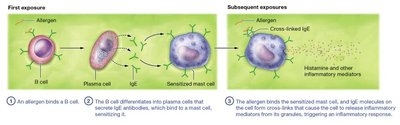
Additional info: The diagram illustrates the process of sensitization and subsequent allergic response, showing the role of IgE and mast cells.
Type II: Antibody-Mediated Hypersensitivity
Type II hypersensitivity occurs when antibodies bind not only to foreign cells but also to self-antigens, leading to tissue damage.
Mechanism: Foreign antigens bind to normal self antigens, or donor erythrocytes have mismatched antigens.
Autoimmunity: Self-reactive B cells are not destroyed, causing autoimmunity.
Treatment: Antibiotics such as Amoxicillin may be used.
Example: Hemolytic disease of the newborn occurs when maternal antibodies attack fetal red blood cells.
Type III: Immune Complex–Mediated Hypersensitivity
Type III hypersensitivity involves immune complexes—clusters of soluble antigens bound to antibodies—that are not easily cleared by phagocytes.
Immune complexes: Can accumulate in capillary beds, kidneys, blood vessel walls, joints, and brain.
Inflammation: Neutrophils gather and cause inflammation.
Example: Systemic lupus erythematosus (SLE) is a disease where immune complexes deposit in tissues, causing widespread inflammation.
Type IV: Delayed-Type Hypersensitivity (DTH)
Type IV hypersensitivity is mediated by T cells rather than antibodies and typically occurs 2-3 days after exposure.
Mechanism: Th cells recognize antigen as foreign, attract macrophages and sometimes Tc cells.
Contact dermatitis: Rash results from dendritic cells presenting foreign substances to Th cells.
Severity: Some DTH reactions, such as tuberculosis, are difficult to deactivate and can be fatal.
Example: Poison ivy exposure leads to a delayed skin rash due to T cell-mediated response.
Allergy Treatments
Various treatments are available for allergies, targeting different mediators of the allergic response.
Antihistamines: Block histamine, but may cause drowsiness.
Antileukotriene agents: Block leukotriene production, preventing allergy response.
Corticosteroids: Block leukotrienes and prostaglandins; commonly used for asthma.
Allergen immunotherapy: Allergy shots to increase tolerance and diminish IgE response.
Immunodeficiency Disorders
Primary Immunodeficiency Disorders
Primary immunodeficiency disorders are genetic or developmental, resulting in improper formation of immune system components.
Innate immunity: Defects in complement proteins or phagocytes increase risk of bacterial and parasitic infections.
Adaptive immunity: Examples include SCID (severe combined immunodeficiency), leukopenia, and hypogammaglobulinemia.
Example: SCID patients have failures in lymphoid cell lines, leading to recurrent infections.
Secondary Immunodeficiency Disorders
Secondary immunodeficiency disorders are acquired, often resulting from cancer, treatments, or infections such as HIV/AIDS.
Induced: Artificially induced to fight cancer or prevent transplant rejection.
AIDS: Most common secondary immunodeficiency, caused by HIV-1.
HIV-1: Retrovirus that binds to CD4 molecules on Th cells, monocytes, macrophages, and dendritic cells.
Mechanism: HIV-1 uses reverse transcription (), inserts DNA into host genome, leading to cell death and infection spread.
Stages of HIV-1 Infection:
Acute phase: 3 months; sharp decline in Th cells, rise in HIV-1 virions, flu-like symptoms.
Chronic phase: 8+ years untreated; antibody production, slight Th cell recovery, decline in virions.
AIDS: 3 or fewer years untreated; rapid Th cell decline, increased virions.
AIDS Symptoms: Recurrent infections, Kaposi sarcoma, muscle wasting, nervous system damage.
Treatments: Drug therapy cocktails inhibit reverse transcriptase, viral enzymes, and block HIV-1 entry. High mutation rate complicates vaccine development.
Autoimmune Disorders
Mechanisms and Examples
Autoimmune disorders occur when self-reactive T or B cells attack the body's own tissues, often due to genetic predisposition.
Autoantibodies: Antibodies that bind to self antigens.
Hypersensitivity: Can create Type II, III, or IV hypersensitivity reactions.
Situations Leading to Autoimmunity:
Release of self antigens not previously encountered by T cells (e.g., multiple sclerosis).
Foreign antigens mimic self antigens (e.g., rheumatic fever).
Inappropriate expression of Class II MHC molecules (e.g., Type I diabetes).
Pathogens nonspecifically activate B cells, leading to autoantibody production.
Example: In Type I diabetes, immune cells attack insulin-producing cells in the pancreas.
Summary Table: Types of Hypersensitivity
Type | Mechanism | Key Cells/Antibodies | Examples |
|---|---|---|---|
I (Immediate) | IgE-mediated, mast cell activation | IgE, mast cells, basophils | Allergies, anaphylaxis |
II (Antibody-mediated) | Antibodies bind to self/foreign antigens | IgG, IgM, B cells | Hemolytic disease, transfusion reactions |
III (Immune complex-mediated) | Immune complexes deposit in tissues | Antigen-antibody complexes, neutrophils | SLE, glomerulonephritis |
IV (Delayed-type) | T cell-mediated response | Th cells, macrophages | Contact dermatitis, tuberculosis |
Additional info: This table summarizes the four types of hypersensitivity, their mechanisms, key cells, and examples.
