Back
Infection, Infectious Diseases, and Epidemiology: Core Concepts and Mechanisms
Study Guide - Smart Notes
 Tailored notes based on your materials, expanded with key definitions, examples, and context.
Infection and Disease: Definitions and Distinctions
Understanding Infection and Disease
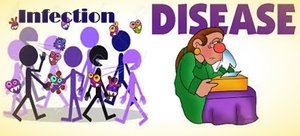
Infection refers to the invasion of a host organism by pathogenic microorganisms, such as bacteria, viruses, fungi, or parasites. Disease develops when the invading pathogen disrupts normal body functions, leading to noticeable clinical symptoms or signs.
Infection: The presence and multiplication of a pathogen in the body, which may or may not result in disease.
Disease: The condition in which infection leads to impaired body function, often accompanied by symptoms and signs.
Not all infections result in disease; some may be asymptomatic or subclinical.
Pathogenicity and Virulence
Key Concepts in Microbial Pathogenesis
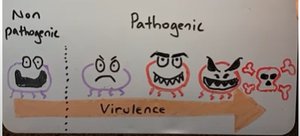
Pathogenicity and virulence are terms used to describe the ability of microorganisms to cause disease and the severity of the disease they cause.
Pathogenicity: The ability of a microbe to cause disease (a qualitative trait: yes or no).
Virulence: The degree of pathogenicity, or the extent of damage a pathogen can cause (a quantitative trait: mild to severe).
Virulence factors: Molecules or structures that enable pathogens to establish infection, invade tissues, evade the immune system, or damage the host.
Virulence Factors
Attachment Factors
Attachment factors enable pathogens to adhere to host cells, a critical first step in establishing infection. These include specialized structures and molecules on the microbial surface.
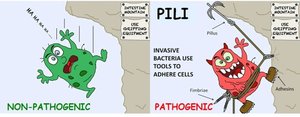
Adhesins: Surface proteins or appendages that facilitate attachment to host tissues.
Pili and fimbriae: Hair-like structures that help bacteria adhere to specific cell types.
Invasion Factors
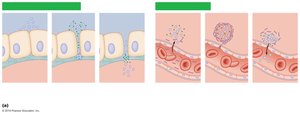
Invasion factors allow pathogens to penetrate and spread within host tissues, often by breaking down physical barriers.
Destructive enzymes: Such as hyaluronidase and collagenase, which degrade connective tissue components, facilitating deeper tissue invasion.
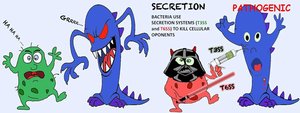
Secretion systems: Molecular syringes (e.g., Type III secretion system) that inject proteins into host cells to manipulate or kill them.
Immune Evasion Factors
Pathogens have evolved mechanisms to avoid detection and destruction by the host immune system.
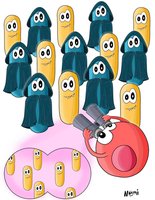
Capsules: Thick, gelatinous layers (glycocalyces) that mask bacterial surface antigens, making them less recognizable to phagocytes.
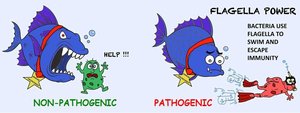
Flagella: Motility structures that help bacteria escape immune cells or reach favorable environments.
Toxins
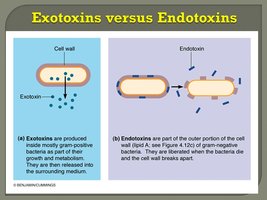
Toxins are chemicals produced by pathogens that directly damage host tissues or trigger harmful immune responses. They are classified as exotoxins or endotoxins.
Exotoxins: Proteins secreted by mostly Gram-positive bacteria; they have specific targets and effects (e.g., neurotoxins, enterotoxins).
Endotoxins: Lipopolysaccharide (LPS) components of the outer membrane of Gram-negative bacteria; released upon bacterial cell death, causing generalized effects such as fever, diarrhea, and shock.
Signs, Symptoms, and Syndromes
Clinical Manifestations of Disease
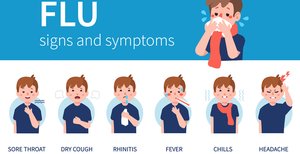
Diseases are characterized by a combination of signs and symptoms, which together may define a syndrome.
Signs: Objective, observable, and measurable indicators of disease (e.g., fever, rash).
Symptoms: Subjective experiences reported by the patient (e.g., pain, fatigue).
Syndrome: A set of characteristic signs and symptoms associated with a particular disease.
Stages of Infectious Disease
Progression of Disease After Infection
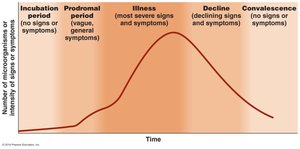
Infectious diseases typically progress through five distinct stages, each with characteristic features.
Incubation period: Time between pathogen entry and appearance of symptoms; no signs or symptoms present.
Prodromal period: Onset of vague, general symptoms (e.g., malaise).
Illness: Most severe stage, with characteristic signs and symptoms.
Decline: Signs and symptoms begin to subside as the immune response or treatment takes effect.
Convalescence: Recovery phase; body returns to normal, and symptoms disappear.
Portals of Exit
How Pathogens Leave the Host
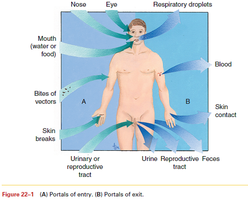
Portals of exit are routes by which pathogens exit the host to infect new individuals. These often overlap with portals of entry.
Secretions: Saliva, sputum, respiratory droplets.
Excretions: Urine, feces.
Bodily fluids: Blood, cerebrospinal fluid (CSF), vaginal secretions, semen.
Common portals: Respiratory tract, gastrointestinal tract, urogenital tract, skin, and blood.