Back
Innate and Adaptive Immunity: The Immune System and Body Defenses
Study Guide - Smart Notes
 Tailored notes based on your materials, expanded with key definitions, examples, and context.
Innate (Nonspecific) Defenses
Species Specificity
Some organisms are naturally resistant to diseases that affect other species. This resistance is due to genetic differences and physiological barriers that prevent cross-species infections.
Key Point: Humans are not susceptible to many animal diseases, and vice versa.
First Line of Defense: Mechanical Barriers
The skin and mucous membranes act as physical barriers to pathogens, preventing their entry into the body. These are considered the body's first line of defense.
Key Point: Intact skin and mucosa block most pathogens.
Key Point: Other nonspecific defenses are considered part of the second line.
Second Line of Defense: Chemical Barriers
Chemical substances in body fluids provide additional protection against pathogens.
Interferons: Proteins that stimulate phagocytosis and interfere with viral replication.
Defensins: Peptides that rupture microbial membranes.
Complement: A group of proteins that enhance inflammation, attract phagocytes, and promote phagocytosis.
Collectins: Proteins that bind to a wide range of microbes, aiding in their clearance.
Transferrin: Binds iron, reducing its availability to bacteria and inhibiting their growth.
Second Line of Defense: Natural Killer (NK) Cells
NK cells are a type of lymphocyte that target virus-infected and cancerous cells. They release cytolytic substances called perforins, which destroy infected cells.
Key Point: NK cells act similarly to defensins by rupturing cell membranes.
Second Line of Defense: Inflammation
Inflammation is a localized response to injury or infection, characterized by redness, swelling, heat, and pain. These signs are traditionally named in Latin: rubor (redness), tumor (swelling), dolor (pain), and calor (heat).
Key Point: Inflammation helps isolate and eliminate pathogens and initiates tissue repair.
Second Line of Defense: Phagocytosis
Phagocytic cells, such as neutrophils and monocytes, ingest and destroy pathogens. Chemotaxis is the process by which these cells are attracted to the site of injury by chemical signals.
Key Point: Phagocytosis is essential for clearing infections and cellular debris.
Second Line of Defense: Fever
A fever is triggered when infections stimulate lymphocytes to release interleukin-1 (IL-1), which raises body temperature. Elevated temperature can inhibit pathogen growth and enhance immune responses.
Key Point: Fever is a systemic response to infection.
Adaptive (Specific) Defenses or Immunity
Third Line of Defense: Immunity
Adaptive immunity is the body's ability to recognize and remember specific pathogens, distinguishing "self" from "non-self." This response is mediated by lymphocytes and involves the production of antibodies.
Antigens: Molecules on cell surfaces that trigger immune responses. The most effective antigens are large and complex.
Lymphocyte Origins
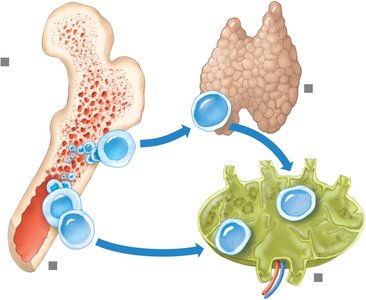
Lymphocytes originate from stem cells in the red bone marrow. They differentiate into B cells or T cells depending on their maturation site.
B cells: Mature in the bone marrow.
T cells: Mature in the thymus.
Both cell types circulate in the blood and reside in lymphatic organs.
T Cells and the Cellular Immune Response
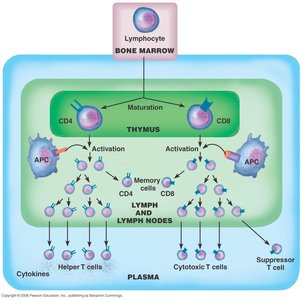
T cells must be activated before responding to antigens. Activation requires two signals: recognition of antigen presented by an antigen-presenting cell (APC) with MHC molecules, and a costimulatory signal (often cytokines).
Helper T cells (CD4): Activate other T cells and B cells; essential for immune response; targeted by HIV.
Cytotoxic T cells (CD8): Destroy infected or abnormal cells by releasing granules that cause cell lysis.
Memory T cells: Provide rapid response upon re-exposure to the same antigen.
B Cells and the Humoral Immune Response
B cells are activated when their receptors bind to specific antigens, often with help from helper T cells. Activated B cells differentiate into plasma cells (which secrete antibodies) and memory B cells.
Plasma cells: Produce and secrete antibodies (immunoglobulins).
Memory B cells: Provide long-term immunity by responding quickly to future exposures.
Major Immunoglobulins (Antibody Classes)
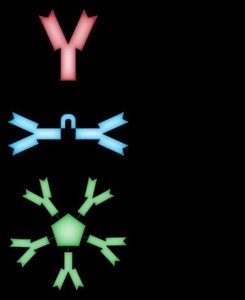
IgG: Crosses the placenta; effective against bacteria, viruses, and toxins.
IgM: First antibody produced in response to infection; includes anti-A and anti-B antibodies.
IgA: Found in body fluids such as saliva, tears, and breast milk.
IgD: Present on B cell surfaces; involved in B cell activation.
IgE: Involved in allergic reactions (e.g., hay fever).
How Antibodies Work
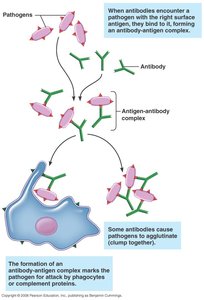
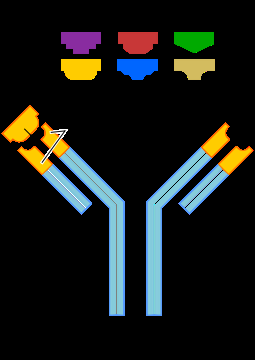
Antibodies bind to specific antigens, forming antigen-antibody complexes. These complexes can neutralize pathogens, cause them to clump (agglutinate), or mark them for destruction by phagocytes or complement proteins.
Key Point: Antibodies are crucial for targeting extracellular pathogens.
Primary and Secondary Immune Responses
The primary immune response occurs after the first exposure to an antigen and is slower and less intense. The secondary response, upon re-exposure, is faster and stronger due to memory cells.
Key Point: Immunological memory is the basis for effective vaccination.
Practical Classification of Immunity
Naturally Acquired Active Immunity: Results from exposure to a live pathogen (infection).
Artificially Acquired Active Immunity: Results from vaccination with weakened or dead pathogens.
Artificially Acquired Passive Immunity: Involves injection of antibodies (e.g., antiserum).
Naturally Acquired Passive Immunity: Antibodies passed from mother to child via placenta or breast milk.
Hypersensitivity (Allergic) Reactions
Hypersensitivity reactions are exaggerated immune responses to harmless antigens (allergens). They are classified into four types:
Type I: Immediate (minutes); includes hives, hay fever, asthma, anaphylaxis.
Type II: Cytotoxic (1-3 hours); e.g., transfusion reactions.
Type III: Immune-complex (1-3 hours); e.g., rheumatoid arthritis.
Type IV: Delayed (about 48 hours); e.g., contact dermatitis (poison ivy).
Transplantation and Tissue Rejection
Tissue rejection occurs when the recipient's immune system attacks transplanted tissue recognized as foreign. Graft-versus-host disease (GVHD) happens when donor immune cells attack the recipient. Matching MHC antigens and using immunosuppressive drugs help prevent rejection.
Key Point: Immune suppression increases risk of infection but is necessary to prevent rejection.
Autoimmunity
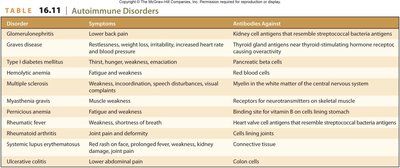
Autoimmune diseases occur when the immune system fails to recognize "self" and attacks the body's own tissues, producing autoantibodies and cytotoxic T cells against self-antigens.
Disorder | Symptoms | Antibodies Against |
|---|---|---|
Glomerulonephritis | Lower back pain | Kidney cell antigens that resemble streptococcal bacteria antigens |
Graves disease | Restlessness, weight loss, irritability, increased heart rate and blood pressure | Thyroid gland antigens near thyroid-stimulating hormone receptor; causing overactivity |
Type 1 diabetes mellitus | Thirst, hunger, weakness, emaciation | Pancreatic beta cells |
Hemolytic anemia | Fatigue and weakness | Red blood cells |
Multiple sclerosis | Weakness, incoordination, speech disturbances, visual complaints | Myelin in the white matter of the central nervous system |
Myasthenia gravis | Muscle weakness | Receptors for acetylcholine on skeletal muscle |
Pernicious anemia | Fatigue and weakness | Binding site for vitamin B12 on cells lining stomach |
Rheumatic fever | Weakness, aches, shortness of breath | Heart valve cell antigens that resemble streptococcal bacteria antigens |
Rheumatoid arthritis | Joint pain and deformity | Cells lining joints |
Systemic lupus erythematosus | Red rash on face, prolonged fever, weakness, kidney damage, joint pain | Connective tissue |
Ulcerative colitis | Lower abdominal pain | Colon cells |