 Back
BackGI Tract 6 - March 13
Study Guide - Smart Notes
 Tailored notes based on your materials, expanded with key definitions, examples, and context.
Integrated Function of the Small and Large Intestine
Overview of Gastrointestinal Anatomy
The gastrointestinal (GI) tract is responsible for the digestion and absorption of nutrients, as well as the concentration and elimination of waste. The small intestine is the primary site for nutrient absorption, while the large intestine concentrates waste and absorbs water and ions.
Protein Digestion and Absorption
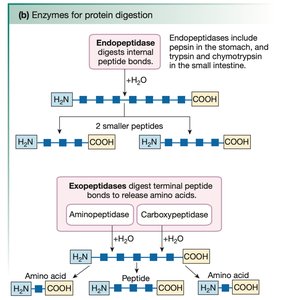
Proteins are broken down into smaller peptides and amino acids by specific enzymes. The process involves both endopeptidases and exopeptidases, which act at different sites on the protein molecule.
Endopeptidases: Digest internal peptide bonds (e.g., pepsin, trypsin, chymotrypsin).
Exopeptidases: Digest terminal peptide bonds to release amino acids (e.g., aminopeptidase, carboxypeptidase).
Absorption: Most protein digestion results in free amino acids, dipeptides, and tripeptides. Single amino acids are absorbed via Na+ cotransporters, while di- and tripeptides use H+ cotransporters.
Transcytosis: Some peptides larger than three amino acids are absorbed by transcytosis, which may play a role in food allergies.
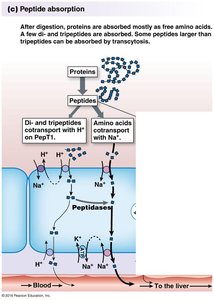
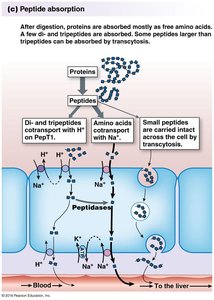
Example: Peptidases within enterocytes further break down di- and tripeptides to single amino acids before they exit the cell.
Vitamin and Mineral Absorption
Vitamins and minerals are absorbed in the small intestine through various mechanisms. Fat-soluble vitamins (A, D, E, K) are absorbed with dietary fats, while water-soluble vitamins (C and most B) are absorbed by mediated transport. Vitamin B12 requires intrinsic factor for absorption in the ileum.
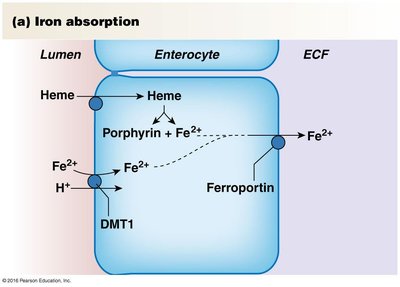
Mineral absorption: Most minerals are absorbed by active transport. Iron is absorbed via divalent metal transporter 1 (DMT1) and regulated by hormones such as hepcidin.
Ion and Water Absorption
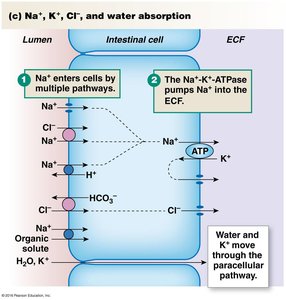
Most water absorption occurs in the small intestine, driven by osmotic gradients created by nutrient and ion absorption. Similar mechanisms exist in the colon.
Na+, K+, Cl- absorption: Sodium enters cells by multiple pathways and is pumped out by Na+-K+-ATPase. Water and potassium move through paracellular pathways.
Regulation of the Intestinal Phase
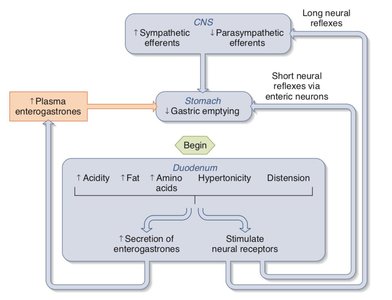
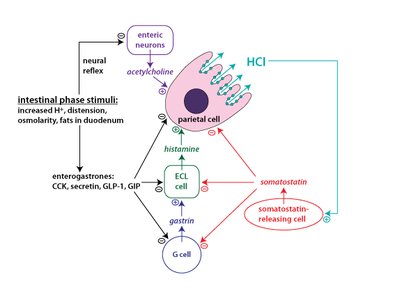
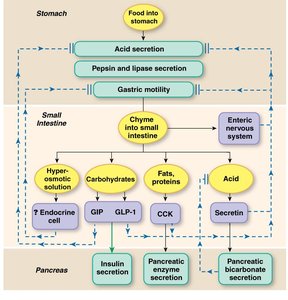
The intestinal phase is regulated by distention, acidity, and digestive products in the small intestine through short and long reflexes and endocrine signaling. This phase reduces motility and secretions in the stomach and increases them in the intestine.
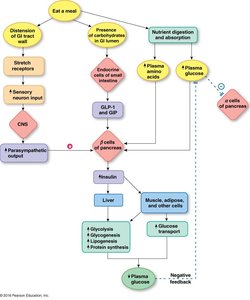
Enterogastrones: Hormones such as secretin, cholecystokinin (CCK), GIP, and GLP-1 regulate motility and secretion.
Neural regulation: Intestinal motility is influenced primarily by enteric nervous system (ENS) neurons, especially the myenteric plexus.
Accessory Secretions and Hormonal Regulation
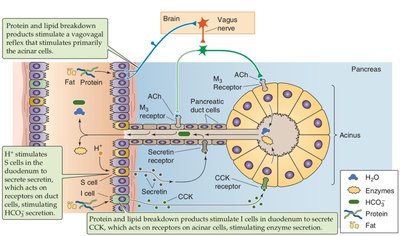
Accessory glands such as the pancreas and liver secrete enzymes and bicarbonate, regulated by hormones and neural reflexes.
Secretin: Stimulates bicarbonate secretion from the pancreas and bile secretion from the liver; inhibits gastric acid secretion and motility.
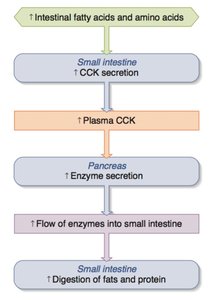
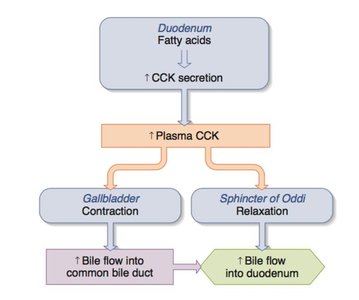
Cholecystokinin (CCK): Regulates pancreatic enzyme secretion and bile secretion; inhibits gastric acid production and emptying.
GIP and GLP-1: Inhibit gastric acid secretion and motility; play a role in glucose homeostasis.
Integration of Gastric and Intestinal Phases
Acid, enzymes, and digested food in the small intestine result in hyperosmotic chyme, which inhibits gastric emptying via the enterogastric reflex. This reflex is stimulated by distension and acidity in the intestine.
The Large Intestine: Concentration of Waste
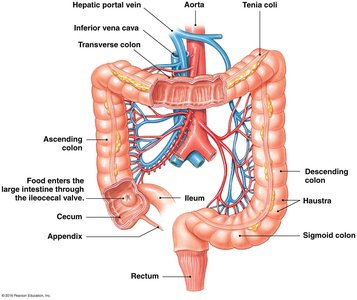
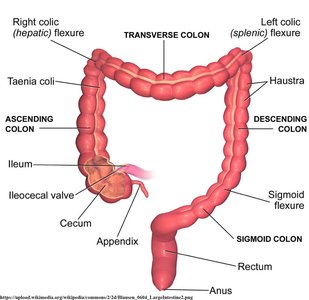
The large intestine stores and concentrates fecal matter. Approximately 1.5 L of chyme enters the large intestine daily, and most ions and water are absorbed, leaving about 0.1 L at the end. The large intestine lacks villi and has minimal secretions, primarily mucus.
Motility: Includes slow segmental contractions (haustral churning) and mass peristalsis (gastrocolic reflex).
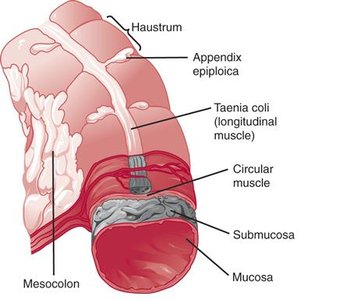
Structure: Features circular muscle and thickened bands of longitudinal muscle (taenia coli), creating pouches called haustra.
Secretions and Digestion in the Large Intestine
Traditionally, the large intestine was believed to have no digestive function. However, indigestible carbohydrates, fats, and proteins are broken down by bacteria through fermentation, producing lactate, short-chain fatty acids, absorbable vitamins (e.g., vitamin K), and gases.
Gut flora: The large intestine contains a diverse population of bacteria that aid in fermentation and vitamin production.
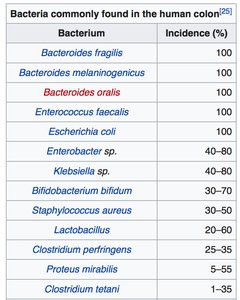
Bacterium | Incidence (%) |
|---|---|
Bacteroides fragilis | 100 |
Bacteroides melaninogenicus | 100 |
Bacteroides oralis | 100 |
Enterococcus faecalis | 100 |
Escherichia coli | 100 |
Enterobacter sp. | 40-80 |
Klebsiella sp. | 40-80 |
Bifidobacterium bifidum | 50-60 |
Staphylococcus aureus | 30-50 |
Lactobacillus | 20-60 |
Clostridium perfringens | 25-35 |
Proteus mirabilis | 5-55 |
Clostridium tetani | 1-35 |
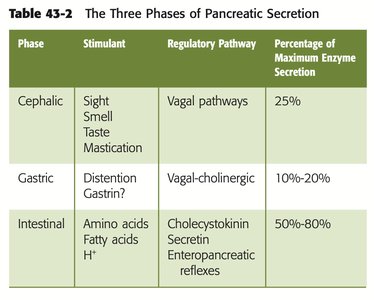
Summary Table: Phases of Pancreatic Secretion
The pancreas secretes digestive enzymes in three phases: cephalic, gastric, and intestinal. Each phase is regulated by specific stimuli and pathways.
Phase | Stimulant | Regulatory Pathway | Percentage of Maximum Enzyme Secretion |
|---|---|---|---|
Cephalic | Sight, Smell, Taste, Mastication | Vagal pathways | 25% |
Gastric | Distension, Gastrin? | Vagal-cholinergic | 10%-20% |
Intestinal | Amino acids, Fatty acids, H+ | Cholecystokinin, Secretin, Enteropancreatic reflexes | 50%-80% |
Key Equations
Osmosis and transport equations are fundamental to understanding absorption:
Osmosis:
Na+-K+ ATPase:
Additional info: The notes integrate content from Ch. 21 (The Digestive System), Ch. 22 (Metabolism and Energy Balance), and Ch. 20 (Fluid and Electrolyte Balance), providing a comprehensive overview of intestinal physiology relevant to ANP college courses.
