 Back
Intro to Anatomy Test – Step-by-Step Study Guidance
Study Guide - Smart Notes
 Tailored notes based on your materials, expanded with key definitions, examples, and context.
Q1. Which system of the body contains glands and hormones?
Background
Topic: Body Systems – Endocrine System
This question tests your knowledge of the major body systems and their functions, specifically focusing on the system responsible for glands and hormone production.
Key Terms:
Endocrine System: A network of glands that produce and release hormones to regulate bodily functions.
Hormones: Chemical messengers that travel through the bloodstream to target organs.
Step-by-Step Guidance
Recall the main function of each body system listed in the options.
Identify which system is primarily responsible for hormone production and secretion.
Think about examples of glands (like the pituitary, thyroid, adrenal) and which system they belong to.
Try solving on your own before revealing the answer!
Final Answer: b) endocrine system
The endocrine system contains glands that produce hormones, which regulate many bodily functions.
Q2. Which system of the body is responsible for fighting infection?
Background
Topic: Body Systems – Immune Function
This question tests your understanding of which body system is involved in defending against pathogens and infection.
Key Terms:
Lymphatic System: Includes lymph nodes, vessels, and organs that help fight infection.
Immune Response: The body's defense mechanism against harmful invaders.
Step-by-Step Guidance
Review the functions of each system listed in the options.
Identify which system is most directly involved in immune defense.
Recall the role of lymph nodes and white blood cells in fighting infection.
Try solving on your own before revealing the answer!
Final Answer: d) lymphatic system
The lymphatic system is responsible for fighting infection and supporting immune function.
Q3. A group of similar cells working together is called a(n)...
Background
Topic: Levels of Organization
This question tests your understanding of the hierarchy of biological organization, specifically the definition of tissue.
Key Terms:
Tissue: A group of similar cells performing a specific function.
Organ: Structure made of different tissues working together.
Step-by-Step Guidance
Recall the levels of organization: cell, tissue, organ, system, organism.
Identify which level involves similar cells working together.
Compare the definitions of organ, tissue, and organism.
Try solving on your own before revealing the answer!
Final Answer: b) tissue
A tissue is a group of similar cells working together to perform a specific function.
Q4. If a doctor is comparing the size of one person’s brain to another, this would be part of...
Background
Topic: Anatomy vs. Physiology
This question tests your understanding of the difference between anatomy (structure) and physiology (function).
Key Terms:
Anatomy: Study of body structure.
Physiology: Study of body function.
Step-by-Step Guidance
Recall the definitions of anatomy and physiology.
Determine whether comparing size is about structure or function.
Think about examples of anatomical vs. physiological studies.
Try solving on your own before revealing the answer!
Final Answer: a) anatomy
Comparing the size of organs is a study of anatomy, which focuses on structure.
Q5. Consider the following levels of organization: (1) cell, (2) organ, (3) mitochondria, (4) organism, (5) tissue, (6) system. Which is the correct order from smallest to largest?
Background
Topic: Levels of Biological Organization
This question tests your ability to sequence the levels of organization in the human body from smallest to largest.
Key Terms:
Mitochondria: Organelle within a cell.
Cell: Basic unit of life.
Tissue: Group of similar cells.
Organ: Structure made of tissues.
System: Group of organs working together.
Organism: Complete living being.
Step-by-Step Guidance
List the levels from smallest (organelle) to largest (organism).
Arrange mitochondria, cell, tissue, organ, system, organism in order.
Check each answer choice for the correct sequence.
Try solving on your own before revealing the answer!
Final Answer: d) 3, 1, 5, 2, 6, 4
The correct order is: mitochondria, cell, tissue, organ, system, organism.
Q6. Which of the following organs would be found within the dorsal cavity?
Background
Topic: Body Cavities
This question tests your knowledge of anatomical body cavities and the organs they contain.
Key Terms:
Dorsal Cavity: Includes cranial and spinal cavities.
Abdominal Cavity: Contains digestive organs.
Step-by-Step Guidance
Recall which organs are located in the dorsal cavity (brain and spinal cord).
Identify which option matches an organ in the dorsal cavity.
Eliminate organs found in other cavities.
Try solving on your own before revealing the answer!
Final Answer: d) brain
The brain is located in the cranial portion of the dorsal cavity.
Q7. Which of the following organs would be found within the abdominal cavity?
Background
Topic: Body Cavities
This question tests your knowledge of the organs located in the abdominal cavity.
Key Terms:
Abdominal Cavity: Contains digestive organs like stomach, intestines, liver, and reproductive organs like ovaries.
Step-by-Step Guidance
Recall which organs are located in the abdominal cavity.
Identify which option matches an organ in the abdominal cavity.
Eliminate organs found in other cavities.
Try solving on your own before revealing the answer!
Final Answer: a) stomach
The stomach is located in the abdominal cavity.
Q8. Which body cavity contains all others listed here?
Background
Topic: Body Cavities – Hierarchy
This question tests your understanding of the relationships between body cavities.
Key Terms:
Ventral Cavity: Contains thoracic, abdominal, and pelvic cavities.
Pleural: Contains lungs.
Mediastinum: Central compartment of thoracic cavity.
Thoracic: Contains pleural and mediastinum.
Step-by-Step Guidance
Recall the hierarchy of body cavities.
Identify which cavity is the largest and contains the others.
Check each answer choice for inclusion of other cavities.
Try solving on your own before revealing the answer!
Final Answer: d) ventral
The ventral cavity contains the thoracic, pleural, and mediastinum cavities.
Q9. Examine this DNA strand: TACCTGGCA. The sequence that would be found on the other side of the DNA molecule would be:
Background
Topic: DNA Base Pairing
This question tests your understanding of complementary base pairing in DNA.
Key Terms:
Base Pairing: Adenine (A) pairs with Thymine (T), Cytosine (C) pairs with Guanine (G).
DNA: Double-stranded molecule with complementary sequences.
Step-by-Step Guidance
Write out the original DNA sequence.
Match each base with its complement: A-T, T-A, C-G, G-C.
Construct the complementary strand using these rules.
Try solving on your own before revealing the answer!
Final Answer: b) ATGGACCGT
The complementary DNA strand is formed by matching each base with its pair.
Q10. Which of the following is NOT a correct match between the term and its description?
Background
Topic: Cell Processes
This question tests your knowledge of mitosis, transcription, translation, and passive transport.
Key Terms:
Mitosis: Division of somatic cells.
Transcription: Copying DNA into mRNA.
Passive Transport: Movement from high to low concentration.
Translation: Creation of amino acid chain from mRNA.
Step-by-Step Guidance
Review the definitions of each process.
Identify which description does not match the term.
Check for errors in the direction of transport or process description.
Try solving on your own before revealing the answer!
Final Answer: c) passive transport – the movement of molecules from low to high concentration
Passive transport moves molecules from high to low concentration, not low to high.
Q11. Which of the following is NOT one of the 4 major categories of tissues found in the human body?
Background
Topic: Tissue Types
This question tests your knowledge of the four major tissue types: epithelial, connective, muscle, and nervous.
Key Terms:
Epithelial: Covers surfaces.
Muscular: Contracts for movement.
Nervous: Conducts impulses.
Connective: Supports and binds.
Step-by-Step Guidance
Recall the four major tissue types.
Identify which option is not a major tissue type.
Compare each option to the list of major tissues.
Try solving on your own before revealing the answer!
Final Answer: b) vascular
Vascular is not a major tissue type; connective tissue includes blood vessels.
Q12. The type of tissue that you would find lining the pelvic cavity is...
Background
Topic: Tissue Types – Epithelial
This question tests your knowledge of which tissue lines body cavities.
Key Terms:
Epithelial Tissue: Lines cavities and surfaces.
Step-by-Step Guidance
Recall which tissue type lines internal cavities.
Identify the function of epithelial tissue.
Eliminate other tissue types based on their primary functions.
Try solving on your own before revealing the answer!
Final Answer: c) epithelial
Epithelial tissue lines the pelvic cavity and other internal surfaces.
Q13. Meiosis would be a common process in which body system?
Background
Topic: Cell Division – Meiosis
This question tests your understanding of where meiosis occurs in the body.
Key Terms:
Meiosis: Cell division producing gametes (sperm and egg).
Reproductive System: Responsible for producing gametes.
Step-by-Step Guidance
Recall the purpose of meiosis.
Identify which system produces gametes.
Eliminate systems not involved in gamete production.
Try solving on your own before revealing the answer!
Final Answer: a) reproductive
Meiosis occurs in the reproductive system to produce gametes.
Q14. The screen is an example of a...
Background
Topic: Membranes – Permeability
This question tests your understanding of membrane types and their permeability.
Key Terms:
Semipermeable Membrane: Allows some substances to pass through.
Visceral/Parietal Membrane: Related to organs and body cavities.
Step-by-Step Guidance
Recall the definition of semipermeable membrane.
Identify which option best describes a screen that lets some particles through.
Eliminate options not related to permeability.
Try solving on your own before revealing the answer!
Final Answer: c) semipermeable membrane
A screen acts as a semipermeable membrane, allowing some particles to pass.
Q15. The movement of the pollen is an illustration of...
Background
Topic: Transport Mechanisms
This question tests your understanding of passive and active transport, diffusion, and membrane permeability.
Key Terms:
Passive Transport: Movement without energy input.
Simple Diffusion: Movement from high to low concentration.
Facilitated Diffusion: Uses proteins to help movement.
Active Transport: Requires energy.
Step-by-Step Guidance
Recall the definitions of passive and active transport.
Identify which process describes movement through a screen without energy.
Eliminate options that require energy or special proteins.
Try solving on your own before revealing the answer!
Final Answer: d) simple diffusion
Pollen moves through the screen by simple diffusion, a passive process.
Q16. Which of the following body parts is inferior to the heart?
Background
Topic: Anatomical Directions
This question tests your understanding of anatomical terms like inferior, superior, lateral, and proximal.
Key Terms:
Inferior: Below another structure.
Superior: Above another structure.
Step-by-Step Guidance
Recall the definition of inferior.
Identify which body part is located below the heart.
Eliminate options above or lateral to the heart.
Try solving on your own before revealing the answer!
Final Answer: b) stomach
The stomach is located inferior to the heart.
Q17. Which of the following body parts is lateral to the heart?
Background
Topic: Anatomical Directions
This question tests your understanding of the term lateral, meaning away from the midline.
Key Terms:
Lateral: Away from the midline.
Medial: Toward the midline.
Step-by-Step Guidance
Recall the definition of lateral.
Identify which body part is located to the side of the heart.
Eliminate options that are medial or inferior.
Try solving on your own before revealing the answer!
Final Answer: c) lungs
The lungs are lateral to the heart.
Q18. Which of the following body parts is proximal to the elbow?
Background
Topic: Anatomical Directions – Proximal/Distal
This question tests your understanding of the term proximal, meaning closer to the point of attachment.
Key Terms:
Proximal: Closer to the trunk or point of attachment.
Distal: Farther from the trunk or point of attachment.
Step-by-Step Guidance
Recall the definition of proximal.
Identify which body part is closer to the shoulder than the elbow.
Eliminate options that are distal to the elbow.
Try solving on your own before revealing the answer!
Final Answer: d) shoulder
The shoulder is proximal to the elbow.
Q19. If someone sliced you between the eyes and directly downwards, what type of plane would that be?
Background
Topic: Anatomical Planes
This question tests your understanding of anatomical planes: sagittal, frontal, and transverse.
Key Terms:
Median/Midsagittal Plane: Divides body into left and right halves.
Frontal Plane: Divides body into front and back.
Transverse Plane: Divides body into top and bottom.
Step-by-Step Guidance
Recall the definitions of anatomical planes.
Identify which plane divides the body into left and right halves.
Eliminate planes that divide front/back or top/bottom.
Try solving on your own before revealing the answer!
Final Answer: a) median/midsagittal
The median/midsagittal plane divides the body into left and right halves.
Q20. Which is the deepest membrane of those listed here?
Background
Topic: Membranes – Parietal vs. Visceral
This question tests your understanding of the layers of serous membranes.
Key Terms:
Parietal Serosa: Lines cavity walls.
Visceral Serosa: Covers organs directly.
Serous Fluid: Lubricates between layers.
Step-by-Step Guidance
Recall the arrangement of serous membranes.
Identify which membrane is closest to the organ.
Eliminate membranes that are more superficial.
Try solving on your own before revealing the answer!
Final Answer: c) visceral serosa
The visceral serosa is the deepest, covering the organs directly.
Matching: Match the following life function to the example that correctly describes it.
Background
Topic: Life Functions
This section tests your ability to match life functions (like movement, responsiveness, digestion) to real-life examples.
Key Terms:
Life Functions: Maintaining boundaries, movement, responsiveness, digestion, metabolism, excretion, reproduction, growth.
Step-by-Step Guidance
Review the definition of each life function.
Read each example and match it to the correct function.
Eliminate options that do not fit the description.
Try matching on your own before revealing the answer!
Final Answer:
Maintaining boundaries – g) bacteria from a door handle does not penetrate the skin
Movement – c) skeletal muscles are used to walk across the room
Responsiveness – f) you turn towards a sudden noise
Digestion – b) the nutrients from your lunch are absorbed into the blood
Metabolism – e) glucose is combined to form glycogen for energy storage
Excretion – d) as you run, sweat forms on your forehead
Reproduction – a) a mouse has a litter of babies
Growth – h) hormones increase the rate of mitosis, making you taller
Terms: Based on the prefixes and suffixes you’ve learned, provide a probable definition for the following words:
Background
Topic: Medical Terminology
This question tests your ability to use prefixes and suffixes to define medical terms.
Key Terms:
craniology: Study of the skull (crani- means skull, -ology means study).
pericarditis: Inflammation of the pericardium (peri- means around, card- means heart, -itis means inflammation).
Step-by-Step Guidance
Break down each term into its prefix, root, and suffix.
Define each part and combine them for the full meaning.
Try defining on your own before revealing the answer!
Final Answer:
craniology: The study of the skull.
pericarditis: Inflammation of the membrane surrounding the heart.
Labeling: Label A - I in the diagram below:
Background
Topic: Anatomical Landmarks and Body Cavities
This question tests your ability to identify and label anatomical regions and cavities in a human body diagram.
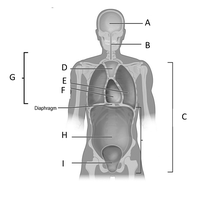
Key Terms:
Cranial cavity, thoracic cavity, abdominal cavity, diaphragm, pelvic cavity, etc.
Step-by-Step Guidance
Review the diagram and identify the major anatomical regions.
Recall the names and locations of each cavity and landmark.
Match each label (A-I) to the correct anatomical structure.
Try labeling on your own before revealing the answer!
Final Answer:
A – Cranial cavity
B – Spinal cavity
C – Ventral cavity
D – Thoracic cavity
E – Mediastinum
F – Pleural cavity
G – Dorsal cavity
H – Abdominal cavity
I – Pelvic cavity
Free Response: Answer 5 of the questions below. Use full sentences.
Q1. You are describing the location of a mole to your dermatologist. It is located near your belly button. Describe this location using at least three anatomical terms.
Background
Topic: Anatomical Terminology
This question tests your ability to use anatomical terms to describe locations on the body.
Key Terms:
Anterior: Front of the body.
Inferior: Below another structure.
Medial: Toward the midline.
Step-by-Step Guidance
Identify the belly button as the umbilical region.
Use terms like anterior, inferior, and medial to describe the location.
Construct a sentence using at least three anatomical terms.
Try writing your own description before revealing the answer!
Final Answer:
The mole is located in the anterior, inferior, and medial region near the umbilicus.
Q2. Name 3 organs located within the abdominal cavity.
Background
Topic: Abdominal Cavity Organs
This question tests your knowledge of the organs found in the abdominal cavity.
Key Terms:
Stomach, liver, intestines, kidneys, spleen, etc.
Step-by-Step Guidance
Recall the major organs in the abdominal cavity.
List three organs found in this region.
Try listing the organs before revealing the answer!
Final Answer:
Three organs in the abdominal cavity are the stomach, liver, and intestines.
Q3. Name the 3 regions (out of 9) of the abdominal cavity that are just inferior to the lungs.
Background
Topic: Abdominal Regions
This question tests your knowledge of the nine regions of the abdominal cavity.
Key Terms:
Epigastric, umbilical, hypogastric, hypochondriac, lumbar, iliac regions.
Step-by-Step Guidance
Recall the nine regions of the abdominal cavity.
Identify which regions are directly below the lungs.
List the three regions in this area.
Try naming the regions before revealing the answer!
Final Answer:
The three regions just inferior to the lungs are the epigastric, left hypochondriac, and right hypochondriac regions.
Q4. During a workout, your body temperature rises and the temperature change is detected by thermoreceptors. Your brain sends signals that increase the amount of sweat you’re producing. Identify the stimulus, effector, control center, and receptor in this situation.
Background
Topic: Homeostasis – Feedback Loops
This question tests your understanding of the components of a feedback loop in homeostasis.
Key Terms:
Stimulus: Change in environment.
Receptor: Detects the change.
Control Center: Processes information.
Effector: Responds to the change.
Step-by-Step Guidance
Identify the stimulus (what causes the change).
Determine the receptor (what detects the change).
Find the control center (what processes the information).
Identify the effector (what responds to the change).
Try identifying each component before revealing the answer!
Final Answer:
Stimulus: Increased body temperature
Receptor: Thermoreceptors
Control Center: Brain (hypothalamus)
Effector: Sweat glands
Q5. What is the most common type of feedback loop in the body?
Background
Topic: Homeostasis – Feedback Loops
This question tests your understanding of negative and positive feedback loops.
Key Terms:
Negative Feedback: Reverses a change to maintain homeostasis.
Positive Feedback: Amplifies a change.
Step-by-Step Guidance
Recall the definitions of negative and positive feedback.
Identify which type is most common in maintaining homeostasis.
Try answering before revealing the answer!
Final Answer:
Negative feedback is the most common type of feedback loop in the body.
Q6. Contrast transcription and translation.
Background
Topic: Protein Synthesis
This question tests your understanding of the differences between transcription and translation.
Key Terms:
Transcription: Copying DNA into mRNA.
Translation: Creating a protein from mRNA.
Step-by-Step Guidance
Recall the steps of protein synthesis.
Identify where transcription and translation occur.
Contrast the processes and their outcomes.
Try contrasting before revealing the answer!
Final Answer:
Transcription occurs in the nucleus and copies DNA into mRNA; translation occurs in the cytoplasm and uses mRNA to build a protein.
Q7. Explain how base pairing allows DNA to be copied without mistakes.
Background
Topic: DNA Replication
This question tests your understanding of the role of base pairing in accurate DNA replication.
Key Terms:
Base Pairing: A-T, C-G pairing ensures accuracy.
DNA Replication: Process of copying DNA.
Step-by-Step Guidance
Recall the rules of base pairing.
Explain how each base pairs with its complement.
Describe how this ensures accurate copying.
Try explaining before revealing the answer!
Final Answer:
Base pairing ensures that each strand of DNA is copied accurately, as A always pairs with T and C with G, preventing mistakes.
Q8. Compare and contrast the processes of mitosis and meiosis.
Background
Topic: Cell Division
This question tests your understanding of the differences and similarities between mitosis and meiosis.
Key Terms:
Mitosis: Produces two identical cells.
Meiosis: Produces four genetically unique gametes.
Step-by-Step Guidance
Recall the purpose and outcome of mitosis and meiosis.
Identify the number of divisions and resulting cells.
Contrast the genetic similarity of the products.
Try comparing before revealing the answer!
Final Answer:
Mitosis produces two identical somatic cells, while meiosis produces four genetically unique gametes for reproduction.
