 Back
BackIntroduction to Anatomy: Anatomical Position, Directional Terms, Body Planes, Cavities, and Serous Membranes
Study Guide - Smart Notes
 Tailored notes based on your materials, expanded with key definitions, examples, and context.
Anatomical Position and Scientific Method
Scientific Method in Anatomy & Physiology
The scientific method is a systematic approach used in anatomy and physiology to investigate questions and hypotheses about the human body. It ensures that findings are reliable and reproducible.
Observation: Noting phenomena or patterns.
Question: Formulating a question based on observations.
Hypothesis: A testable statement predicting the outcome. Example: “Will exercise increase blood pressure?”
Experiment: Designing and conducting tests to evaluate the hypothesis.
Analyze Data: Interpreting results from the experiment.
Conclusion: Summarizing findings and relating them to the hypothesis.
Key Terms: Independent Variable: The factor manipulated in an experiment. Dependent Variable: The factor measured in response. Control Group: The group not exposed to the experimental variable. Experimental Group: The group exposed to the variable. Double-blind Procedure: Neither subjects nor experimenters know who receives the variable, reducing bias.
Anatomical Position
Definition and Importance
The anatomical position is the standard reference posture for describing locations and directions on the human body. The body is erect, facing forward, feet together, and palms facing forward. This position is essential for consistency in anatomical terminology.
Body erect
Face forward
Feet together
Palms face forward


Directional Terms
Orientation and Directional Terms
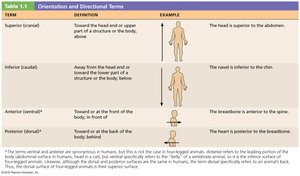
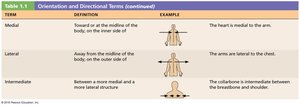
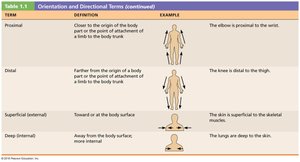
Directional terms are used to describe the locations of structures relative to other structures or locations in the body. These terms are fundamental for clear communication in anatomy.
Superior (Cephalic): Toward the head or upper part of a structure.
Inferior (Caudal): Away from the head or toward the lower part.
Anterior (Ventral): Toward the front of the body.
Posterior (Dorsal): Toward the back of the body.
Medial: Toward the midline of the body.
Lateral: Away from the midline.
Intermediate: Between a more medial and a more lateral structure.
Proximal: Closer to the origin of a body part or point of attachment.
Distal: Farther from the origin or point of attachment.
Superficial: Toward or at the body surface.
Deep: Away from the body surface; more internal.
Regional Body Terms
Body Regions and Terminology
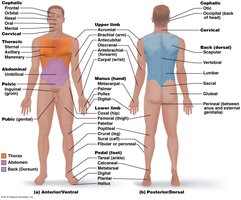
Body regions are specific areas used to describe locations and reference points in anatomy. Some regions cover both anterior and posterior aspects, while others have distinct names for each side.
Femoral: Refers to the thigh region (both anterior and posterior).
Crural: Refers to the anterior aspect of the leg.
Sural: Refers to the posterior aspect of the leg.
Body Planes
Planes of the Body
Body planes are imaginary lines used to divide the body into sections for anatomical study and medical imaging.
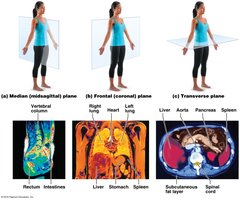
Median (Midsagittal) Plane: Divides the body into equal right and left halves.
Frontal (Coronal) Plane: Divides the body into anterior (front) and posterior (back) sections.
Transverse Plane: Divides the body into superior (upper) and inferior (lower) sections.
Body Cavities
Major Body Cavities
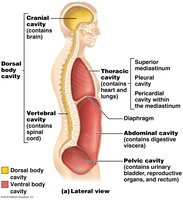
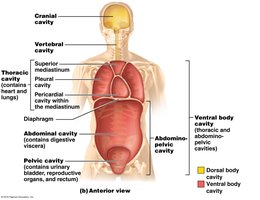
The human body contains several cavities that house organs and provide protection. These cavities are classified as dorsal and ventral.
Dorsal Body Cavity: Includes the cranial cavity (brain) and vertebral cavity (spinal cord).
Ventral Body Cavity: Includes the thoracic cavity (heart and lungs), abdominal cavity (digestive organs), and pelvic cavity (urinary bladder, reproductive organs, rectum).
Abdominal Subdivisions
Quadrants and Regions
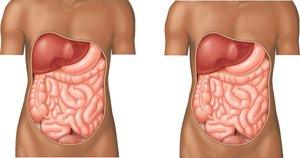
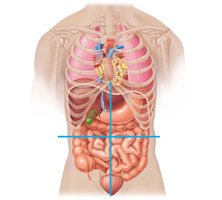
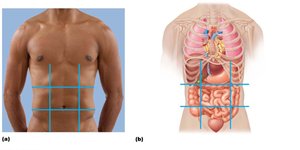
The abdomen is divided into quadrants and regions for clinical and anatomical reference. This helps in locating organs and describing pain or pathology.
Four Quadrants: Right Upper Quadrant (RUQ), Left Upper Quadrant (LUQ), Right Lower Quadrant (RLQ), Left Lower Quadrant (LLQ).
Nine Regions: Right hypochondriac, epigastric, left hypochondriac, right lumbar, umbilical, left lumbar, right iliac, hypogastric, left iliac.
Serous Membranes
Thoracic and Abdominal Serous Membranes
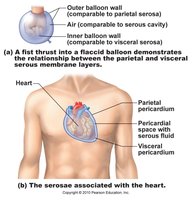
Serous membranes are thin tissues that line body cavities and cover organs. They reduce friction and provide protection.
Visceral Layer: Covers the organ.
Parietal Layer: Lines the cavity or body wall.
Thoracic Membranes:
Pleura: Surrounds the lungs.
Pericardium: Surrounds the heart.
Abdominopelvic Membranes:
Peritoneum: Surrounds abdominal organs.
Serous Membranes: Specific Names and Functions
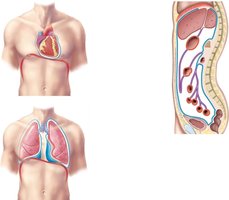
Serous membranes are named according to the organs and cavities they surround.
Pericardium: Heart
Pleura: Lungs and thoracic cavity
Peritoneum: Abdominopelvic cavity
Summary Table: Directional Terms
Orientation and Directional Terms Table
This table summarizes the main directional terms used in anatomy, their definitions, and examples.
Term | Definition | Example |
|---|---|---|
Superior (Cephalic) | Toward the head or upper part | The head is superior to the abdomen |
Inferior (Caudal) | Away from the head or toward the lower part | The navel is inferior to the chin |
Anterior (Ventral) | Toward or at the front of the body | The breastbone is anterior to the spine |
Posterior (Dorsal) | Toward or at the back of the body | The heart is posterior to the breastbone |
Medial | Toward the midline of the body | The heart is medial to the arm |
Lateral | Away from the midline of the body | The arms are lateral to the chest |
Intermediate | Between a more medial and a more lateral structure | The collarbone is intermediate between the breastbone and shoulder |
Proximal | Closer to the origin of the body part | The elbow is proximal to the wrist |
Distal | Farther from the origin of the body part | The knee is distal to the thigh |
Superficial | Toward or at the body surface | The skin is superficial to the skeletal muscles |
Deep | Away from the body surface; more internal | The lungs are deep to the skin |
Conclusion
Understanding anatomical position, directional terms, body planes, cavities, and serous membranes is fundamental for studying anatomy and physiology. These concepts provide a universal language for describing the structure and function of the human body.
