 Back
BackIntroduction to Anatomy and Physiology: Anatomical Language, Orientation, and Core Principles
Study Guide - Smart Notes
 Tailored notes based on your materials, expanded with key definitions, examples, and context.
Introduction to Anatomy and Physiology
Overview of Anatomy and Physiology
Anatomy is the study of the structure of the human body, while physiology focuses on the functions of these structures. Understanding both is essential for comprehending how the body operates as an integrated whole.
Anatomy: Examines the physical structures of organisms.
Physiology: Investigates the processes and functions of those structures.
Specialties and Subfields
Gross Anatomy: Study of structures visible to the naked eye.
Microscopic Anatomy: Study of structures requiring magnification, including histology (tissues) and cytology (cells).
Regional Anatomy: Focuses on specific areas such as the head, neck, or back.
Surface Anatomy: Identifies anatomical landmarks on the body surface.
Levels of Organization in the Human Body
Hierarchical Structure
The human body is organized into several levels, each building upon the previous:
Chemical Level: Atoms and molecules form the basis of all matter.
Cellular Level: Molecules combine to form cells, the basic units of life.
Tissue Level: Similar cells and their extracellular matrix form tissues.
Organ Level: Two or more tissue types combine to form organs.
Organ System Level: Organs work together as systems (e.g., digestive, nervous).
Organism Level: All systems function together to sustain the living organism.
Characteristics of Life
Essential Properties
Cellular Composition: All living things are composed of cells.
Metabolism: The sum of all chemical reactions in the body, including:
Anabolism: Building larger molecules from smaller ones.
Catabolism: Breaking down larger molecules into smaller ones.
Growth: Increase in size and number of cells.
Excretion: Removal of waste products.
Responsiveness: Ability to sense and react to stimuli.
Movement: Motion of the organism or its parts.
Reproduction: Formation of new cells or organisms.
Major Organ Systems and Their Functions
Overview of Organ Systems
Integumentary System: Protects the body, regulates temperature.
Skeletal System: Provides support and protection, enables movement.
Muscular System: Facilitates movement, maintains posture.
Nervous System: Controls responses to stimuli, coordinates activities.
Endocrine System: Regulates body functions via hormones.
Cardiovascular System: Transports nutrients, gases, and wastes.
Lymphatic System: Defends against infection, returns tissue fluids to blood.
Respiratory System: Facilitates gas exchange.
Digestive System: Processes food, absorbs nutrients.
Urinary System: Eliminates waste, regulates fluid balance.
Reproductive System: Produces offspring (male and female systems).
Language of Anatomy and Physiology
Directional Terms and Body Planes
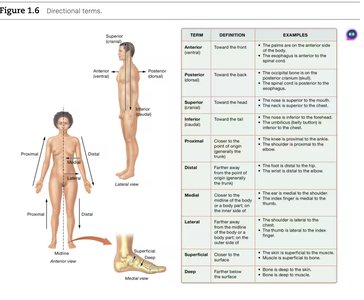
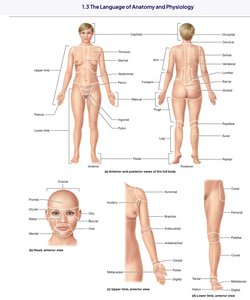
Directional terms and planes are used to describe locations and sections of the body precisely.
Anterior (Ventral): Toward the front of the body.
Posterior (Dorsal): Toward the back of the body.
Superior (Cranial): Toward the head.
Inferior (Caudal): Toward the tail or lower part.
Medial: Toward the midline.
Lateral: Away from the midline.
Proximal: Closer to the point of attachment.
Distal: Farther from the point of attachment.
Superficial: Closer to the surface.
Deep: Further from the surface.
Body Planes
Sagittal Plane: Divides the body into left and right portions.
Frontal (Coronal) Plane: Divides the body into anterior and posterior portions.
Transverse Plane: Divides the body into superior and inferior portions.
Common Anatomical Terms
Supine: Lying face up.
Prone: Lying face down.
Prefixes and Suffixes:
Supra-, Epi-: Above
Infra-, Sub-: Below
Endo-: Inside
Extra-: Outside
Inter-: In between
Peri-: Around
Body Cavities and Membranes
Major Body Cavities
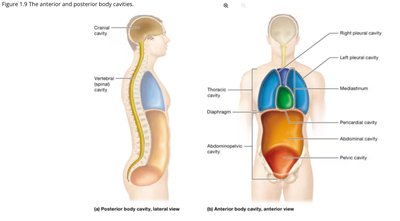
The body contains several major cavities that house and protect organs:
Dorsal (Posterior) Cavity: Contains the cranial and spinal cavities (central nervous system).
Ventral (Anterior) Cavity: Includes the thoracic and abdominopelvic cavities.
Thoracic Cavity: Contains the pleural cavities (lungs), mediastinum (heart, trachea, esophagus), and pericardial cavity (heart).
Abdominopelvic Cavity: Subdivided into abdominal and pelvic cavities.
Abdominopelvic Quadrants and Regions
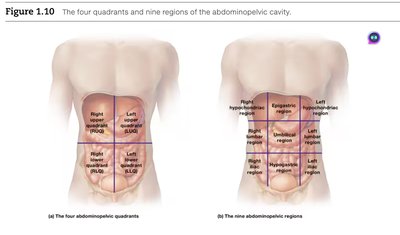
The abdominopelvic cavity is further divided for clinical and anatomical reference:
Four Quadrants: Right upper, left upper, right lower, left lower.
Nine Regions: Right/left hypochondriac, epigastric, right/left lumbar, umbilical, right/left iliac, hypogastric.
Serous Membranes
Serous Membrane: A single continuous layer of tissue that folds over itself, creating a cavity filled with serous fluid for lubrication.
Visceral Layer: Inner layer, in contact with the organ.
Parietal Layer: Outer layer, lines the cavity wall.
Neuroanatomical Orientation
Directional Terms in Neuroanatomy
Dorsal: Toward the back or upper side.
Ventral: Toward the belly or lower side.
Rostral: Toward the front (nose/beak).
Caudal: Toward the tail or posterior.
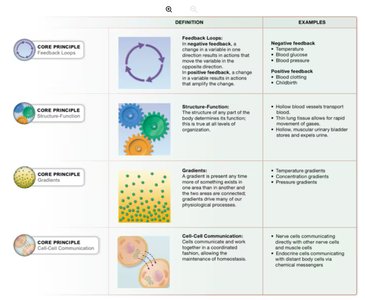
Core Principles of Anatomy and Physiology
Feedback Loops
Feedback loops are mechanisms that maintain homeostasis by regulating physiological processes.
Negative Feedback: Reduces the effect of a stimulus to maintain balance (e.g., body temperature regulation).
Positive Feedback: Enhances the effect of a stimulus (e.g., blood clotting, childbirth).
Structure-Function Relationship
The structure of a body part is closely related to its function. For example, hollow blood vessels transport blood efficiently, and thin lung tissues allow for rapid gas exchange.
Gradients
A gradient exists when more of something is present in one area than another, driving physiological processes such as temperature or pressure gradients.
Cell-Cell Communication
Cells communicate via chemical messengers or electrical signals to coordinate body functions and maintain homeostasis.
Summary Table: Directional Terms
Term | Definition | Example |
|---|---|---|
Anterior (Ventral) | Toward the front | The palms are on the anterior side of the body. |
Posterior (Dorsal) | Toward the back | The spinal cord is posterior to the esophagus. |
Superior (Cranial) | Toward the head | The nose is superior to the mouth. |
Inferior (Caudal) | Toward the tail | The nose is inferior to the forehead. |
Proximal | Closer to the point of origin | The knee is proximal to the foot. |
Distal | Farther from the point of origin | The foot is distal to the hip. |
Medial | Closer to the midline | The index finger is medial to the thumb. |
Lateral | Farther from the midline | The thumb is lateral to the index finger. |
Superficial | Closer to the surface | The skin is superficial to the muscle. |
Deep | Farther below the surface | The bone is deep to the muscle. |
Conclusion
Understanding anatomical language, body organization, and core physiological principles is foundational for further study in anatomy and physiology. Mastery of these concepts enables clear communication and comprehension of more advanced topics in the field.
