Back
BackIntroduction to Anatomy and Physiology: Foundational Concepts and Organization
Study Guide - Smart Notes
 Tailored notes based on your materials, expanded with key definitions, examples, and context.
Introduction to Anatomy and Physiology
Defining Anatomy and Physiology
Anatomy and physiology are foundational sciences in understanding the human body. Anatomy is the study of the structure or form of the human body, while physiology focuses on the body's functions. The structure and function of the body are closely related, as the form of a structure is suited to its function.
Characteristics of Living Organisms
Properties Shared by Living Organisms
Cellular Composition: All living organisms are composed of cells, the smallest units that carry out the functions of life.
Metabolism: The sum of all chemical processes in the body. Anabolism refers to building processes that consume energy, while catabolism refers to breaking down processes that release energy.
Growth: An increase in the size and/or number of cells.
Excretion: Elimination of potentially harmful waste products from metabolic processes.
Responsiveness (Irritability): The ability to sense and react to changes or stimuli in the environment.
Movement: Movement of the organism or individual cells.
Reproduction: Production of new cells for growth or repair, or the creation of new organisms.
Levels of Structural Organization and Body Systems
Hierarchical Organization of the Human Body
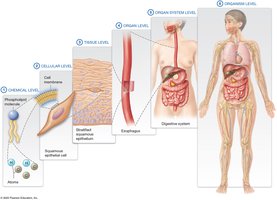
The human body is organized into a series of increasingly complex levels:
Chemical Level: Atoms and molecules form the basis of all matter.
Cellular Level: Molecules combine to form cells, the basic units of life.
Tissue Level: Groups of similar cells and their extracellular matrix perform common functions.
Organ Level: Two or more tissue types form organs with specialized tasks.
Organ System Level: Groups of organs work together to perform broad functions.
Organism Level: All organ systems function together to form the complete human organism.
The 11 Organ Systems of the Human Body
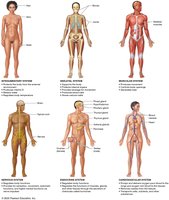
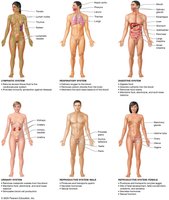
The human body contains 11 organ systems, each with specific functions essential for survival and homeostasis:
Integumentary System
Skeletal System
Muscular System
Nervous System
Endocrine System
Cardiovascular System
Lymphatic System
Respiratory System
Digestive System
Urinary System
Reproductive System
Types of Anatomy and Physiology
Approaches to Studying Anatomy
Systemic Anatomy: Study of individual organ systems.
Regional Anatomy: Study of specific regions of the body.
Surface Anatomy: Study of surface markings.
Gross Anatomy: Study of structures visible to the naked eye.
Microscopic Anatomy: Study of cells (cytology) and tissues (histology) using a microscope.
Subfields of Physiology
Physiology is often divided by organ systems (e.g., neurophysiology, cardiophysiology) or by structural level (chemical, cellular, tissue).
Anatomical Position and Directional Terms
Standard Anatomical Position
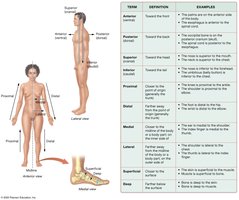
The anatomical position is a standard reference for describing body parts and regions. The body stands upright, feet shoulder-width apart, arms at the sides, and head and palms facing forward.

Directional Terms
Directional terms describe the locations of body parts relative to each other:
Term | Definition | Example |
|---|---|---|
Anterior (Ventral) | Toward the front | The palms are on the anterior side of the body. |
Posterior (Dorsal) | Toward the back | The spine is posterior to the heart. |
Superior (Cranial) | Toward the head | The nose is superior to the mouth. |
Inferior (Caudal) | Toward the tail | The chest is inferior to the head. |
Proximal | Closer to the point of origin | The knee is proximal to the foot. |
Distal | Farther from the point of origin | The wrist is distal to the elbow. |
Medial | Closer to the midline | The heart is medial to the lungs. |
Lateral | Farther from the midline | The thumb is lateral to the index finger. |
Superficial | Closer to the surface | The skin is superficial to the muscles. |
Deep | Farther below the surface | The bones are deep to the muscles. |
Regional Terms
Major Body Regions
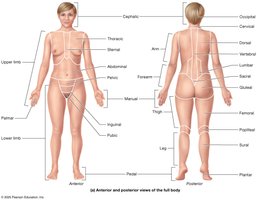
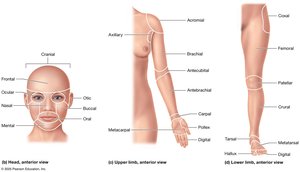
The body is divided into two main regions:
Axial Region: Head, neck, and trunk
Appendicular Region: Upper and lower limbs (appendages)
Each region can be further subdivided and named using anatomical terminology (e.g., brachial region for the upper arm).
Planes of Section
Body Planes
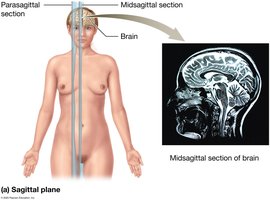
Body planes are used to divide the body or its parts for anatomical study:
Sagittal Plane: Divides the body into right and left sections. The midsagittal (median) plane divides it into equal halves; parasagittal divides it unequally.
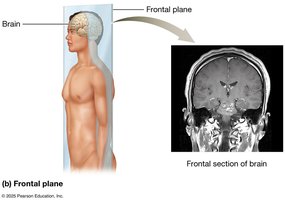
Frontal (Coronal) Plane: Divides the body into anterior and posterior sections.
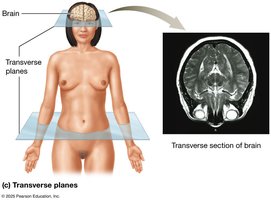
Transverse (Horizontal) Plane: Divides the body into superior and inferior sections.
Oblique Plane: Divides the body at an angle (less common).
Body Cavities and Membranes
Major Body Cavities
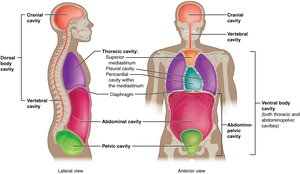
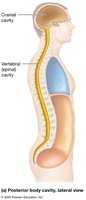
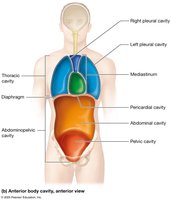
Dorsal Body Cavity: Located on the posterior side; includes the cranial cavity (brain) and vertebral cavity (spinal cord), both filled with cerebrospinal fluid.
Ventral Body Cavity: Located on the anterior side; divided by the diaphragm into the thoracic cavity (superior) and abdominopelvic cavity (inferior).
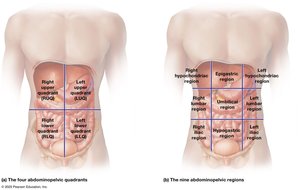
Abdominopelvic Quadrants and Regions
The abdominopelvic cavity can be divided into four quadrants or nine regions to help localize organs and pain:
Quadrants: Right Upper (RUQ), Left Upper (LUQ), Right Lower (RLQ), Left Lower (LLQ)
Regions: Right/Left hypochondriac, right/left lumbar, right/left iliac, epigastric, umbilical, hypogastric
Serous Membranes
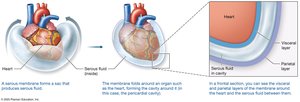
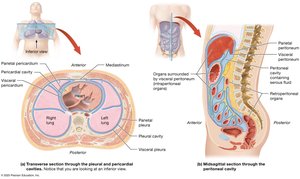
Serous membranes are thin sheets of tissue that form double layers around organs, filled with serous fluid to reduce friction:
Visceral Layer: Contacts the organ directly.
Parietal Layer: Attaches to surrounding structures.
Homeostasis and Feedback Mechanisms
Homeostasis
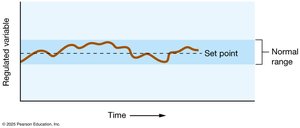
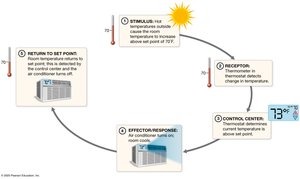
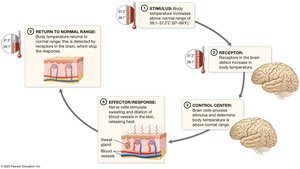
Homeostasis is the maintenance of a relatively stable internal environment. Disturbances in homeostasis can lead to disease or death. Variables such as temperature and blood sugar are regulated to stay within a normal range.
Feedback Loops
Feedback loops are mechanisms that maintain homeostasis:
Negative Feedback Loops: Oppose the initial change and reduce output, promoting stability. Each variable has a set point and normal range.
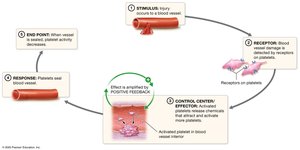
Positive Feedback Loops: Reinforce the initial change and increase output, often found within negative feedback loops for rapid responses (e.g., blood clotting, childbirth).
Principles of Structure and Function
Complementarity of Structure and Function
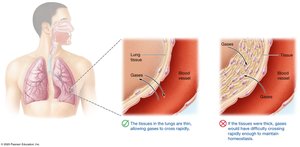
The form of a structure is always suited to its function at all levels of organization. For example, the thin walls of lung tissue allow for efficient gas exchange.
Cell-Cell Communication
Coordination of Body Functions
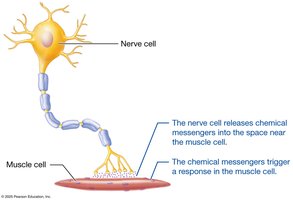
Cells communicate to maintain homeostasis through electrical signals and chemical messengers. These signals can act on neighboring cells or travel through body fluids to distant cells.