 Back
BackIntroduction to Anatomy and Physiology: Foundational Concepts and Terminology
Study Guide - Smart Notes
 Tailored notes based on your materials, expanded with key definitions, examples, and context.
Introduction to Anatomy and Physiology
Anatomy and Physiology (A&P) is the study of the structure and function of the human body. Anatomy focuses on the physical structures, while physiology explores how these structures work together to sustain life. Understanding both is essential for students entering health and biological sciences.
Levels of Structural Organization
Hierarchy of Biological Organization
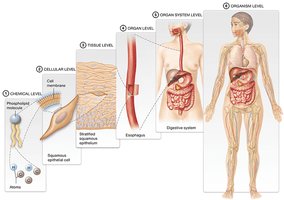
The human body is organized into a hierarchy of structural levels, each building upon the previous one. This organization is fundamental to understanding how the body functions as a whole.
Chemical Level: Atoms and molecules form the chemical building blocks of the body.
Cellular Level: Cells are the basic units of life, composed of organelles and surrounded by a membrane.
Tissue Level: Groups of similar cells that perform a common function (e.g., epithelial tissue).
Organ Level: Structures composed of two or more tissue types that perform specific functions (e.g., the esophagus).
Organ System Level: Groups of organs that work together to accomplish a common purpose (e.g., the digestive system).
Organism Level: The complete living being, with all organ systems working in harmony.
Types of Anatomy and Physiology
Major Subdivisions
Anatomy and physiology can be studied from several perspectives, each providing unique insights into the human body.
Systemic Anatomy: Study of individual organ systems (e.g., digestive, nervous, respiratory systems).
Regional Anatomy: Study of specific regions of the body (e.g., head and neck, abdomen).
Surface Anatomy: Study of external features and surface markings (e.g., skin pigment, musculature).
Gross Anatomy: Study of structures visible to the naked eye (e.g., bones, organs).
Microscopic Anatomy: Study of structures requiring magnification, including:
Cytology: Study of cells.
Histology: Study of tissues.
Physiology Specializations: Classified by organ/system (e.g., neurophysiology, cardiovascular physiology).
The Organ Systems of the Human Body
Overview of Major Organ Systems
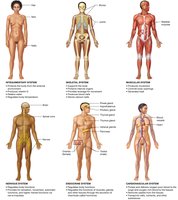
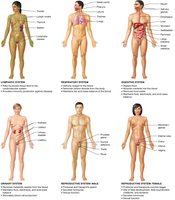
The human body is composed of eleven major organ systems, each with distinct functions essential for survival and homeostasis.
Integumentary System
Skeletal System
Muscular System
Lymphatic System
Respiratory System
Digestive System
Nervous System
Endocrine System
Cardiovascular System
Urinary System
Reproductive System
Anatomical Position
Standard Reference for Describing the Body
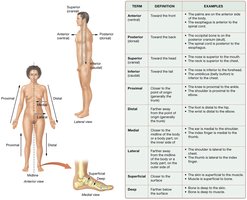
The anatomical position is a standardized posture used to describe the locations and relationships of body parts. The body stands upright, facing forward, with arms at the sides and palms facing forward.

Directional Terms
Describing Locations and Relationships
Directional terms are used to describe the positions of structures relative to other structures or locations in the body. These terms are essential for clear communication in anatomy.
Term | Definition | Examples |
|---|---|---|
Anterior (ventral) | Toward the front | The sternum is anterior to the spine. |
Posterior (dorsal) | Toward the back | The heart is posterior to the sternum. |
Superior (cranial) | Toward the head | The nose is superior to the mouth. |
Inferior (caudal) | Toward the feet | The stomach is inferior to the heart. |
Proximal | Closer to the point of attachment | The elbow is proximal to the wrist. |
Distal | Farther from the point of attachment | The fingers are distal to the elbow. |
Medial | Toward the midline | The nose is medial to the eyes. |
Lateral | Away from the midline | The ears are lateral to the nose. |
Superficial | Closer to the surface | The skin is superficial to the muscles. |
Deep | Farther from the surface | The bones are deep to the skin. |
Regional Terms
Identifying Specific Body Areas
Regional terms specify particular areas of the body, aiding in precise anatomical description. These terms are used in both clinical and academic settings.
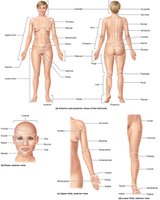
Planes of Section
Dividing the Body for Study
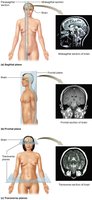
Planes of section are imaginary lines used to divide the body or organs for anatomical study and medical imaging. The three primary planes are:
Sagittal Plane: Divides the body into right and left parts.
Frontal (Coronal) Plane: Divides the body into anterior and posterior parts.
Transverse (Horizontal) Plane: Divides the body into superior and inferior parts.
The Anterior and Posterior Body Cavities
Major Body Cavities and Their Subdivisions
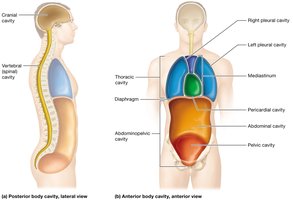
The body contains two main cavities that house and protect internal organs:
Posterior (Dorsal) Cavity: Includes the cranial cavity (brain) and vertebral (spinal) cavity.
Anterior (Ventral) Cavity: Includes the thoracic cavity (heart and lungs) and abdominopelvic cavity (digestive, urinary, and reproductive organs).
Regions of the Abdominopelvic Cavity
Divisions for Clinical and Anatomical Reference
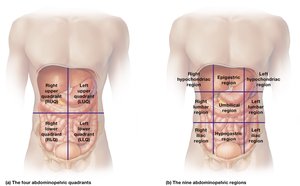
The abdominopelvic cavity is divided into regions and quadrants to help locate organs and describe pain or injury locations. The nine-region method is commonly used in clinical settings.
Right/Left Hypochondriac
Epigastric
Right/Left Lumbar
Umbilical
Right/Left Iliac (Inguinal)
Hypogastric (Pubic)
Homeostasis and Feedback Loops
Maintaining Internal Balance
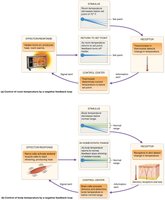
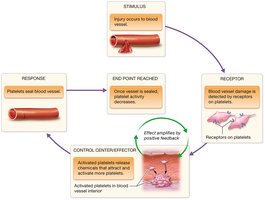
Homeostasis is the maintenance of a stable internal environment. The body uses feedback loops to regulate physiological processes:
Negative Feedback Loops: Reverse a change to maintain balance (e.g., body temperature regulation).
Positive Feedback Loops: Amplify a response until a specific endpoint is reached (e.g., blood clotting).
Summary Table: Directional Terms
Term | Definition | Example |
|---|---|---|
Anterior (ventral) | Toward the front | The sternum is anterior to the heart. |
Posterior (dorsal) | Toward the back | The spine is posterior to the stomach. |
Superior (cranial) | Toward the head | The nose is superior to the mouth. |
Inferior (caudal) | Toward the feet | The stomach is inferior to the heart. |
Medial | Toward the midline | The nose is medial to the eyes. |
Lateral | Away from the midline | The ears are lateral to the nose. |
Proximal | Closer to the point of attachment | The elbow is proximal to the wrist. |
Distal | Farther from the point of attachment | The fingers are distal to the elbow. |
Superficial | Closer to the surface | The skin is superficial to the muscles. |
Deep | Farther from the surface | The bones are deep to the skin. |
Additional info: Understanding these foundational concepts is essential for further study in anatomy and physiology, as they provide the language and framework for describing the human body in health and disease.
