 Back
Introduction to Anatomy and Physiology: Foundational Concepts and Terminology
Study Guide - Smart Notes
 Tailored notes based on your materials, expanded with key definitions, examples, and context.
Introduction to Anatomy and Physiology
Overview
Anatomy and physiology are foundational sciences in the study of the human body. Anatomy focuses on the structure of body parts, while physiology explores their functions. Understanding both is essential for comprehending how the body maintains health and responds to disease.
Levels of Structural Organization
Hierarchy of Organization
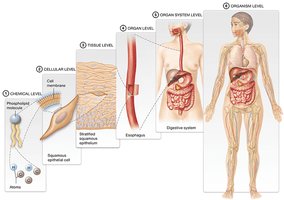
The human body is organized into a hierarchy of structural levels, each building upon the previous one:
Chemical Level: Atoms and molecules form the chemical building blocks of the body.
Cellular Level: Cells are the basic units of life, each with specialized functions.
Tissue Level: Groups of similar cells form tissues, such as epithelial, connective, muscle, and nervous tissue.
Organ Level: Organs are composed of two or more tissue types working together for specific functions.
Organ System Level: Related organs form organ systems, each with a major physiological role.
Organism Level: The human organism is the sum of all structural levels working together to maintain life.
Types of Anatomy and Physiology
Subdisciplines of Anatomy
Systemic Anatomy: Study of individual organ systems (e.g., digestive, nervous, respiratory).
Regional Anatomy: Study of specific regions of the body (e.g., head and neck, back, abdomen).
Surface Anatomy: Study of surface markings and features (e.g., skin pigment, hand lines, musculature).
Gross Anatomy: Study of structures visible to the naked eye (e.g., stomach, trachea, bones).
Microscopic Anatomy: Study of structures requiring a microscope.
Cytology: Study of cells.
Histology: Study of tissues.
Subdisciplines of Physiology
Physiology is often classified by the organ or system studied (e.g., neurophysiology, cardiovascular physiology, reproductive physiology).
The Organ Systems of the Human Body
Major Organ Systems
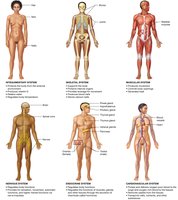
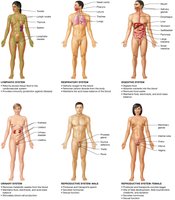
The human body is organized into eleven major organ systems, each with distinct functions:
Integumentary System
Skeletal System
Muscular System
Lymphatic System
Respiratory System
Digestive System
Nervous System
Endocrine System
Cardiovascular System
Urinary System
Reproductive System
Anatomical Position
Standard Reference Position
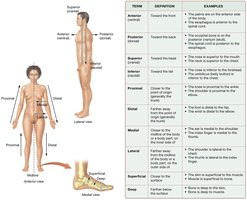
The anatomical position is the standard reference for describing locations and directions on the human body. The body stands upright, facing forward, with arms at the sides and palms facing forward.

Directional Terms
Describing Locations and Relationships
Directional terms are used to describe the positions of structures relative to other structures or locations in the body. Common terms include anterior/posterior, superior/inferior, proximal/distal, medial/lateral, superficial/deep, and more.
Term | Definition | Example |
|---|---|---|
Anterior (ventral) | Toward the front | The sternum is anterior to the spine. |
Posterior (dorsal) | Toward the back | The heart is posterior to the sternum. |
Superior (cranial) | Toward the head | The nose is superior to the mouth. |
Inferior (caudal) | Toward the feet | The stomach is inferior to the lungs. |
Proximal | Closer to the point of attachment | The elbow is proximal to the wrist. |
Distal | Farther from the point of attachment | The fingers are distal to the elbow. |
Medial | Toward the midline | The nose is medial to the eyes. |
Lateral | Away from the midline | The ears are lateral to the nose. |
Superficial | Closer to the surface | The skin is superficial to the muscles. |
Deep | Farther from the surface | The bones are deep to the skin. |
Regional Terms
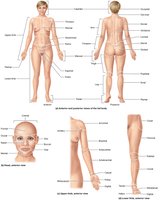
Body Regions
Regional terms specify distinct areas of the body, such as the cephalic (head), cervical (neck), thoracic (chest), brachial (arm), and more. These terms help in accurately describing locations of injuries, conditions, or procedures.
Planes of Section
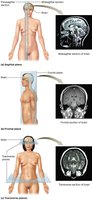
Body Planes
Body planes are imaginary lines used to divide the body into sections for anatomical study:
Sagittal Plane: Divides the body into right and left parts.
Frontal (Coronal) Plane: Divides the body into anterior and posterior parts.
Transverse (Horizontal) Plane: Divides the body into superior and inferior parts.
The Anterior and Posterior Body Cavities
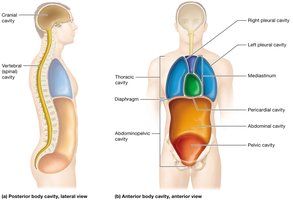
Major Body Cavities
The body contains two main cavities:
Posterior (Dorsal) Cavity: Includes the cranial cavity (brain) and vertebral cavity (spinal cord).
Anterior (Ventral) Cavity: Includes the thoracic cavity (heart and lungs) and abdominopelvic cavity (digestive, urinary, and reproductive organs).
Regions of the Abdominopelvic Cavity
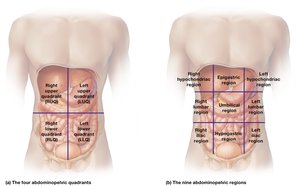
Abdominopelvic Quadrants and Regions
The abdominopelvic cavity is divided for clinical and anatomical reference:
Four Quadrants: Right upper, left upper, right lower, left lower.
Nine Regions: Right/left hypochondriac, epigastric, right/left lumbar, umbilical, right/left iliac, hypogastric.
Homeostasis and Feedback Loops
Negative Feedback Loops
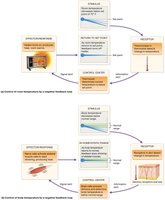
Negative feedback loops are mechanisms that reverse a change in a controlled condition, maintaining homeostasis. For example, body temperature regulation involves sensors, a control center, and effectors to restore normal temperature.
Positive Feedback Loops
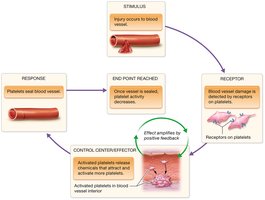
Positive feedback loops amplify a change rather than reversing it. These are less common but important in processes like blood clotting, where the response enhances the original stimulus until a specific endpoint is reached.
Summary Table: Key Anatomical Terms
Term | Definition | Example |
|---|---|---|
Anterior | Toward the front | The sternum is anterior to the heart. |
Posterior | Toward the back | The spine is posterior to the stomach. |
Superior | Above | The head is superior to the chest. |
Inferior | Below | The liver is inferior to the lungs. |
Medial | Toward the midline | The nose is medial to the eyes. |
Lateral | Away from the midline | The arms are lateral to the chest. |
Proximal | Closer to the trunk | The elbow is proximal to the wrist. |
Distal | Farther from the trunk | The fingers are distal to the elbow. |
Additional info: Understanding these foundational concepts is essential for further study in anatomy and physiology, as they provide the language and framework for describing the human body in health and disease.
