 Back
Introduction to Anatomy and Physiology: Foundational Concepts and Terminology
Study Guide - Smart Notes
 Tailored notes based on your materials, expanded with key definitions, examples, and context.
An Introduction to Anatomy and Physiology
Definitions and Interrelationship
Anatomy and Physiology are foundational sciences in understanding the human body. Anatomy is the study of body structures, their arrangement, and relationships, while physiology is the science of body functions—how these structures work. The two are inseparable, as function always reflects structure, a concept known as the principle of complementarity.
Anatomy: From Greek "ana" (apart) + "tomy" (to cut) – the study of structures.
Physiology: From Greek "physi" (nature/work) + "-logy" (study of) – the study of how structures function.
Principle of Complementarity: Structure determines function; what a structure can do depends on its specific form.
Anatomical Terminology and Body Position
Anatomical Position
All anatomical terminology is based on the anatomical position: the body stands upright, facing forward, with feet parallel, arms at the sides, and palms facing forward. This standard position allows for consistent reference to body parts and regions.
Anterior (ventral): Front of the body
Posterior (dorsal): Back of the body
Prone: Lying face down
Supine: Lying face up
Body Planes and Sections
Major Body Planes
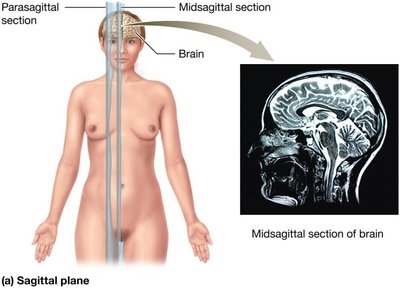
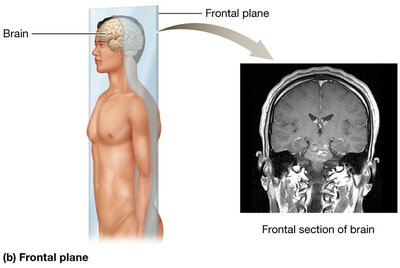
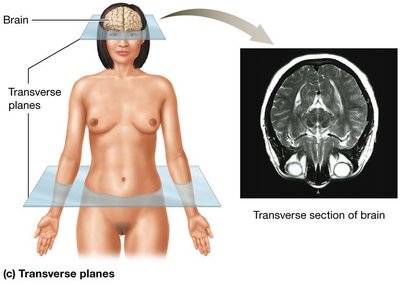
Body planes are imaginary lines used to divide the body for anatomical study and medical imaging.
Sagittal Plane: Divides the body into right and left portions.
Midsagittal (Median) Plane: Divides the body into equal right and left halves.
Parasagittal Plane: Divides the body into unequal right and left portions.
Frontal (Coronal) Plane: Divides the body into anterior and posterior portions.
Transverse (Horizontal) Plane: Divides the body into superior and inferior portions.
Oblique Plane: Passes through the body at an angle.
Directional Terms
Standard Anatomical Directions
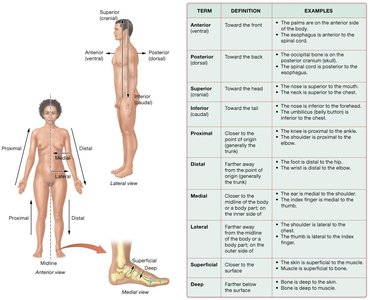
Directional terms describe the locations of structures relative to other structures or locations in the body.
Superior (Cephalic): Toward the head or upper part of a structure
Inferior (Caudal): Toward the lower part or tail
Anterior (Ventral): Toward the front
Posterior (Dorsal): Toward the back
Medial: Closer to the midline
Lateral: Farther from the midline
Intermediate: Between two structures
Ipsilateral: On the same side
Contralateral: On the opposite side
Proximal: Nearer to the origin or attachment
Distal: Farther from the origin or attachment
Superficial: Toward or on the surface
Deep (Profundus): Away from the surface
Parietal: On the outer wall of a body cavity
Visceral: On the organs or covering of organs within body cavities
Body Cavities and Membranes
Major Body Cavities
The body contains two main cavities: dorsal and ventral, each housing specific organs and lined by membranes.
Dorsal Cavity: Cranial cavity (brain) and vertebral cavity (spinal cord)
Ventral Cavity: Thoracic cavity (superior to diaphragm) and abdominopelvic cavity (inferior to diaphragm)
Thoracic Cavity: Contains pericardial cavity (heart), pleural cavities (lungs), and mediastinum (central region)
Abdominopelvic Cavity: Abdominal cavity (digestive organs) and pelvic cavity (urinary bladder, reproductive organs, rectum)
Serous Membranes
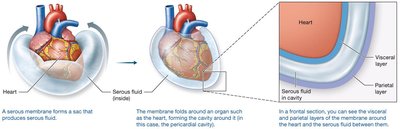
Most organs in the ventral body cavity are surrounded by serous membranes, which are thin, double-layered sacs that reduce friction as organs move.
Parietal Layer: Lines the cavity wall
Visceral Layer: Covers the organ
Serous Fluid: Fills the space between layers, preventing friction
Abdominopelvic Regions and Quadrants
Clinical and Anatomical Divisions
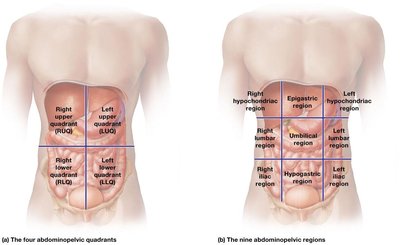
The abdominopelvic cavity is divided for clinical and anatomical reference:
Quadrants: Used by clinicians (Right Upper, Left Upper, Right Lower, Left Lower)
Regions: Used by anatomists (nine regions: right/left hypochondriac, epigastric, right/left lumbar, umbilical, right/left iliac, hypogastric)
Homeostasis
Definition and Importance
Homeostasis is the dynamic equilibrium of the body's internal environment, maintaining stability within narrow limits despite external changes. It is a central theme in anatomy and physiology, ensuring optimal conditions for cellular function.
Dynamic Equilibrium: Internal conditions fluctuate within a narrow range
Central Theme: Essential for health and survival
Feedback Systems
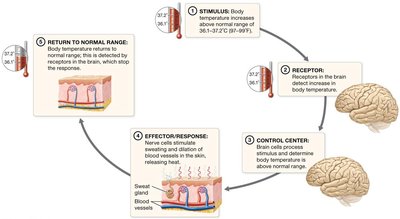
Homeostasis is regulated by feedback systems consisting of three components:
Receptor: Monitors changes and sends information to the control center
Control Center: Receives input, sets the range, and determines the response
Effector: Produces a response to restore balance
Negative Feedback Systems
In a negative feedback system, the output reverses the original change, maintaining conditions within their ideal range. Most physiological processes use negative feedback (e.g., body temperature, blood pH, blood sugar).
Example: If body temperature rises, mechanisms act to lower it back to normal.
Positive Feedback Systems
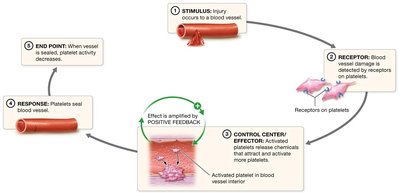
In a positive feedback system, the output reinforces the original change, amplifying the response. These are less common but occur in processes like blood clotting and childbirth.
Example: Platelet activation during blood clotting increases until the vessel is sealed.
Summary Table: Directional Terms
Term | Definition | Example |
|---|---|---|
Anterior (ventral) | Toward the front | The palms are on the anterior side of the body. |
Posterior (dorsal) | Toward the back | The spine is posterior to the esophagus. |
Superior (cephalic) | Toward the head | The nose is superior to the mouth. |
Inferior (caudal) | Toward the tail | The chin is inferior to the mouth. |
Proximal | Closer to the point of origin | The knee is proximal to the ankle. |
Distal | Farther from the point of origin | The foot is distal to the hip. |
Medial | Closer to the midline | The heart is medial to the lungs. |
Lateral | Farther from the midline | The thumb is lateral to the index finger. |
Superficial | Closer to the surface | The skin is superficial to the muscle. |
Deep | Farther below the surface | Bone is deep to the muscle. |
