 Back
Introduction to Anatomy and Physiology: Foundational Concepts and Organization
Study Guide - Smart Notes
 Tailored notes based on your materials, expanded with key definitions, examples, and context.
Introduction to Anatomy and Physiology
Overview of Science and the Human Body
Anatomy and physiology are foundational sciences that explore the structure and function of the human body. Scientific advances in these fields rely on observation, experimentation, and logical reasoning. The principle that form and function are inextricably linked is central to understanding the human body.
Human anatomy: Study of the structure of the human body.
Human physiology: Study of the functions of the body.
Characteristics of Living Organisms
Defining Life
All living organisms share several distinct properties that distinguish them from non-living matter:
Cellular composition: All organisms are composed of cells, the basic units of life.
Metabolism: The sum of all chemical reactions in the body, including both anabolic (building up) and catabolic (breaking down) processes.
Growth: Increase in size of individual cells or in the number of cells.
Excretion: Removal of waste products generated by metabolic processes.
Responsiveness (Irritability): Ability to sense and react to environmental changes.
Movement: Can involve the entire organism, individual cells, or materials within cells.
Reproduction: Production of new cells for growth or repair, and production of offspring.
Levels of Structural Organization and Body Systems
Hierarchy of Organization
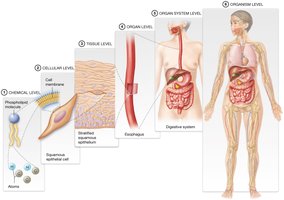
The human body is organized into a hierarchy of structural levels, each building on the previous one:
Chemical level: Atoms and molecules form the foundation of all matter.
Cellular level: Molecules combine to form cells, the basic units of life.
Tissue level: Groups of similar cells and their extracellular matrix perform common functions.
Organ level: Two or more tissue types form organs with specific shapes and functions.
Organ system level: Groups of organs work together to perform broad functions.
Organism level: All organ systems function together to maintain the life of the individual.
The 11 Organ Systems of the Human Body
The human body contains 11 organ systems, each with specialized functions essential for survival:
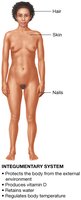
Integumentary
Skeletal
Muscular
Nervous
Endocrine
Cardiovascular
Lymphatic
Respiratory
Digestive
Urinary
Reproductive
Types of Anatomy and Physiology
Approaches to Study
Systemic anatomy: Study by organ systems.
Regional anatomy: Study by body regions.
Surface anatomy: Study of surface markings.
Gross anatomy: Study of structures visible to the naked eye.
Microscopic anatomy: Study of structures requiring a microscope (e.g., histology and cytology).
Physiology is often divided by organ system (e.g., neurophysiology, cardiovascular physiology) but can also focus on cellular or molecular levels.
The Language of Anatomy and Physiology
Terminology and Anatomical Position
Scientific terms are built from word roots, prefixes, and suffixes. The anatomical position is the standard reference for describing body parts and regions: standing upright, feet shoulder-width apart, arms at sides, palms facing forward.
Axial and Appendicular Regions
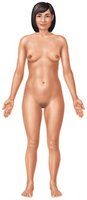
The body is divided into:
Axial region: Head, neck, and trunk.
Appendicular region: Upper and lower limbs (appendages).
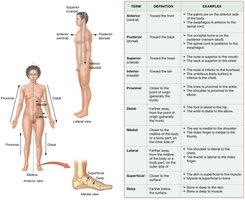
Directional Terms
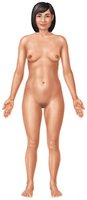
Directional terms describe the locations of body parts relative to each other. Common pairs include:
Term | Definition | Example |
|---|---|---|
Anterior (ventral) | Toward the front | The sternum is anterior to the heart. |
Posterior (dorsal) | Toward the back | The heart is posterior to the sternum. |
Superior (cranial) | Toward the head | The head is superior to the neck. |
Inferior (caudal) | Toward the tail | The neck is inferior to the head. |
Proximal | Closer to point of origin | The shoulder is proximal to the elbow. |
Distal | Farther from point of origin | The wrist is distal to the elbow. |
Medial | Closer to midline | The nose is medial to the eyes. |
Lateral | Farther from midline | The ears are lateral to the nose. |
Superficial | Closer to surface | The skin is superficial to muscles. |
Deep | Farther from surface | The bones are deep to the skin. |
Regional Terms
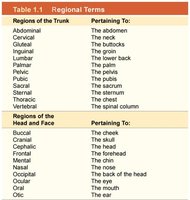
Regional terms specify areas of the body. The trunk, head, face, upper limb, and lower limb each have specific regional names.
Region | Pertaining To |
|---|---|
Abdominal | The abdomen |
Cervical | The neck |
Gluteal | The buttocks |
Brachial | The arm |
Femoral | The thigh |
Carpal | The wrist |
Tarsal | The ankle |
Planes of Section
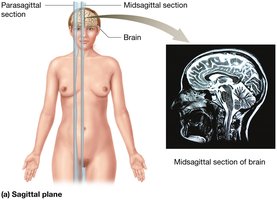
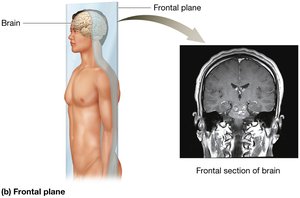
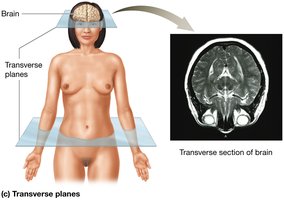
Three primary planes are used to divide the body for anatomical study:
Sagittal plane: Divides body into right and left sections (midsagittal = equal halves; parasagittal = unequal).
Frontal (coronal) plane: Divides body into anterior and posterior sections.
Transverse (horizontal) plane: Divides body into superior and inferior sections.
Oblique plane: Divides body at an angle; less commonly used.
Body Cavities and Membranes
Major Body Cavities
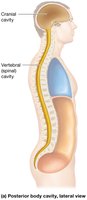
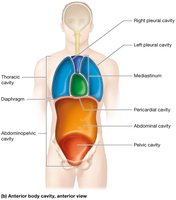
Body cavities are fluid-filled spaces that protect organs and allow for movement and expansion. The two main cavities are:
Posterior (dorsal) cavity: Includes cranial cavity (brain) and vertebral cavity (spinal cord).
Anterior (ventral) cavity: Includes thoracic cavity (pleural, mediastinum, pericardial) and abdominopelvic cavity (abdominal, pelvic, peritoneal).
Abdominopelvic Quadrants and Regions
The abdominopelvic cavity can be divided into four quadrants or nine regions to help localize organs and pain:
Quadrants: RUQ, RLQ, LUQ, LLQ
Regions: Right/left hypochondriac, epigastric, right/left lumbar, umbilical, right/left iliac, hypogastric
Serous Membranes
Serous membranes are thin sheets of tissue that line body cavities and cover organs. They consist of:
Visceral layer: In contact with the organ.
Parietal layer: Attached to surrounding structures.
Serous fluid: Lubricates and reduces friction between layers.
Core Principles in Anatomy and Physiology
Homeostasis
Homeostasis is the maintenance of a stable internal environment. It is achieved through homeostatic control systems involving:
Receptor: Detects changes in a variable.
Control center: Processes information and determines response.
Effector: Carries out the response to restore balance.
Most physiological processes operate to maintain homeostasis. Imbalances can lead to disease or death.
Feedback Loops
Negative feedback: Opposes initial change and returns variable to normal (e.g., body temperature regulation).
Positive feedback: Amplifies initial stimulus until a specific outcome is achieved (e.g., blood clotting, childbirth).
Other Core Principles
Structure and function: Form follows function at all levels of organization.
Gradients: Differences in concentration, pressure, or temperature drive physiological processes.
Cell-to-cell communication: Essential for coordination, often via chemical messengers or electrical signals.
Summary Table: The 11 Organ Systems
System | Main Organs | Primary Functions |
|---|---|---|
Integumentary | Skin, hair, nails | Protection, vitamin D synthesis, temperature regulation |
Skeletal | Bones, joints | Support, protection, movement, blood cell production |
Muscular | Skeletal muscles | Movement, heat production |
Nervous | Brain, spinal cord, nerves | Regulation, sensation, communication |
Endocrine | Glands (e.g., pituitary, thyroid) | Hormone secretion, regulation |
Cardiovascular | Heart, blood vessels | Transport, waste removal |
Lymphatic | Lymph nodes, vessels, spleen | Immunity, fluid balance |
Respiratory | Lungs, trachea | Gas exchange, acid-base balance |
Digestive | Stomach, intestines, liver | Digestion, absorption, waste elimination |
Urinary | Kidneys, bladder | Waste removal, fluid/electrolyte balance |
Reproductive | Ovaries/testes, uterus/prostate | Offspring production, hormone secretion |
Additional info: This guide covers the foundational concepts of anatomy and physiology, including terminology, organization, and core physiological principles. For further study, refer to subsequent chapters on specific systems and processes.
