 Back
BackIntroduction to Anatomy & Physiology: Foundational Concepts and Terminology
Study Guide - Smart Notes
 Tailored notes based on your materials, expanded with key definitions, examples, and context.
Introduction to Anatomy & Physiology
Definition and Scope
Anatomy is the study of the structure of body parts and their relationships to one another, while physiology concerns the function of the body and how its parts work together to sustain life. Understanding both is essential for comprehending how the human body operates in health and disease.
Gross anatomy: Study of large body structures visible to the naked eye.
Regional anatomy: Focuses on structures in a specific area of the body.
Systemic anatomy: Examines body systems (e.g., cardiovascular system).
Surface anatomy: Studies internal structures as related to the overlying skin.
Microscopic anatomy: Examines structures too small to be seen without magnification.
Developmental anatomy: Traces structural changes throughout the lifespan.
Levels of Structural Organization
Hierarchy of Complexity
All living things are composed of common elements, organized in a hierarchical structure from the simplest to the most complex:
Chemical level: Atoms and molecules essential for life.
Cellular level: Cells are the basic units of life.
Tissue level: Groups of similar cells performing a common function.
Organ level: Structures composed of at least two tissue types performing specific functions.
Organ system level: Groups of organs working together (11 major systems in the human body).
Organismal level: The complete individual.
Basic Anatomical Terminology
Anatomical Position and Regional Terms
The anatomical position is a standard reference in which the body stands erect, feet slightly apart, palms facing forward, and thumbs pointing away from the body. This position is used to describe locations and directions on the body.
Cephalic: Toward the head
Caudal: Toward the tail or lower part of the body
Dorsal: Toward the back
Ventral: Toward the front (belly side)
Prone: Lying face down
Supine: Lying face up
Contralateral: On the opposite side of the body
Ipsilateral: On the same side of the body
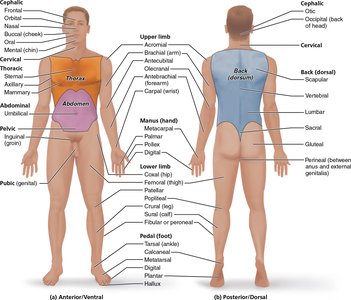
Orientation and Directional Terms
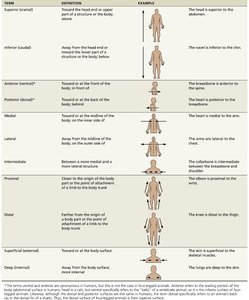
Directional terms are used to explain where one body structure is in relation to another. These terms are essential for clear communication in anatomy and medicine.
Term | Definition | Example |
|---|---|---|
Superior (cranial) | Toward the head or upper part of a structure | The head is superior to the abdomen. |
Inferior (caudal) | Away from the head or toward the lower part | The navel is inferior to the chin. |
Anterior (ventral) | Toward the front of the body | The breastbone is anterior to the spine. |
Posterior (dorsal) | Toward the back of the body | The heart is posterior to the breastbone. |
Medial | Toward the midline of the body | The heart is medial to the arm. |
Lateral | Away from the midline of the body | The arms are lateral to the chest. |
Intermediate | Between a more medial and a more lateral structure | The collarbone is intermediate between the breastbone and shoulder. |
Proximal | Closer to the origin of the body part | The thigh is proximal to the foot. |
Distal | Farther from the origin of a body part | The knee is distal to the thigh. |
Superficial | Toward or at the body surface | The skin is superficial to the skeleton. |
Deep | Away from the body surface | The lungs are deep to the rib cage. |
Planes of Section
Body Planes and Sections
Body planes are imaginary lines used to divide the body for anatomical study:
Sagittal plane: Divides the body into right and left parts.
Midsagittal (median): Divides the body into equal right and left halves.
Parasagittal: Divides the body into unequal right and left portions.
Transverse (horizontal) plane: Divides the body into superior and inferior parts.
Coronal (frontal) plane: Divides the body into anterior and posterior parts.
Oblique sections: Cuts made diagonally between horizontal and vertical planes.
Body Cavities
Major Body Cavities and Their Subdivisions
The body contains internal cavities that protect organs and allow for organ movement and expansion:
Dorsal body cavity: Protects the nervous system; includes the cranial cavity (brain) and vertebral cavity (spinal cord).
Ventral body cavity: Houses internal organs (viscera); subdivided into:
Thoracic cavity: Surrounded by ribs and chest muscles; includes right and left pleural cavities (lungs), mediastinum (central compartment), and pericardial cavity (heart).
Abdominopelvic cavity: Contains abdominal cavity (digestive organs) and pelvic cavity (urinary bladder, reproductive organs, rectum).
Membranes in the Ventral Body Cavity
Serous membranes (serosa) are double-layered membranes that line body cavities and cover organs:
Parietal layer: Lines the cavity walls.
Visceral layer: Covers the organs within the cavity.
Serous fluid: Lubricates and reduces friction between the layers.
Abdominopelvic Regions and Quadrants
Quadrants
The abdominopelvic cavity is divided into four quadrants for clinical reference:
Right Upper Quadrant (RUQ)
Left Upper Quadrant (LUQ)
Right Lower Quadrant (RLQ)
Left Lower Quadrant (LLQ)
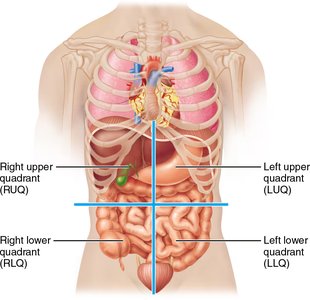
Regions
For more precise anatomical study, the abdominopelvic cavity is divided into nine regions:
Right hypochondriac
Epigastric
Left hypochondriac
Right lumbar
Umbilical
Left lumbar
Right iliac (inguinal)
Hypogastric (pubic)
Left iliac (inguinal)
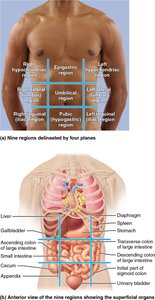
Overview of Organ Systems
Major Organ Systems and Their Functions
The human body is organized into 11 major organ systems, each with specific functions essential for survival:
Integumentary system: Protection of the body (skin, hair, nails).
Cardiovascular system: Transportation of blood, nutrients, gases, and wastes.
Nervous system: Communication via electrical signals (brain, spinal cord, nerves).
Digestive system: Breakdown and absorption of food.
Lymphatic system: Immune response and fluid balance.
Endocrine system: Hormonal communication and regulation.
Skeletal system: Structure, protection, and movement (206 named bones).
Muscular system: Movement of the body (over 600 named muscles).
Reproductive system: Production of offspring.
Urinary system: Removal of wastes, regulation of blood composition (kidneys, bladder).
Respiratory system: Gas exchange (oxygen and carbon dioxide).
