 Back
BackIntroduction to Anatomy & Physiology: Foundational Concepts and Homeostasis
Study Guide - Smart Notes
 Tailored notes based on your materials, expanded with key definitions, examples, and context.
Introduction to Anatomy & Physiology
Using the Text and Art Effectively
Mastering Anatomy & Physiology requires integrating textual information with visual aids. The textbook is structured in sections that build upon each other, and figures are placed near relevant text for clarity.
Strategy 1: Read the text, then study the corresponding image to reinforce understanding.
Strategy 2: Focus on learning outcomes, as they highlight essential knowledge and skills for assessment.
Strategy 3: Engage with your instructor, follow the syllabus, keep up with assignments, and utilize available study tools.

Defining Anatomy and Physiology
Basic Definitions and Relationship
Anatomy is the study of internal and external body structures and their relationships, while physiology focuses on how living organisms perform vital functions. These disciplines are closely integrated, as structure determines function—a concept known as the principle of complementarity.
Gross (Macroscopic) Anatomy: Study of large, visible structures.
Microscopic Anatomy: Study of structures requiring magnification (cells, tissues).
Specialties in Anatomy
Surface Anatomy: Study of external features.
Regional Anatomy: Focus on specific body areas.
Sectional Anatomy: Cross-sectional analysis of body structures.
Systemic Anatomy: Study of organ systems.
Clinical Anatomy: Application in clinical practice (e.g., pathological, radiologic, surgical anatomy).
Developmental Anatomy: Changes from fertilization to adulthood (including embryology).
Specialties in Physiology
Cell Physiology: Cellular functions and processes.
Organ Physiology: Functions of specific organs.
Systemic Physiology: Functions of organ systems.
Pathological Physiology: Effects of diseases on function.
Physicians use anatomical and physiological knowledge, along with chemical and psychological data, to diagnose diseases using the scientific method (observation, hypothesis, experimentation).
Levels of Organization in the Human Body
Hierarchy from Atoms to Organism
The human body is organized into six hierarchical levels, each building upon the previous:
Chemical Level: Atoms and molecules (e.g., proteins, DNA).
Cellular Level: Cells, the basic units of life.
Tissue Level: Groups of similar cells performing specific functions.
Organ Level: Structures composed of two or more tissue types.
Organ System Level: Groups of organs working together (11 major systems in humans).
Organism Level: The complete living individual.
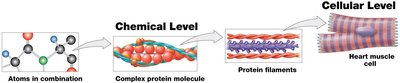
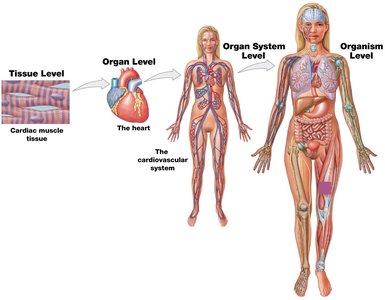
Major Organ Systems and Their Functions
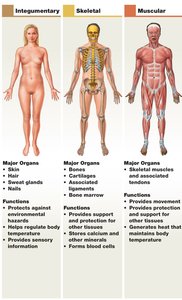
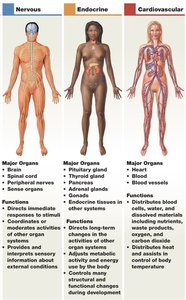
Each organ system has distinct structures and functions essential for homeostasis and survival.
System | Major Organs | Functions |
|---|---|---|
Integumentary | Skin, hair, sweat glands, nails | Protection, temperature regulation, sensory information |
Skeletal | Bones, cartilage, ligaments, bone marrow | Support, protection, mineral storage, blood formation |
Muscular | Skeletal muscles, tendons | Movement, support, heat production |
Nervous | Brain, spinal cord, nerves, sense organs | Immediate response, coordination, sensory input |
Endocrine | Pituitary, thyroid, adrenal glands, pancreas, gonads | Long-term changes, metabolic regulation, development |
Cardiovascular | Heart, blood, blood vessels | Transport, temperature regulation |
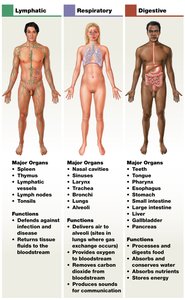
Lymphatic | Spleen, thymus, lymph nodes, vessels | Defense, fluid return |
Respiratory | Nasal cavities, sinuses, larynx, trachea, lungs | Gas exchange, sound production |
Digestive | Teeth, tongue, stomach, intestines, liver, pancreas | Digestion, absorption, water conservation |
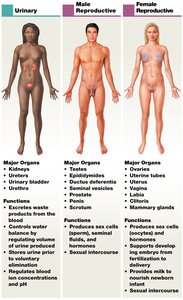
Urinary | Kidneys, ureters, bladder, urethra | Waste excretion, water balance, pH regulation |
Reproductive | Testes/ovaries, associated ducts and glands | Sexual function, reproduction |
Medical Terminology
Origins and Importance of Standardization
Medical terminology is constructed from word roots, prefixes, suffixes, and combining forms. Understanding these components aids in learning anatomy and physiology. While eponyms (names based on discoverers) are sometimes used, standardized terms are preferred for clarity and precision.
Anatomical Terminology
Body Regions, Sections, and Relative Positions
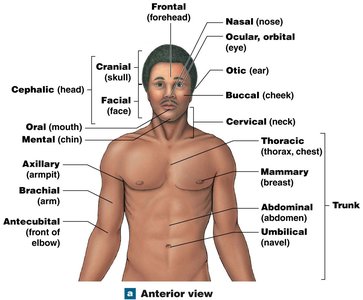
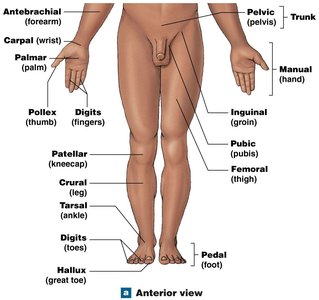
Surface anatomy identifies external landmarks, and the anatomical position (standing, palms forward) is the reference for describing locations and directions.
Anterior (front) and Posterior (back) views are standard perspectives.
Supine: Lying face up; Prone: Lying face down.
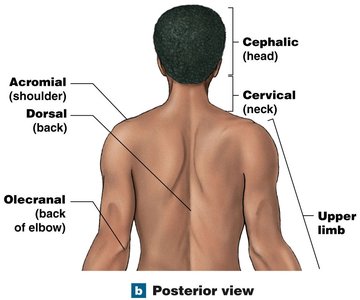
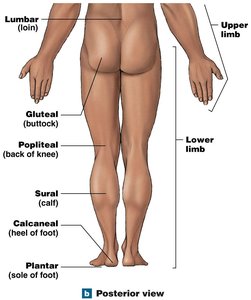
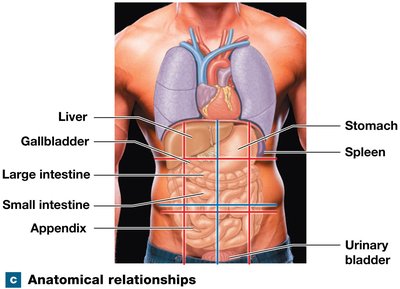
Abdominopelvic Quadrants and Regions
The abdominopelvic area is divided for clinical and anatomical reference:
Quadrants: Right Upper (RUQ), Left Upper (LUQ), Right Lower (RLQ), Left Lower (LLQ).
Regions: Nine regions for more precise localization (e.g., epigastric, umbilical, hypogastric).
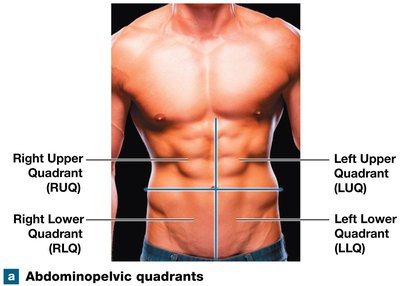
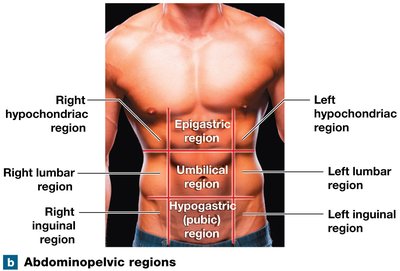
Directional References
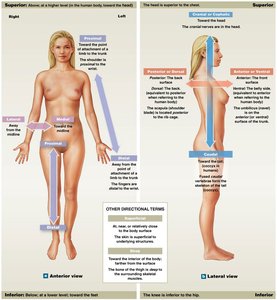
Directional terms describe the location of structures relative to others (e.g., superior, inferior, medial, lateral, proximal, distal).
Sectional Anatomy and Planes
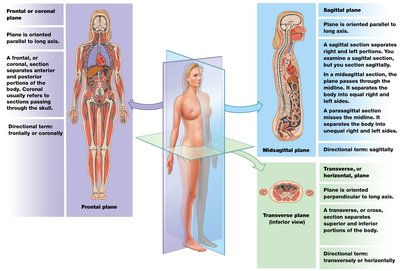
Sections and planes are used to visualize internal structures:
Frontal (coronal) plane: Divides body into anterior and posterior parts.
Sagittal plane: Divides body into left and right parts (midsagittal = equal halves).
Transverse (horizontal) plane: Divides body into superior and inferior parts.
Body Cavities
Major Cavities and Their Functions
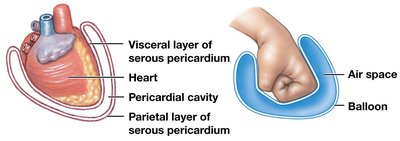
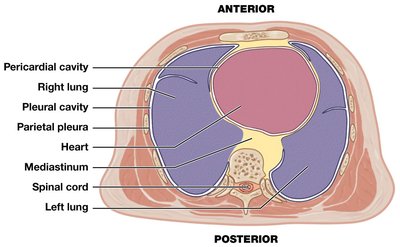
Body cavities are closed, fluid-filled spaces lined by serous membranes, housing and protecting vital organs (viscera). They allow organs to change size and shape and protect them from shock.
Serous membrane (serosa): Has parietal (lines cavity) and visceral (covers organ) layers, with serous fluid reducing friction.
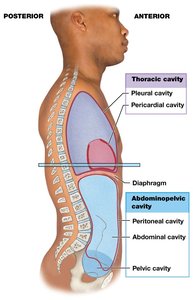
Thoracic Cavity
Divided from the abdominopelvic cavity by the diaphragm.
Contains right and left pleural cavities (lungs), pericardial cavity (heart), and mediastinum (central compartment).
Abdominopelvic Cavity
Extends from diaphragm to pelvis; contains abdominal (digestive organs) and pelvic (reproductive, urinary, rectum) cavities.
Peritoneal cavity: Lined by peritoneum; retroperitoneal organs (e.g., kidneys) lie behind it; infraperitoneal organs (e.g., bladder) extend below it.
Homeostasis
Definition and Mechanisms
Homeostasis is the maintenance of a stable internal environment through continuous physiological processes. It involves keeping variables (e.g., temperature, pH) within normal ranges despite external and internal changes.
Autoregulation: Local, automatic adjustment by cells, tissues, or organs.
Extrinsic regulation: Control by nervous (fast, short-term) or endocrine (slower, long-term) systems.
Homeostatic Regulatory Mechanism
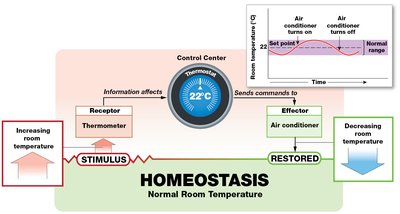
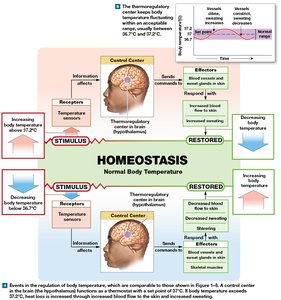
Receptor: Detects changes (stimulus).
Control Center: Processes information and sends commands.
Effector: Carries out the response to restore balance.
Negative and Positive Feedback
Types of Feedback in Homeostatic Regulation
Negative Feedback: The response opposes the original stimulus, maintaining variables within a normal range (e.g., body temperature regulation).
Positive Feedback: The response amplifies the original stimulus, used for rapid completion of processes (e.g., blood clotting).
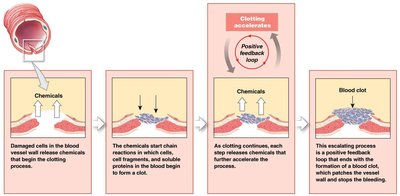
Systems Integration and Dynamic Equilibrium
Organ systems work together to maintain homeostasis. Adjustments in one system affect others, and the body maintains a dynamic equilibrium—constantly adapting to changes. Failure to maintain homeostasis leads to disease or death.
Table: Roles of Organ Systems in Homeostatic Regulation
Internal Stimulus | Primary Organ Systems Involved | Functions of the Organ Systems |
|---|---|---|
Body temperature | Integumentary, Muscular, Cardiovascular, Nervous | Heat loss, production, distribution, and coordination |
Nutrient concentration | Digestive, Cardiovascular, Urinary, Skeletal | Absorption, distribution, storage, and release of nutrients |
Oxygen, carbon dioxide levels | Respiratory, Cardiovascular | Gas exchange and transport |
Levels of toxins and pathogens | Lymphatic | Removal and inactivation of toxins/pathogens |
Body fluid volume | Urinary, Digestive, Integumentary, Cardiovascular, Lymphatic | Water balance and distribution |
Waste concentration | Urinary, Digestive, Cardiovascular | Excretion and transport of wastes |
Blood pressure | Cardiovascular, Nervous, Endocrine | Blood movement and pressure regulation |
