 Back
BackIntroduction to Anatomy & Physiology: Foundations, Organization, and Chemistry
Study Guide - Smart Notes
 Tailored notes based on your materials, expanded with key definitions, examples, and context.
Introduction to Anatomy & Physiology
Definitions and Scope
Anatomy is the study of the structure of body parts and their relationships to one another, while physiology focuses on the function of these parts and how they carry out life-sustaining activities. Anatomy can be divided into:
Gross (macroscopic) anatomy: Study of large, visible structures (regional, system, and surface anatomy).
Microscopic anatomy: Study of structures too small to be seen by the naked eye (cytology and histology).
Physiology is often subdivided by organ systems and focuses on cellular and molecular levels, requiring an understanding of basic physical and chemical principles.
Levels of Structural Organization
Hierarchy of Complexity
The human body is organized into a hierarchy of structural levels:
Chemical level: Atoms, molecules, and organelles.
Cellular level: Cells made of molecules (studied in cytology).
Tissue level: Groups of similar cells performing specific functions (studied in histology).
Organ level: Organs composed of different tissue types.
Organ system level: Different organs working together closely.
Organismal level: The human organism as a whole.
Necessary Life Functions
Basic Functions for Survival
Maintaining boundaries: Separation between internal and external environments (e.g., plasma membranes, skin).
Movement: Muscular system enables movement of the body and substances within the body.
Responsiveness: Ability to sense and respond to stimuli.
Digestion: Breakdown of food for absorption and use.
Metabolism: All chemical reactions in the body, including catabolism (breaking down) and anabolism (building up).
Excretion: Removal of wastes.
Reproduction: Cellular division for growth/repair and organismal reproduction.
Growth: Increase in size of a body part or organism.
Organ Systems Overview
Major Body Systems and Their Functions
Integumentary System: External body covering, protection, vitamin D synthesis, sensory receptors.
Skeletal System: Support, protection, movement, blood cell formation, mineral storage.
Muscular System: Movement, posture, heat production.
Nervous System: Fast-acting control, response to stimuli.
Endocrine System: Hormone secretion, regulation of processes.
Cardiovascular System: Blood transport, heart function.
Lymphatic System: Fluid return, immunity.
Respiratory System: Gas exchange (O2 and CO2).
Digestive System: Food breakdown, nutrient absorption, waste elimination.
Urinary System: Waste elimination, water/electrolyte/acid-base balance.
Reproductive Systems: Production of offspring, gamete and hormone production.
Homeostasis
Maintaining Internal Stability
Homeostasis is the maintenance of relatively stable internal conditions despite continuous environmental changes. Most diseases result from homeostatic imbalance.
Receptor: Monitors environment and detects changes (stimuli).
Control center: Determines set point, processes input, and directs response.
Effector: Carries out response to restore balance (muscles or glands).
Feedback mechanisms:
Negative feedback: Reduces or shuts off original stimulus (e.g., regulation of blood glucose, body temperature).
Positive feedback: Enhances original stimulus (e.g., blood clotting, labor contractions).
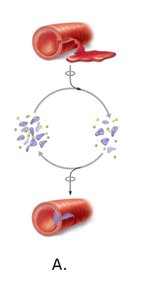
Feedforward response: Anticipatory response, such as salivation upon smelling food.
Directional and Regional Terms
Describing Body Locations
Superior (cranial): Toward the head/upper part.
Inferior (caudal): Away from the head/lower part.
Anterior (ventral): Toward the front.
Posterior (dorsal): Toward the back.
Medial: Toward the midline.
Lateral: Away from the midline.
Intermediate: Between medial and lateral.
Proximal: Closer to the origin/attachment.
Distal: Farther from the origin/attachment.
Superficial (external): Toward the surface.
Deep (internal): Away from the surface.
Major body divisions:
Axial: Head, neck, trunk.
Appendicular: Limbs.
Body Planes and Sections
Dividing the Body for Study
Sagittal plane: Divides body into right and left (midsagittal = midline, parasagittal = off-center).
Frontal (coronal) plane: Divides body into anterior and posterior parts.
Transverse (horizontal) plane: Divides body into superior and inferior parts.
Oblique section: Cuts at angles other than 90° to vertical plane.
Body Cavities and Membranes
Major Cavities and Their Subdivisions
Dorsal cavity: Protects the central nervous system (CNS), includes cranial and vertebral cavities.
Ventral cavity: Houses viscera, includes thoracic and abdominopelvic cavities, lined by serous membranes.
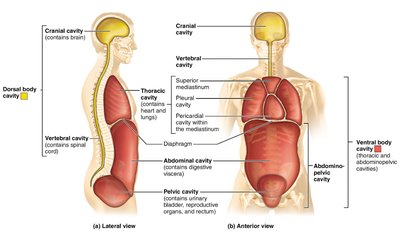
Types of membranes:
Cutaneous: Skin.
Mucous: Line cavities open to exterior.
Serous: Line cavities not open to exterior (ventral cavity).
Basic Chemistry for Anatomy & Physiology
Elements, Atoms, and Energy
All matter is composed of elements, which are substances that cannot be broken down by ordinary chemical means. Each element consists of atoms with a unique atomic symbol. The structure of an atom includes:
Protons: Positive charge, in nucleus.
Neutrons: Neutral, in nucleus.
Electrons: Negative charge, orbit nucleus.
Key atomic properties:
Atomic number: Number of protons.
Mass number: Protons + neutrons.
Atomic weight: Average of all isotopes' mass numbers.
Radioisotopes: Unstable isotopes that decay, emitting radiation.
Major and Minor Elements in the Body
Major elements (96%): Carbon, Hydrogen, Oxygen, Nitrogen (CHON).
Lesser elements (3.9%): Calcium, Phosphorus, Potassium, Sodium, Magnesium, etc.
Trace elements (<0.01%): 11 elements essential in minute amounts.
States and Forms of Matter
Solid: Definite shape and volume.
Liquid: Changeable shape, definite volume.
Gas: Changeable shape and volume.
Energy in Biological Systems
Energy: Capacity to do work; does not have mass or occupy space.
Kinetic energy: Energy in action.
Potential energy: Stored energy.
Forms of energy:
Chemical energy: Stored in bonds (e.g., ATP).
Electrical energy: Movement of charged particles (ions).
Mechanical energy: Direct movement of matter.
Radiant/electromagnetic energy: Travels in waves (light, heat, X-rays).
Energy conversions are inefficient; some energy is always lost as heat.
Tables
Major Elements and Their Functions
Element | Function in the Body |
|---|---|
Carbon (C) | Component of organic and inorganic molecules; needed for ATP production |
Oxygen (O) | Component of all organic molecules; essential for cellular respiration |
Hydrogen (H) | Component of all organic molecules; influences pH as an ion |
Nitrogen (N) | Component of proteins and nucleic acids |
Calcium (Ca) | Bone/teeth structure, muscle contraction, nerve conduction, blood clotting |
Phosphorus (P) | Bone/teeth structure, nucleic acids, ATP, phospholipids |
Potassium (K) | Major intracellular cation, nerve impulses, muscle contraction |
Sodium (Na) | Major extracellular cation, water balance, nerve impulses, muscle contraction |
Magnesium (Mg) | Bone structure, metabolic cofactor |
Additional info: This guide expands on the provided notes with definitions, examples, and academic context to ensure completeness and clarity for college-level Anatomy & Physiology students.
