 Back
BackIntroduction to Anatomy & Physiology: The Human Machine
Study Guide - Smart Notes
 Tailored notes based on your materials, expanded with key definitions, examples, and context.
Introduction to Anatomy & Physiology
Overview of the Human Machine
Anatomy and Physiology (A&P) is the foundational study of the human body, focusing on its structure (anatomy) and function (physiology). Understanding the human body as a complex machine involves learning about its components, how they interact, and the principles that govern their operation and maintenance.

Defining Anatomy and Physiology
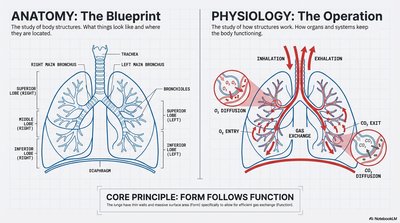
Anatomy: The Blueprint
Anatomy is the study of body structures, including their forms, locations, and relationships. It answers the question: What do body parts look like and where are they found?
Gross Anatomy: Study of structures visible to the naked eye (e.g., organs, muscles).
Microscopic Anatomy: Study of structures only visible under a microscope (e.g., cells, tissues).
Physiology: The Operation
Physiology is the study of how body structures work and how organs and systems keep the body functioning. It answers: How do these parts operate and interact?
Systemic Physiology: Study of the function of organ systems (e.g., cardiovascular, respiratory).
Cellular Physiology: Study of cell function and processes.
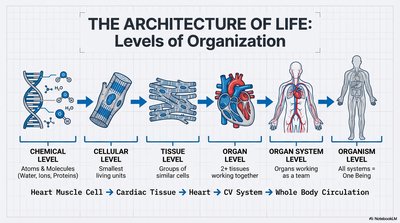
The Architecture of Life: Levels of Organization
Hierarchical Structure of the Human Body
The human body is organized into increasing levels of complexity, from the smallest chemical units to the entire organism.
Chemical Level: Atoms and molecules (e.g., water, ions, proteins).
Cellular Level: Smallest living units (cells).
Tissue Level: Groups of similar cells performing a common function.
Organ Level: Two or more tissue types working together (e.g., heart).
Organ System Level: Organs working as a team (e.g., cardiovascular system).
Organism Level: All systems functioning together as a living being.
Example: Heart muscle cell → Cardiac tissue → Heart → Cardiovascular system → Whole body circulation
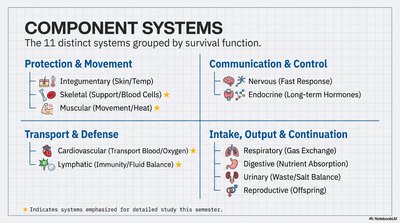
Component Systems of the Human Body
The 11 Major Organ Systems
The body is divided into 11 distinct systems, each with specialized survival functions. These systems are grouped by their primary roles:
Group | Systems | Main Functions |
|---|---|---|
Protection & Movement | Integumentary, Skeletal, Muscular | Skin/temperature, support/blood cells, movement/heat |
Transport & Defense | Cardiovascular, Lymphatic | Transport blood/oxygen, immunity/fluid balance |
Communication & Control | Nervous, Endocrine | Fast response, long-term hormones |
Intake, Output & Continuation | Respiratory, Digestive, Urinary, Reproductive | Gas exchange, nutrient absorption, waste/salt balance, offspring |
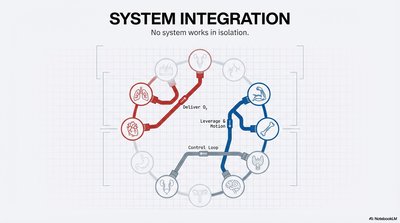
System Integration
Interdependence of Body Systems
No organ system works in isolation. Systems interact to deliver oxygen, leverage motion, and maintain control loops for homeostasis. For example, the respiratory and cardiovascular systems work together to deliver oxygen, while the nervous and endocrine systems coordinate responses.
Homeostasis: The Operating System
Maintaining Internal Stability
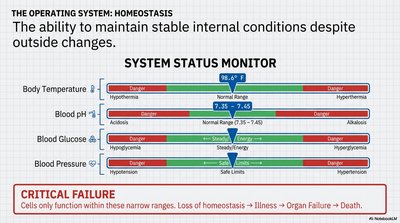
Homeostasis is the ability to maintain stable internal conditions despite external changes. It is essential for cell survival and overall health. Key variables include body temperature, blood pH, blood glucose, and blood pressure.
Normal Ranges: Each variable has a narrow range for optimal function (e.g., body temperature: 98.6°F, blood pH: 7.35–7.45).
Critical Failure: Loss of homeostasis can lead to illness, organ failure, or death.
Mechanisms of Regulation: Feedback Loops
Negative Feedback
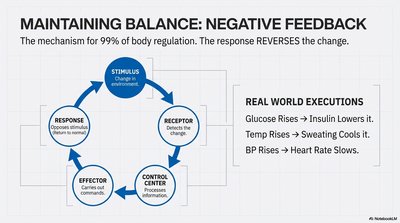
Negative feedback is the primary mechanism for body regulation, where the response reverses the initial change. This maintains balance and stability.
Steps: Stimulus → Receptor → Control Center → Effector → Response
Examples: Increased blood glucose triggers insulin release; increased temperature triggers sweating; increased blood pressure triggers heart rate reduction.
Positive Feedback
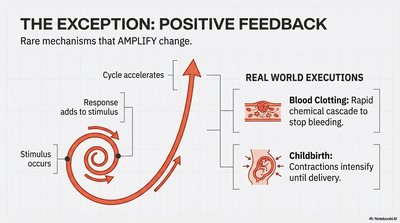
Positive feedback mechanisms amplify changes and are less common. They are used in processes that need rapid completion.
Examples: Blood clotting (cascade to stop bleeding), childbirth (intensifying contractions).
Standard Reference: Anatomical Position
Defining the Anatomical Position
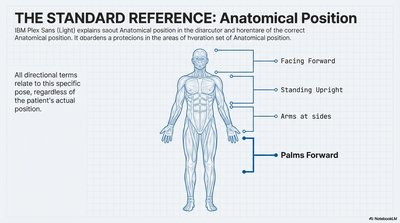
The anatomical position is the standard reference for describing body locations and directions. The body stands upright, facing forward, arms at the sides, and palms facing forward. All directional terms are based on this position, regardless of the patient's actual orientation.
Navigational Terms
Directional Language in Anatomy
Directional terms describe the location of body parts relative to one another in the anatomical position. These include:
Superior/Inferior: Above/below
Anterior/Posterior: Front/back
Medial/Lateral: Toward/away from midline
Proximal/Distal: Closer to/farther from trunk
Example: The elbow is proximal to the wrist. The nose is medial to the eyes.

Body Planes & Cavities
Anatomical Divisions and Spaces
Body planes are imaginary lines used to divide the body for reference and diagnosis:
Sagittal Plane: Divides left/right
Frontal (Coronal) Plane: Divides front/back
Transverse Plane: Divides top/bottom
Body cavities are internal spaces that house organs:
Dorsal Cavity: Cranial and spinal cavities (brain and spinal cord)
Ventral Cavity: Thoracic and abdominopelvic cavities (major organs of digestion, respiration, circulation, and reproduction)

Exam Strategy: Key Concepts
High-Priority Topics for Assessment
To excel in introductory A&P, focus on these five core areas:
Form Follows Function: Understand how structure supports function (e.g., lung walls and gas exchange).
Negative Feedback: Memorize the regulatory loop: Stimulus → Receptor → Control → Effector → Response.
Organ Systems: Know the functions of all 11 systems, with emphasis on skeletal, muscular, cardiovascular, and lymphatic systems.
Directional Terms: Apply anatomical language to describe relationships between body parts.
Body Planes: Visualize sagittal, frontal, and transverse cuts for reference and diagnosis.

