 Back
Introduction to Anatomy & Physiology: The Language of Anatomy and Organ Systems Overview
Study Guide - Smart Notes
 Tailored notes based on your materials, expanded with key definitions, examples, and context.
Introduction to Anatomy & Physiology
The Language of Anatomy
The language of anatomy is a standardized set of terms used by healthcare professionals and scientists to describe the structure and location of body parts accurately. This system ensures clear communication about the human body, regardless of language or location.
Anatomical Position: The reference position for anatomical terminology. The body , feet slightly apart, head and toes pointed forward, arms at sides, and palms facing forward.
Major Divisions:
Axial: Includes the head, neck, and trunk.
Appendicular: Includes the limbs (arms and legs).
Regional Terms: Specific names for areas of the body (e.g., brachial for arm, femoral for thigh).
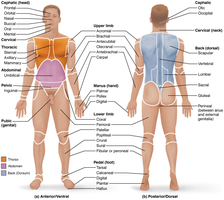
Directional Terms
Directional terms are used to describe the locations of structures relative to other structures or locations in the body.
Superior (cranial): Toward the head or upper part of a structure.
Inferior (caudal): Away from the head or toward the lower part of a structure.
Anterior (ventral): Toward the front of the body.
Posterior (dorsal): Toward the back of the body.
Medial: Toward the midline of the body.
Lateral: Away from the midline of the body.
Proximal: Closer to the point of attachment or origin.
Distal: Farther from the point of attachment or origin.
Body Planes
Body planes are imaginary lines that divide the body into sections, useful for describing locations and movements.
Sagittal Plane: Divides the body into left and right parts.
Frontal (Coronal) Plane: Divides the body into anterior and posterior parts.
Transverse (Horizontal) Plane: Divides the body into superior and inferior parts.
Body Cavities
The human body contains several cavities that house and protect internal organs.
Dorsal Cavity: Includes the cranial and spinal cavities.
Ventral Cavity: Includes the thoracic and abdominopelvic cavities.
Serous Membranes
Serous membranes line the ventral body cavities and cover the organs within these cavities. Each membrane has a visceral layer (touches the organ) and a parietal layer (lines the cavity wall), with serous fluid between them to reduce friction.
Pleura: Surrounds the lungs.
Pericardium: Surrounds the heart.
Peritoneum: Surrounds the abdominal cavity. Organs outside this membrane, such as the kidneys, are called retroperitoneal.
Abdominopelvic Quadrants and Regions
The abdominopelvic cavity is divided into quadrants and regions to help locate organs and describe pain or injury.
Quadrants: Right Upper, Left Upper, Right Lower, Left Lower.
Regions: Nine regions including epigastric, umbilical, hypogastric, etc.
Organ Systems Overview
The Eleven Human Body Organ Systems
The human body is organized into 11 major organ systems, each with specific organs and functions. Understanding these systems is fundamental to anatomy and physiology.
Cardiovascular System: Heart and blood vessels; transports blood, nutrients, gases, and wastes.
Digestive System: Stomach, intestines, liver, etc.; breaks down food and absorbs nutrients.
Endocrine System: Glands such as thyroid and adrenal; regulates body functions via hormones.
Integumentary System: Skin, hair, nails; protects the body and regulates temperature.
Lymphatic System: Lymph nodes, lymph vessels; defends against infection and disease.
Muscular System: Muscles; enables movement and maintains posture.
Nervous System: Brain, spinal cord, nerves; controls body activities and responds to stimuli.
Reproductive System: Ovaries, testes, etc.; produces offspring.
Respiratory System: Lungs, trachea; exchanges gases (oxygen and carbon dioxide).
Skeletal System: Bones, joints; supports and protects the body.
Urinary System: Kidneys, bladder; removes waste and maintains water balance.
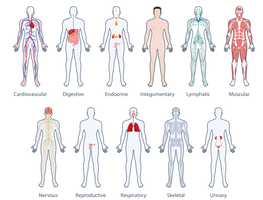
Table: Major Organ Systems, Organs, and Functions
System | Major Organs | Primary Functions |
|---|---|---|
Cardiovascular | Heart, blood vessels | Transport of nutrients, gases, wastes |
Digestive | Stomach, intestines, liver | Breakdown and absorption of food |
Endocrine | Glands (thyroid, adrenal) | Hormonal regulation |
Integumentary | Skin, hair, nails | Protection, temperature regulation |
Lymphatic | Lymph nodes, vessels | Immunity, fluid balance |
Muscular | Muscles | Movement, posture |
Nervous | Brain, spinal cord, nerves | Control, coordination |
Reproductive | Ovaries, testes | Reproduction |
Respiratory | Lungs, trachea | Gas exchange |
Skeletal | Bones, joints | Support, protection |
Urinary | Kidneys, bladder | Waste removal, water balance |
Lab Safety
Basic Laboratory Safety Rules
Lab safety is essential to prevent accidents and ensure a safe learning environment. Follow all posted rules and instructions from your instructor.
No open-toed shoes: Always wear closed-toe shoes in the lab to protect your feet from spills and dropped objects.

No food or drink: Eating or drinking in the lab is prohibited to avoid contamination and accidental ingestion of hazardous substances.

Exercises and Activities
Learning Activities
To reinforce your understanding, complete the following activities:
Use anatomical models and diagr
ams to locate and learn all body regions.
Practice identifying body planes and directional terms.
Review the major organ systems and their functions.
Evaluate your understanding by reviewing the learning outcomes at the beginning of each exercise.
Key Terms and Definitions
Anatomical Position: Standard reference position for anatomical terminology.
Axial: Head, neck, and trunk.
Appendicular: Limbs.
Directional Terms: Words describing location of body parts.
Body Planes: Imaginary lines dividing the body.
Serous Membranes: Double-layered membranes lining body cavities.
Retroperitoneal: Organs located behind the peritoneum.
Formulas and Equations
Example: Surface Area Calculation
While not directly covered in the notes, surface area calculations are sometimes relevant in physiology:
Additional info: This formula is used in clinical settings to calculate dosages and physiological parameters.
