 Back
BackIntroduction to Anatomy, Physiology, and Homeostasis
Study Guide - Smart Notes
 Tailored notes based on your materials, expanded with key definitions, examples, and context.
An Introduction to Anatomy and Physiology
Definitions and Scope
Anatomy is the study of the internal and external structures of the body and the physical relationships among body parts. It includes both gross anatomy (structures visible to the naked eye) and microscopic anatomy (structures only visible with a microscope).
Physiology is the study of how organisms perform their vital functions, focusing on the mechanisms that operate body systems.
Example: Studying the structure of the heart (anatomy) versus understanding how it pumps blood (physiology).
Homeostasis
Definition and Importance
Homeostasis is the maintenance of a relatively constant internal environment, despite changes in the external environment. It is essential for the survival of cells and, by extension, the organism.
Homeostatic regulation involves adjustments of physiological systems to preserve a stable internal state.
Examples include regulation of body temperature, water levels, blood pressure, oxygen and carbon dioxide levels, and blood glucose.
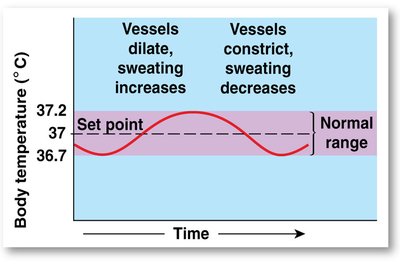
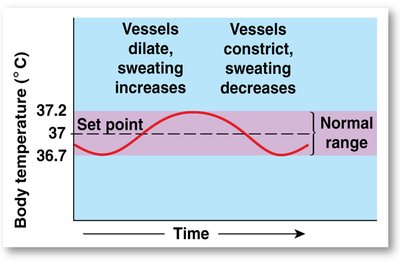
Example: When body temperature rises above normal, mechanisms such as sweating and dilation of blood vessels help cool the body.
Dynamic Nature of Homeostasis
Homeostasis is a dynamic process—internal conditions fluctuate within a normal range rather than remaining absolutely constant. When the environment changes, cells, tissues, or organ systems adjust their activity to maintain balance.
Normal body temperature is about 37°C (98.6°F), but slight deviations are tolerated.
Components of Homeostatic Regulation
Key Elements
Receptor: A sensor that detects changes (stimuli) in the environment.
Control Center: Processes information from the receptor and determines the appropriate response (often the brain or central nervous system).
Effector: Produces a response that restores the internal environment to its set point.
Example: In temperature regulation, skin receptors sense heat, the hypothalamus (control center) processes this information, and sweat glands (effectors) increase sweat production.
Methods of Homeostatic Regulation
Extrinsic vs. Intrinsic Regulation
Extrinsic Regulation: Involves the nervous or endocrine system, which sends signals to multiple parts of the body, resulting in a widespread response.
Intrinsic Regulation (Autoregulation): Occurs when cells, tissues, or organs sense environmental changes and activate local response mechanisms.
Example: Salivating when eating (intrinsic), or the nervous system increasing heart rate during exercise (extrinsic).
Types of Homeostatic Responses
Negative Feedback
Negative feedback is the most common homeostatic response. It occurs when a deviation from the normal range triggers a response that opposes or negates the change, restoring balance.
Receptor senses a stimulus outside the normal range.
Control center activates the effector.
Effector produces a response to correct the situation.
Example: If body temperature rises, mechanisms such as sweating and vasodilation lower it back to normal.
Positive Feedback
Positive feedback is less common. It occurs when a response amplifies or enhances the original stimulus, moving the system further from its starting condition.
Receptor senses a stimulus.
Control center activates the effector.
Effector produces a response that exaggerates the condition.
Examples: Blood clotting (platelets continue to aggregate until bleeding stops), labor contractions, and vomiting.
Homeostasis and Disease
Failure of Homeostatic Mechanisms
When homeostatic mechanisms fail, the body cannot maintain internal stability. This can result from infection, injury, or genetic abnormalities, potentially leading to disease or death.
Example: Uncontrolled blood glucose in diabetes mellitus.
Additional info: Homeostatic imbalance is a major underlying factor in many diseases, emphasizing the importance of these regulatory mechanisms for health.
