 Back
BackIntroduction to Human Anatomy and Physiology: Organization, Systems, and Terminology
Study Guide - Smart Notes
 Tailored notes based on your materials, expanded with key definitions, examples, and context.
Overview of Anatomy and Physiology
Definitions and Subdivisions
Anatomy is the study of the structure of body parts and their relationships to one another, while physiology is the study of the function of the body’s structural machinery. Anatomy is subdivided into:
Gross (macroscopic) anatomy: Study of large body structures visible to the naked eye (e.g., regional, surface, and systemic anatomy).
Microscopic anatomy: Study of structures too small to be seen with the naked eye (e.g., cytology and histology).
Developmental anatomy: Study of structural changes throughout the lifespan (e.g., embryology).
Physiology focuses on the function of body systems at multiple levels, from molecular to organismal.
Levels of Structural Organization
Hierarchical Organization of the Human Body
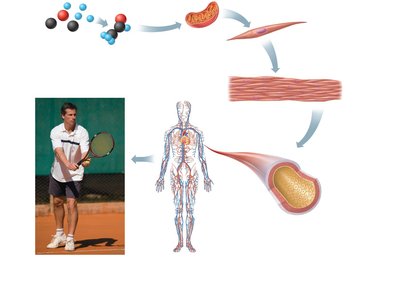
The human body is organized into six structural levels:
Chemical level: Atoms combine to form molecules.
Cellular level: Cells are made up of molecules and organelles.
Tissue level: Tissues consist of groups of similar cells performing a common function.
Organ level: Organs are made up of different types of tissues.
Organ system level: Organ systems consist of different organs that work together closely.
Organismal level: The human organism is made up of many organ systems.
Each level builds upon the previous, creating increasing complexity and specialization.
Organ Systems Interrelationships
Cooperation Among Organ Systems
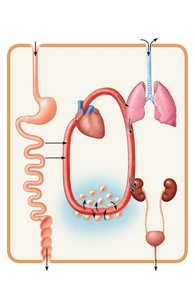
All cells depend on organ systems to meet their survival needs. Organ systems work cooperatively to perform necessary life functions, such as nutrient acquisition, waste removal, and protection.
Digestive system: Takes in nutrients, breaks them down, and eliminates unabsorbed matter.
Respiratory system: Takes in oxygen and eliminates carbon dioxide.
Cardiovascular system: Distributes oxygen and nutrients via blood, and delivers wastes to disposal organs.
Urinary system: Eliminates nitrogenous wastes and excess ions.
Integumentary system: Protects the body from the external environment.
Necessary Life Functions
Essential Functions for Survival
To maintain life, the body must perform several essential functions:
Maintaining boundaries: Separation between internal and external environments (e.g., plasma membranes, skin).
Movement: Of body parts (skeletal muscle) and substances (cardiac and smooth muscle).
Responsiveness: Ability to sense and respond to stimuli (e.g., withdrawal reflex, control of breathing rate).
Digestion: Breakdown of ingested food and absorption of nutrients.
Metabolism: All chemical reactions in body cells, including catabolism and anabolism.
Excretion: Removal of wastes from metabolism and digestion (e.g., urea, carbon dioxide, feces).
Reproduction: Cellular division for growth or repair, and production of offspring.
Growth: Increase in size of a body part or organism.
Homeostasis
Maintaining Internal Stability
Homeostasis is the maintenance of a relatively stable internal environment despite continuous external changes. It is a dynamic state of equilibrium, achieved through continuous monitoring and regulation of variables by the nervous and endocrine systems.
Homeostatic Control Mechanisms
Receptor (sensor): Monitors the environment and responds to stimuli.
Control center: Determines the set point, receives input, and determines the appropriate response.
Effector: Receives output and provides the means to respond, reducing or enhancing the stimulus (feedback).
Feedback Mechanisms
Negative feedback: The response reduces or shuts off the original stimulus (e.g., regulation of body temperature, blood volume).
Positive feedback: The response enhances or exaggerates the original stimulus, often in infrequent events (e.g., labor contractions, blood clotting).
Homeostatic Imbalance
Disturbance of homeostasis increases risk of disease, contributes to aging, and may allow destructive positive feedback mechanisms to take over (e.g., heart failure).
Anatomical Position and Directional Terms
Standard Reference Position
The standard anatomical position is: body erect, feet slightly apart, and palms facing forward. Directional terms are used to describe locations and relationships of body parts.
Regional Terms
Major Body Divisions
Axial: Head, neck, and trunk.
Appendicular: Limbs.
Body Planes
Planes of Section
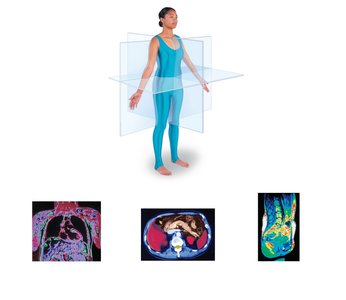
Body planes are flat surfaces along which the body or structures are cut for anatomical study:
Sagittal plane: Divides body vertically into right and left sections.
Midsagittal (median) plane: Lies on the midline.
Parasagittal plane: Not on the midline.
Frontal (coronal) plane: Divides body vertically into anterior and posterior sections.
Transverse (horizontal) plane: Divides body horizontally into superior and inferior sections; produces a cross section.
Oblique section: Cuts made diagonally.
Body Cavities
Dorsal and Ventral Body Cavities
Body cavities protect organs and allow changes in size and shape:
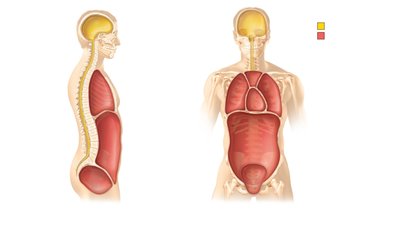
Dorsal cavity: Protects the nervous system.
Cranial cavity: Encases the brain.
Vertebral cavity: Encases the spinal cord.
Ventral cavity: Houses internal organs (viscera).
Thoracic cavity: Contains heart and lungs.
Abdominopelvic cavity: Contains digestive organs, urinary bladder, reproductive organs, and rectum.
Ventral Body Cavity Subdivisions
Thoracic cavity:
Two pleural cavities (each houses a lung).
Pericardial cavity (encloses heart).
Mediastinum (area between sternum and thoracic spine, contains pericardial cavity and thoracic organs).
Abdominopelvic cavity:
Abdominal cavity (stomach, intestines, spleen, liver).
Pelvic cavity (urinary bladder, reproductive organs, rectum).
Serous Membranes (Serosa)
Structure and Function
Serous membranes are thin, double-layered membranes separated by serous fluid:
Parietal serosa: Lines internal body walls.
Visceral serosa: Covers internal organs.
Examples include parietal and visceral peritoneum (abdominal organs), pericardium (heart), and pleura (lungs).
Abdominopelvic Regions and Quadrants
Divisions for Anatomical and Clinical Reference
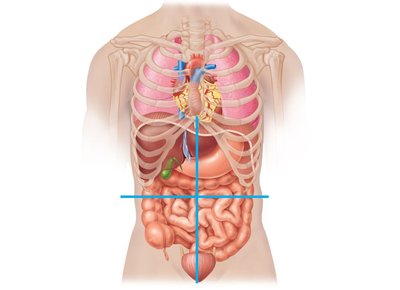
Abdominopelvic regions: Nine divisions used primarily by anatomists.
Abdominopelvic quadrants: Four divisions used primarily by medical personnel.
Other Body Cavities
Additional Cavities
Oral and digestive cavities
Nasal cavity
Orbital cavities
Middle ear cavities
Synovial cavities
These cavities serve specialized functions in protection, sensation, and movement.
