 Back
Introduction to Human Anatomy and Physiology: Foundational Concepts and Cellular Processes
Study Guide - Smart Notes
 Tailored notes based on your materials, expanded with key definitions, examples, and context.
The Human Body: An Orientation
Definition and Scope of Anatomy
Anatomy is the study of the structure and shape of the body and its parts. It involves observation to understand the sizes and relationships of different body parts. Anatomy is divided into:
Gross Anatomy: Study of large, easily identifiable structures.
Microscopic Anatomy: Study of structures that require a microscope to be seen.
Definition and Scope of Physiology
Physiology is the study of how the body and its parts function. The principle of 'form fits function' means that the structure of cells and organs is closely related to their function. For example:
Alveoli in the lungs are thin-walled to facilitate gas exchange.
Ciliated cells in the small intestine increase nutrient absorption and help move waste.
Levels of Structural Organization
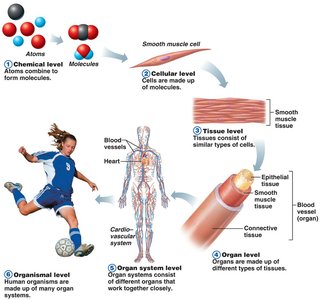
The human body is organized into hierarchical levels, each building on the previous one:
Chemical Level: Atoms combine to form molecules.
Cellular Level: Cells are the basic units of life.
Tissue Level: Tissues consist of similar types of cells.
Organ Level: Organs are made up of different types of tissues.
Organ System Level: Organ systems consist of different organs that work together.
Organismal Level: The human organism is made up of many organ systems.
Chemistry Comes Alive: The Cell Theory and Membrane Structure
Cell Theory
The cell theory is a fundamental concept in biology, stating that:
All living things are composed of cells.
The cell is the basic unit of life and the smallest unit capable of independent survival.
All cells arise from pre-existing cells.
All cells contain genetic material.
Cells are classified as either prokaryotic or eukaryotic.
Cellular Membrane: Phospholipids and the Fluid-Mosaic Model
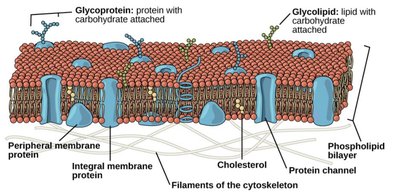
All animal cells possess a plasma membrane composed of a phospholipid bilayer. This membrane acts as a barrier to the external environment and is described by the fluid-mosaic model, which includes:
Phospholipid bilayer
Various membrane proteins (integral and peripheral)
Cholesterol for membrane fluidity
Glycoproteins and glycolipids for cell recognition
Cells: The Living Units
Cellular Communication and Connection
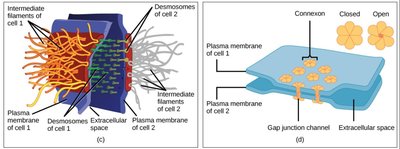
Cells communicate and connect through specialized structures such as desmosomes and gap junctions, which facilitate adhesion and communication between adjacent cells.
Exchange Through Membranes
Diffusion
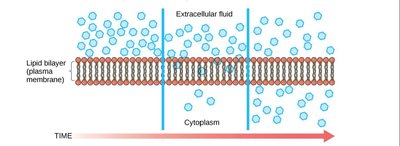
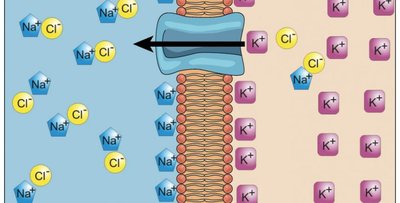
Diffusion is the net movement of molecules from an area of high concentration to an area of low concentration. It is a passive process influenced by:
Concentration gradient
Temperature
Surface area
Diffusion distance
Size of molecule
The cell membrane is selectively permeable, allowing only certain substances to pass through.
Facilitated Diffusion
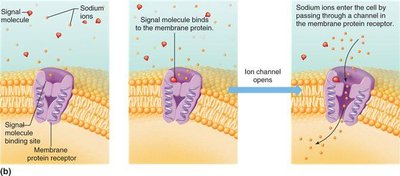
Facilitated diffusion involves the movement of molecules across the plasma membrane via carrier proteins or ion channels. This process is also passive but requires membrane proteins to assist the transport of substances that cannot diffuse directly through the lipid bilayer.
Active Transport
Active transport moves molecules from a region of low concentration to high concentration, against the concentration gradient. This process requires energy (ATP) and involves specific carrier proteins, such as the sodium-potassium pump.
Equation for Active Transport (Sodium-Potassium Pump):
Endocytosis
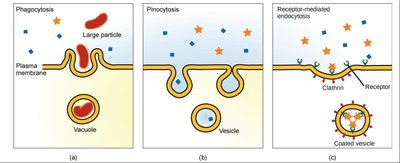
Endocytosis is the process by which cells take in material by engulfing it in a membrane-bound vesicle. There are three main types:
Phagocytosis: Engulfment of large particles.
Pinocytosis: Engulfment of extracellular fluid.
Receptor-mediated endocytosis: Specific molecules are taken in after binding to receptors.
Exocytosis
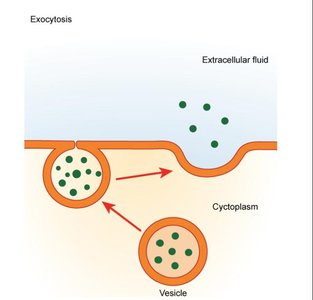
Exocytosis is the process by which cells expel materials in membrane-wrapped packages (vesicles) that fuse with the plasma membrane, releasing their contents outside the cell.
Osmosis
Osmosis is the net movement of water molecules through a selectively permeable membrane. The direction of water movement depends on the relative concentration of solutes inside and outside the cell:
Isotonic: Equal water concentration inside and outside; no net movement.
Hypotonic: Lower solute concentration outside; water enters the cell, causing it to swell.
Hypertonic: Higher solute concentration outside; water leaves the cell, causing it to shrink.
Structural Organization of Organ Systems
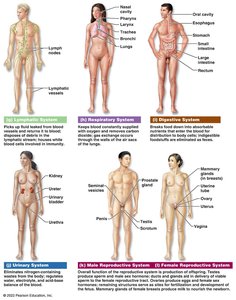
Organ systems are groups of organs that work together to perform complex functions necessary for life. Examples include the digestive, respiratory, cardiovascular, urinary, and reproductive systems.
Maintaining Life
Necessary Life Functions
Maintaining boundaries: Separation of internal and external environments.
Movement: Locomotion and movement of substances within the body.
Responsiveness (Irritability): Ability to sense and respond to changes.
Digestion: Breakdown and absorption of nutrients.
Metabolism: All chemical reactions in the body, including catabolism (breaking down molecules) and anabolism (building molecules). Regulated by hormones and produces energy (ATP).
Excretion: Removal of metabolic wastes (urine, feces, sweat).
Reproduction: Formation of new cells for growth and repair, or new organisms.
Growth: Increase in size and number of cells, regulated by hormones.
Survival Needs
Nutrients: Chemicals for energy and cell building (carbohydrates, proteins, lipids, vitamins, minerals).
Oxygen: Required for cellular respiration and energy production.
Water: Most abundant chemical in the body; essential for chemical reactions and as a solvent.
Normal body temperature: Necessary for proper metabolic reactions (approx. 37°C).
Atmospheric pressure: Required for adequate gas exchange in the lungs.
