Back
Introduction to Human Anatomy and Physiology: The Human Body—An Orientation
Study Guide - Smart Notes
 Tailored notes based on your materials, expanded with key definitions, examples, and context.
The Sciences of Anatomy and Physiology
Definition and Scope
Anatomy is the study of the form and structure of the body, focusing on the relationships among body parts and the structure of individual organs. Physiology examines how the body functions, including the mechanisms by which organs and systems operate under both normal and abnormal conditions. The structure of a body part is closely related to its function, making the two sciences inseparable for understanding health and human performance.
The Body’s Levels of Organization: From Simplest to Most Complex
Hierarchical Organization
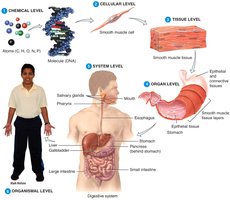
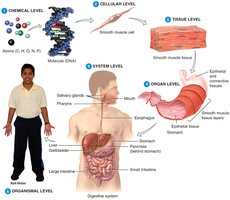
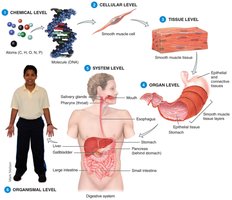
The human body is organized into a hierarchy of levels, each building upon the previous:
Chemical level: Involves atoms (e.g., O, C, H, N) and molecules (e.g., proteins, carbohydrates, fats, nucleic acids).
Cellular level: Consists of cells, the basic structural and functional units of life, which vary widely in structure and specialization.
Tissue level: Groups of similar cells performing common functions. Four types: epithelial, connective, muscle, and nervous tissue.
Organ level: Structures composed of two or more tissue types performing specific functions.
System level: Related organs working together to achieve a common function.
Organismal level: All body systems functioning interdependently in a living being.
Chemical Level
Atoms are the smallest units of matter, and molecules are combinations of atoms. The four major molecules of life are:
Proteins
Carbohydrates
Fats
Nucleic Acids
Cellular Level
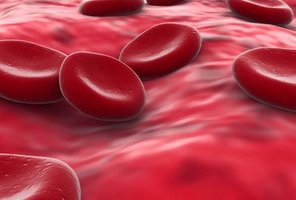
Cells are the basic units of life, each with specialized structures and functions. For example, red blood cells transport oxygen, while muscle cells contract to produce movement.
Tissue Level
Tissues are groups of similar cells that perform common functions. The four primary tissue types are:
Epithelial tissue: Covers exposed surfaces and lines body cavities.
Connective tissue: Protects, supports, and binds structures and organs.
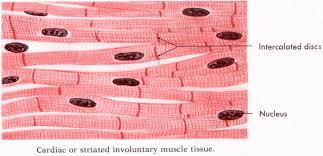
Muscle tissue: Produces movement.
Nervous tissue: Conducts nerve impulses.
Organ, System, and Organismal Levels
Organs are composed of two or more tissue types working together for specific functions. Organ systems consist of related organs that cooperate to achieve a common purpose. The organismal level represents the living human being, where all systems function together.
Introduction to Organ Systems
The Eleven Organ Systems of the Human Body
The human body contains eleven organ systems, each with specific components and functions:
System | Main Components | Main Functions |
|---|---|---|
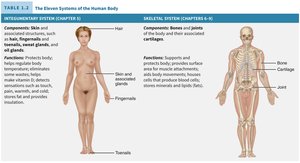
Integumentary | Skin, hair, nails, sweat glands | Protection, temperature regulation, sensation |
Skeletal | Bones, joints, cartilage | Support, protection, movement, blood cell production |
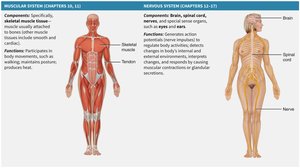
Muscular | Skeletal muscles | Movement, heat production |
Nervous | Brain, spinal cord, nerves | Control, communication, response to stimuli |
Endocrine | Glands (e.g., pituitary, thyroid) | Hormone production, regulation of body processes |
Cardiovascular | Heart, blood vessels | Transport of nutrients, gases, wastes |
Lymphatic | Lymph nodes, vessels, spleen | Immunity, fluid balance |
Respiratory | Lungs, trachea, bronchi | Gas exchange |
Digestive | Mouth, stomach, intestines | Breakdown and absorption of nutrients |
Urinary | Kidneys, bladder | Waste elimination, water balance |
Reproductive | Testes/ovaries, associated organs | Production of offspring |
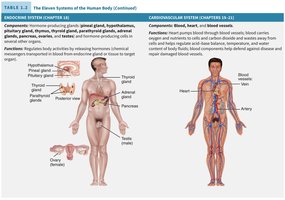
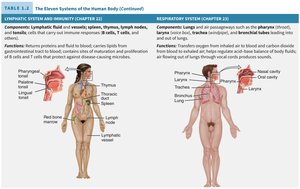
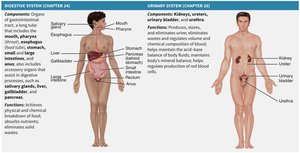
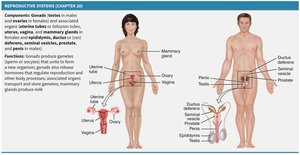
Characteristics of Living Things
Defining Features
Metabolism: All chemical reactions in the body. Includes anabolism (building up) and catabolism (breaking down).
Responsiveness: Ability to sense and react to changes.
Movement: Motion of the body, organs, cells, and internal structures.
Growth: Increase in size and/or number of cells.
Differentiation: Development of specialized cells from unspecialized states.
Reproduction: Production of new cells for growth, repair, and the creation of new organisms.
Anatomic Position and Directional Terms
Anatomic Position
The standard reference position for the body is the anatomic position: upright stance, feet parallel and flat, arms at sides, palms facing forward, head level, and eyes forward. Prone refers to lying face down; supine refers to lying face up.
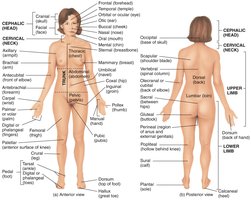
Regional Names
The body is divided into regions for anatomical reference, including the cephalic (head), cervical (neck), thoracic (chest), abdominal, pelvic, upper limb, and lower limb regions.
Directional Terms
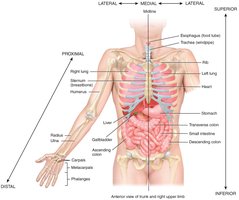
Directional terms describe the positions of structures relative to each other:
Anterior (ventral): Front of the body
Posterior (dorsal): Back of the body
Superior (cranial): Toward the head
Inferior (caudal): Toward the feet
Medial: Toward the midline
Lateral: Away from the midline
Proximal: Closer to the point of attachment
Distal: Farther from the point of attachment
Superficial: Toward the surface
Deep: Away from the surface
Ipsilateral: On the same side
Contralateral: On the opposite side
Planes and Sections of the Body
Body Planes
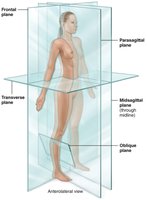
Imaginary flat surfaces, or planes, are used to divide the body for anatomical study:
Coronal (frontal) plane: Divides the body into anterior and posterior parts.
Transverse (horizontal) plane: Divides the body into superior and inferior parts.
Midsagittal plane: Divides the body into equal left and right halves.
Parasagittal plane: Divides the body into unequal left and right parts.
Oblique plane: Passes through the body at an angle.
Regional Anatomy
Axial and Appendicular Regions
The body is divided into two main regions:
Axial region: Head, neck, and trunk (main vertical axis)
Appendicular region: Upper and lower limbs (appendages)
Body Cavities and Membranes
Major Body Cavities
Body cavities are spaces that protect, separate, and support internal organs. The two main cavities are:
Posterior (dorsal) cavity: Cranial cavity (houses the brain) and vertebral canal (houses the spinal cord), both encased in bone.
Ventral (anterior) cavity: Larger, anteriorly placed, and not completely encased in bone. Divided by the diaphragm into the thoracic and abdominopelvic cavities.
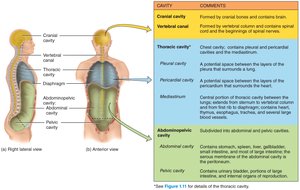
Serous Membranes
Serous membranes line body cavities and consist of two layers:
Parietal layer: Lines the internal surface of the body wall.
Visceral layer: Covers the external surface of organs (viscera).
The space between these layers is the serous cavity, filled with serous fluid to reduce friction from organ movement.
Abdominopelvic Regions and Quadrants
Quadrants
The abdominopelvic cavity can be divided into four quadrants using transverse and midsagittal planes through the umbilicus:
Right upper quadrant (RUQ)
Left upper quadrant (LUQ)
Right lower quadrant (RLQ)
Left lower quadrant (LLQ)
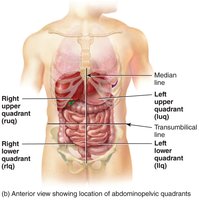
Regions
For more precise anatomical reference, the abdominopelvic cavity is divided into nine regions:
Umbilical region: Center, around the navel
Epigastric region: Superior to the umbilical region
Hypogastric region: Inferior to the umbilical region
Right and left hypochondriac regions: Lateral to the epigastric region
Right and left lumbar regions: Lateral to the umbilical region
Right and left iliac (inguinal) regions: Lateral to the hypogastric region