 Back
Introduction to Human Anatomy and Physiology: Orientation and Foundational Concepts
Study Guide - Smart Notes
 Tailored notes based on your materials, expanded with key definitions, examples, and context.
The Human Body: An Orientation
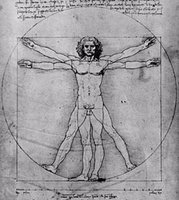
Definition and Scope of Anatomy
Anatomy is the scientific study of the structure of living organisms, focusing on the physical organization and relationships of body parts. It provides the foundational knowledge necessary to understand how the human body is built and how its parts interact.
Gross (Macroscopic) Anatomy: Study of structures visible to the naked eye, such as organs and organ systems.
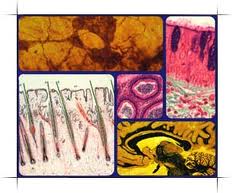
Microscopic Anatomy: Study of structures too small to be seen without a microscope, including cells and tissues.
Developmental Anatomy: Study of structural changes throughout the lifespan, from conception to adulthood.
Definition and Scope of Physiology
Physiology is the study of the functions and mechanisms occurring in living organisms. It explains how anatomical structures operate and interact to sustain life.
Cell Physiology: Examines the functions of cells, the basic units of life.
Special Physiology: Focuses on the functions of specific organs.
Systemic Physiology: Studies the function of organ systems.
Pathological Physiology: Investigates the effects of diseases on organ or system function.
Principle of Complementarity of Structure and Function
This principle states that the function of a body part is dependent on its structure, and the structure is formed to suit its function. For example, the heart's valves are structured to ensure blood flows in only one direction, preventing backflow.
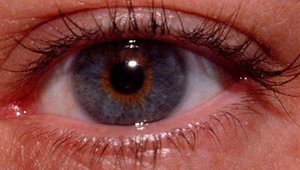
Example: The iris of the eye dilates and contracts to regulate the amount of light entering the eye, demonstrating how structure enables function.
Levels of Structural Organization in the Human Body
Hierarchy of Organization
The human body is organized into a hierarchy of structural levels, each building upon the previous one to create a functional organism.
Chemical Level: Atoms and molecules (e.g., proteins, carbohydrates, nucleic acids, lipids).
Cellular Level: Cells are the smallest units of life, composed of organelles.
Tissue Level: Groups of similar cells performing a common function (e.g., muscle tissue).
Organ Level: Two or more tissue types working together (e.g., stomach).
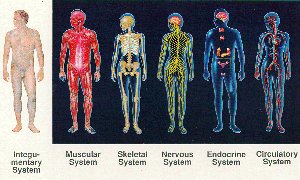
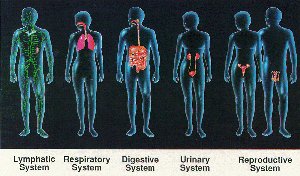
Organ System Level: Organs working together for a common purpose (e.g., digestive system).
Organismal Level: The complete living being, composed of many organ systems (e.g., human).
The Language of Anatomy
Anatomical Position and Terminology
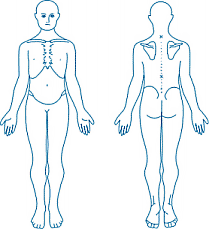
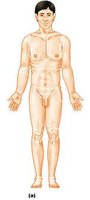
To describe body parts and positions accurately, anatomists use standardized terms and reference positions. The anatomical position is standing upright, facing forward, arms at the sides with palms facing forward.
Directional Terms
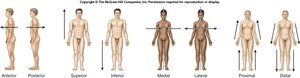
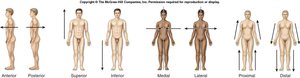
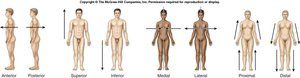
Directional terms are used to describe the locations of structures relative to other structures or locations in the body.
Superior (Cephalic): Toward the head or upper part of a structure.
Inferior (Caudal): Away from the head or toward the lower part of a structure.
Anterior (Ventral): Toward the front of the body.
Posterior (Dorsal): Toward the back of the body.
Medial: Toward the midline of the body.
Lateral: Away from the midline of the body.
Proximal: Closer to the origin of a body part or point of limb attachment.
Distal: Farther from the origin of a body part or point of limb attachment.
Superficial: Toward or at the body surface.
Deep: Away from the body surface; more internal.
Body Planes and Sections
Major Body Planes
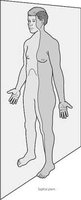
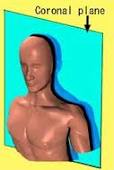
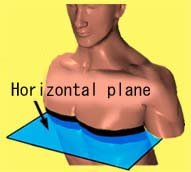
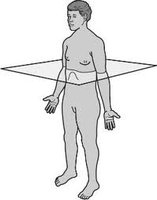
Body planes are imaginary lines used to divide the body into sections for anatomical study and medical imaging.
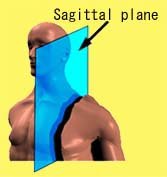
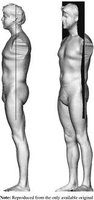
Sagittal Plane: Divides the body into right and left parts. The midsagittal (median) plane divides the body into equal right and left halves.
Frontal (Coronal) Plane: Divides the body into anterior (front) and posterior (back) parts.
Transverse (Horizontal) Plane: Divides the body into superior (upper) and inferior (lower) parts; also called a cross-section.
Body Cavities and Membranes
Major Body Cavities
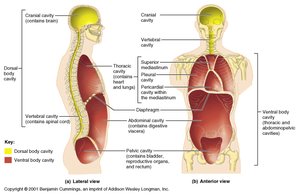
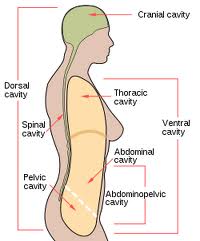
The body contains internal cavities that house and protect vital organs. These cavities are lined by membranes that provide lubrication and protection.
Dorsal Body Cavity: Includes the cranial cavity (encasing the brain) and vertebral (spinal) cavity (encasing the spinal cord).
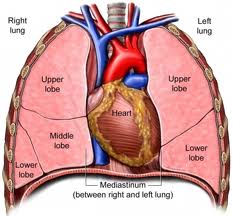
Ventral Body Cavity: Includes the thoracic cavity (chest; contains heart and lungs) and abdominopelvic cavity (contains digestive, urinary, and reproductive organs).
Abdominopelvic Quadrants and Regions
Quadrants
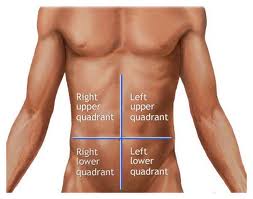
The abdominopelvic cavity is divided into four quadrants for clinical reference:
Right Upper Quadrant (RUQ)
Left Upper Quadrant (LUQ)
Right Lower Quadrant (RLQ)
Left Lower Quadrant (LLQ)
Regions
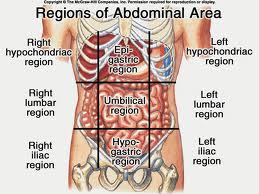
For more precise anatomical study, the abdominopelvic cavity is also divided into nine regions:
Right Hypochondriac | Epigastric | Left Hypochondriac |
|---|---|---|
Right Lumbar | Umbilical | Left Lumbar |
Right Iliac (Inguinal) | Hypogastric (Pubic) | Left Iliac (Inguinal) |
Additional info: The anatomical terminology and organizational hierarchy introduced here are foundational for all subsequent study in anatomy and physiology, providing the language and framework for describing the human body in health and disease.
