 Back
BackL0 - Body Organization and Organ Systems
Study Guide - Smart Notes
 Tailored notes based on your materials, expanded with key definitions, examples, and context.
Introduction to Anatomy and Physiology
Overview
Anatomy and physiology are foundational sciences for understanding the structure and function of the human body. Mastery of these subjects is essential for careers in health professions and for making informed decisions about personal health.
Anatomy: The study of body structure.
Physiology: The study of body function.
Knowledge of anatomy and physiology aids in understanding medical news, making healthful choices, and responding to illness.
Basic Definitions and Divisions of Anatomy
Types of Anatomy
Gross Anatomy: Study of structures visible to the naked eye.
Systemic Anatomy: Study of the body by systems (e.g., skeletal, muscular).
Regional Anatomy: Study of specific areas of the body (e.g., head, arm).
Surface Anatomy: Study of external features and their relation to deeper structures.
Anatomic Position and Descriptive Terminology
Anatomic Position
The standard reference position for the body is standing erect, arms at the sides, and palms facing forward. This position is used to describe locations and directions in the body.
Directional Terms
Cranial (Cephalic, Superior): Toward the head
Caudal (Inferior): Away from the head
Ventral (Anterior): Front (belly) side
Dorsal (Posterior): Back side
Proximal: Nearer to a point of reference
Distal: Farther from a point of reference
Medial: Toward the midline
Lateral: Away from the midline
Afferent: Toward a structure
Efferent: Away from a structure
Internal (Deep): Away from the surface
External (Superficial): Toward the surface
Visceral: Related to internal organs
Parietal: Related to the body wall
Prone: Lying face down
Supine: Lying face up
Ipsilateral: Same side of the body
Contralateral: Opposite side of the body
Body Planes
Major Body Planes
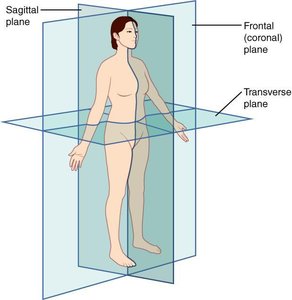
Body planes are imaginary lines used to divide the body for anatomical study.
Sagittal Plane: Divides the body into right and left parts
Coronal (Frontal) Plane: Divides the body into anterior (front) and posterior (back) parts
Transverse (Horizontal) Plane: Divides the body into superior (upper) and inferior (lower) parts
Oblique Plane: Divides the body at an angle
Body Cavities
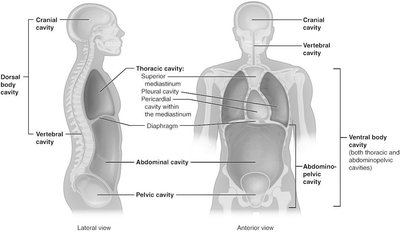
Major Body Cavities and Subdivisions
Dorsal Cavity: Houses the brain and spinal cord
Cranial Cavity: Contains the brain
Vertebral (Spinal) Cavity: Contains the spinal cord
Ventral (Coelom) Cavity: Houses the viscera (internal organs)
Thoracic Cavity: Contains heart, lungs, trachea, bronchi, esophagus, thymus, thyroid
Pericardial Cavity: Surrounds the heart
Pleural Cavities: Surround the lungs
Mediastinum: Central compartment between pleural cavities
Abdominopelvic (Peritoneal) Cavity: Separated from thoracic by the diaphragm
Abdominal Cavity: Contains liver, stomach, spleen, pancreas, intestines
Pelvic Cavity: Contains bladder, rectum, reproductive organs
Membranes of Body Cavities
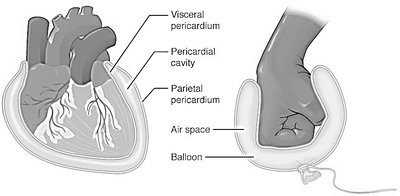
Visceral Membrane: Covers organs
Parietal Membrane: Lines body cavity
Serous Fluid: Secreted between membranes for lubrication
Body Regions and Surface Anatomy
Major Body Regions
Head
Neck
Trunk: Thorax (chest), Abdomen
Upper Extremities: Arms
Lower Extremities: Legs
Abdominal/Pelvic Regions and Quadrants
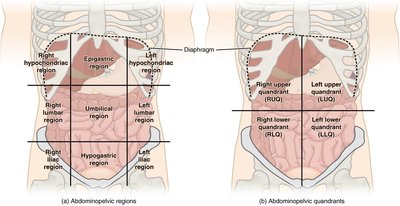
Regions (9): Epigastric, Umbilical, Hypogastric, R/L Hypochondriac, R/L Lumbar, R/L Inguinal
Quadrants (4): Right Upper (RUQ), Left Upper (LUQ), Right Lower (RLQ), Left Lower (LLQ)
Surface Anatomy Landmarks
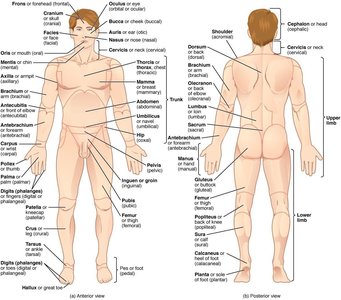
Specific anatomical terms are used to describe surface regions of the body. For example, 'cranial' refers to the skull, 'coxal' to the hip, and 'patellar' to the kneecap.
Organ Systems of the Human Body
Classification and Functions
System Name | Major Organs | Functions |
|---|---|---|
Integumentary | Skin, hair, nails, sweat and sebaceous glands | Protection, temperature regulation, vitamin D synthesis |
Skeletal | Bones, tendons, ligaments, cartilage | Support, protection, movement, calcium storage, blood cell formation |
Muscular | Skeletal muscles | Movement, heat production |
Nervous | Brain, spinal cord, nerves | Coordination, information processing |
Endocrine | Endocrine glands (e.g., thyroid, pancreas, adrenal) | Hormone secretion, homeostasis |
Cardiovascular | Heart, blood vessels | Transport of nutrients, wastes, gases; electrolyte balance |
Lymphatic | Bone marrow, lymph nodes, thymus, spleen | Immune response, fluid return |
Respiratory | Nose, pharynx, larynx, trachea, bronchi, lungs | Gas exchange, pH balance, voice production |
Urinary | Kidneys, ureters, bladder, urethra | Waste removal, blood pH and pressure regulation |
Digestive | Mouth, esophagus, stomach, intestines, liver, pancreas, gall bladder | Breakdown and absorption of food |
Reproductive | Testes, ovaries, associated ducts and glands | Production and transport of gametes, hormone production, fetal development (female) |
Practice and Review
Sample Questions
Which organ system controls cell function with hormones? Endocrine
The membrane on the surface of the lung is called the: Visceral pleura
The trachea is anterior to the esophagus.
The organ system that returns fluid to the bloodstream and provides protection against pathogens is the lymphatic/immune system.
The anatomical term meaning "on the other side of the body" is contralateral.
A plane dividing the body into anterior and posterior portions is called a frontal (coronal) plane.
The organ system including skin, hair, and nails is the integumentary system.
The "shoulder" is the acromial region.
The "armpit" region is the axillary region.
The "fingers or toes" are digits.
A transverse section is the same as a horizontal section.
The heart lies in the thoracic cavity.
Femoral refers to the thigh.
The fingers are proximal to the wrist: False.
Bones are deep to the skin: True.
The sternum is anterior to the vertebral column: True.
The organ system containing the liver is the digestive system.
The urinary bladder is located in the pelvic cavity.
The testis and ovaries are part of both the endocrine and reproductive systems: True.
The spleen is part of the lymphatic/immune system.
Additional info:
Understanding anatomical terminology and body organization is essential for communication in health sciences.
Practice labeling diagrams and identifying organs in each body cavity and region for mastery.
