 Back
BackIntroduction to Human Anatomy: Orientation, Planes, Terms, Cavities, and Systems
Study Guide - Smart Notes
 Tailored notes based on your materials, expanded with key definitions, examples, and context.
Introduction to Anatomy
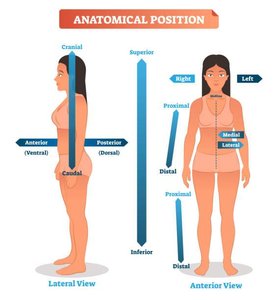
Anatomical Position
The anatomical position is a standardized visual reference point used in anatomy to describe locations and relationships of body parts. In this position, a person stands erect with feet together or flat on the ground, toes pointing forward, eyes facing forward, and palms facing anteriorly (forward) with thumbs pointed away from the body. The terms right and left always refer to the sides belonging to the patient or cadaver, not the observer.
Key Point: Anatomical position is essential for consistent communication in anatomy.
Example: When describing the location of the heart, it is always referenced relative to the anatomical position.
Planes of Section
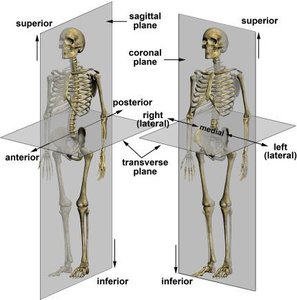
Body planes are imaginary lines used to divide the body for anatomical study. They help describe locations and movements of structures.
Coronal (Frontal) Plane: Divides the body vertically into anterior (front) and posterior (back) parts.
Transverse (Horizontal) Plane: Runs horizontally, dividing the body into superior (upper) and inferior (lower) parts.
Sagittal Plane: Extends vertically, dividing the body into right and left parts.
Midsagittal (Median) Plane: Runs along the midline, dividing the body into equal right and left halves.
Parasagittal Plane: Offset from the midline, dividing the body into unequal right and left parts.
Directional Terms
Standard Anatomical Terms
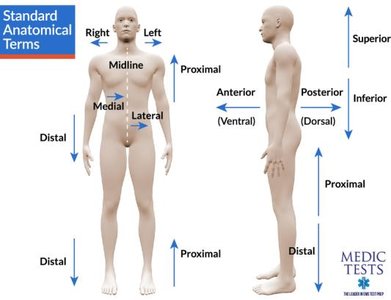
Directional terms are used to describe the locations of structures relative to other structures or locations in the body.
Anterior (Ventral): Toward or at the front of the body.
Posterior (Dorsal): Toward or at the back of the body.
Superior (Cranial): Toward the head end or upper part of a structure.
Inferior (Caudal): Away from the head end or toward the lower part of a structure.
Medial: Toward the midline of the body.
Lateral: Away from the midline of the body.
Superficial (External): Toward or at the body surface.
Deep (Internal): Away from the body surface; more internal.
Proximal: Closer to the origin of a body part or the point of attachment of a limb to the body trunk.
Distal: Farther from the origin of a body part or the point of attachment of a limb to the body trunk.
Body Cavities
Major Body Cavities
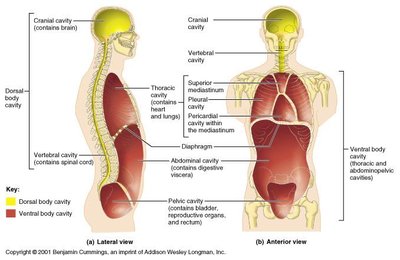
The human body contains two main sets of internal cavities: dorsal and ventral. These cavities house and protect vital organs.
Dorsal Body Cavity: Subdivided into the cranial cavity (contains the brain) and vertebral cavity (contains the spinal cord).
Ventral Body Cavity: Larger and anterior, contains visceral organs. Divided into:
Thoracic Cavity: Surrounded by ribs and chest muscles; includes pericardial cavity (heart), pleural cavities (lungs), and mediastinum (central region with heart, esophagus, trachea).
Abdominopelvic Cavity: Surrounded by abdominal walls and pelvic girdle; divided into abdominal cavity (liver, stomach, kidneys) and pelvic cavity (bladder, reproductive organs, rectum).
Abdominopelvic Regions and Quadrants
Regions and Quadrants
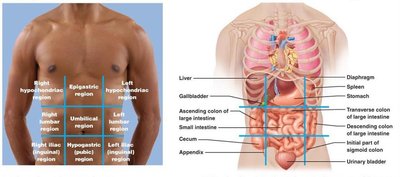
The abdominopelvic area is divided into nine regions and four quadrants to help locate organs and describe pain or injury.
Quadrants:
Right Upper Quadrant (RUQ): Contains liver and gallbladder.
Left Upper Quadrant (LUQ): Contains diaphragm, spleen, stomach, transverse colon.
Right Lower Quadrant (RLQ): Contains ascending colon, small intestine, cecum, appendix.
Left Lower Quadrant (LLQ): Contains descending colon, sigmoid colon, urinary bladder.
Regions: Include right/left hypochondriac, epigastric, right/left lumbar, umbilical, right/left iliac, hypogastric.
Levels of Organization and Organ Systems
Overview of Organ Systems
The human body is organized into levels: cells, tissues, organs, and organ systems. Each organ system has specific functions and major organs.
Integumentary System: Forms external body covering, protects deeper tissues, synthesizes vitamin D, houses receptors and glands.
Skeletal System: Protects and supports organs, provides framework for movement, forms blood cells, stores minerals.
Muscular System: Allows movement, maintains posture, produces heat.
Nervous System: Fast-acting control system, responds to changes by activating muscles and glands.
Endocrine System: Glands secrete hormones regulating growth, reproduction, metabolism.
Cardiovascular System: Blood vessels transport blood; heart pumps blood.
Lymphatic System: Returns leaked fluid to blood, disposes of debris, houses white blood cells, mounts immune response.
Respiratory System: Supplies blood with oxygen, removes carbon dioxide, gaseous exchange occurs in lungs.
Digestive System: Breaks down food, absorbs nutrients, eliminates indigestible food as feces.
Urinary System: Eliminates nitrogenous wastes, regulates water, electrolyte, and acid-base balance.
Reproductive System: Produces offspring, delivers sperm/eggs, supports fertilization and fetal development, nourishes newborn.
Immune System: Protects against infection and disease by identifying and destroying pathogens.
Organ System | Major Organs | Primary Function |
|---|---|---|
Integumentary | Skin, hair, nails | Protection, vitamin D synthesis |
Skeletal | Bones, joints | Support, movement, blood cell formation |
Muscular | Skeletal muscles | Movement, heat production |
Nervous | Brain, spinal cord, nerves | Control, response to stimuli |
Endocrine | Glands (pituitary, thyroid, etc.) | Hormone regulation |
Cardiovascular | Heart, blood vessels | Transport of blood |
Lymphatic | Lymph nodes, spleen | Immunity, fluid balance |
Respiratory | Lungs, trachea | Gas exchange |
Digestive | Stomach, intestines | Digestion, absorption |
Urinary | Kidneys, bladder | Waste elimination, balance |
Reproductive | Testes, ovaries | Offspring production |
Immune | White blood cells, lymphatic organs | Defense against pathogens |
