 Back
BackIntroduction to Human Anatomy: Orientation, Terminology, and Body Organization
Study Guide - Smart Notes
 Tailored notes based on your materials, expanded with key definitions, examples, and context.
An Overview of Anatomy and Physiology
Definition and Scope
Anatomy is the study of the structure of the human body, while physiology focuses on the functions of body parts. Together, these disciplines provide a comprehensive understanding of how the body is organized and how it operates.
Anatomy: Examines the physical structures, from microscopic to macroscopic levels.
Physiology: Explores the mechanisms and processes that allow the body to function.
Subdisciplines of Anatomy
Gross Anatomy: Study of structures visible to the naked eye.
Regional Anatomy: Focuses on specific areas of the body.
Systemic Anatomy: Examines body systems (e.g., skeletal, muscular).
Surface Anatomy: Studies external features as landmarks for deeper structures.
Microscopic Anatomy (Histology): Investigates tissues and cells using a microscope.
Developmental Anatomy: Studies structural changes throughout life.
Embryology: Focuses on development before birth.
Pathological Anatomy (Pathology): Examines structural changes caused by disease.
Radiographic Anatomy: Uses imaging techniques to study structures.
Functional Morphology: Explores the relationship between structure and function.
The Hierarchy of Structural Organization
Levels of Organization
The human body is organized into a hierarchy of structural levels, each building upon the previous one:
Chemical Level: Atoms combine to form molecules.
Cellular Level: Cells and their organelles are the basic units of life.
Tissue Level: Groups of similar cells perform a common function.
Organ Level: Structures composed of at least two tissue types perform specific functions.
Organ System Level: Organs work together to accomplish a common purpose.
Organismal Level: The living human being is the sum of all structural levels working together.
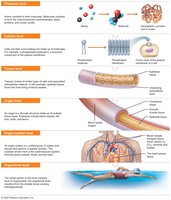
Major Organ Systems of the Human Body
Overview of Organ Systems
Integumentary System: Forms the external body covering, protects deeper tissues, synthesizes vitamin D, and contains sensory receptors and glands.
Skeletal System: Protects and supports organs, provides a framework for muscles, forms blood cells, and stores minerals.
Muscular System: Enables movement, maintains posture, and produces heat.
Nervous System: Fast-acting control system that responds to stimuli and activates muscles and glands.
Endocrine System: Glands secrete hormones regulating growth, reproduction, and metabolism.
Cardiovascular System: Blood vessels transport blood, carrying oxygen, nutrients, and wastes; the heart pumps blood.
Lymphatic System/Immunity: Returns leaked fluids to blood, disposes of debris, and houses immune cells.
Respiratory System: Supplies blood with oxygen and removes carbon dioxide.
Digestive System: Breaks down food for absorption and eliminates indigestible remains.
Urinary System: Eliminates nitrogenous wastes and regulates water, electrolytes, and acid-base balance.
Reproductive Systems: Produce offspring; male and female systems have specialized structures and functions.
Units of Measurement in Anatomy
The metric system is the standard for anatomical measurement, including meters, centimeters, micrometers, liters, milliliters, kilograms, and grams.
Anatomical Terminology
Anatomical terms are derived from Greek and Latin, providing a universal language for describing body structures and positions.
Gross Anatomy: Regional and Directional Terms
Anatomical Position and Regional Terms
The anatomical position is a standard reference: the person stands erect, feet together, eyes forward, and palms facing anteriorly with thumbs pointing away from the body. Regional terms specify areas of the body, divided into axial (head, neck, trunk) and appendicular (limbs) regions.
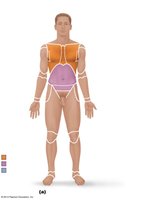
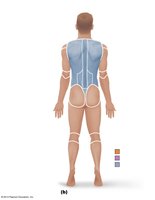
Directional Terms
Directional terms describe the location of one body part relative to another. They are typically used in paired opposites:
Superior (cranial): Toward the head or upper part of a structure.
Inferior (caudal): Away from the head or toward the lower part.
Anterior (ventral): Toward the front of the body.
Posterior (dorsal): Toward the back of the body.
Medial: Toward the midline of the body.
Lateral: Away from the midline.
Proximal: Closer to the origin of a body part or point of attachment.
Distal: Farther from the origin or point of attachment.
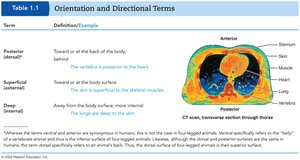
Superficial (external): Toward or at the body surface.
Deep (internal): Away from the body surface; more internal.
Body Planes and Sections
Major Body Planes
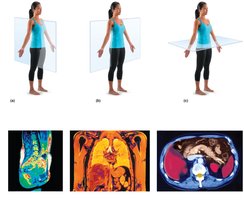
Body planes are imaginary lines used to divide the body for anatomical study:
Sagittal Plane: Divides the body into right and left parts. The midsagittal (median) plane divides it into equal halves.
Frontal (Coronal) Plane: Divides the body into anterior and posterior parts.
Transverse (Horizontal) Plane: Divides the body into superior and inferior parts.
Body Cavities and Membranes
Major Body Cavities
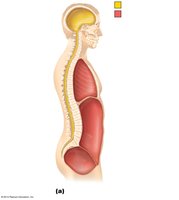
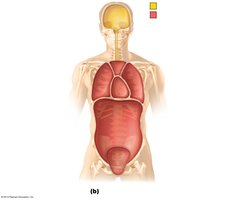
Dorsal Body Cavity: Includes the cranial cavity (brain) and vertebral cavity (spinal cord).
Ventral Body Cavity: Subdivided into the thoracic cavity (heart and lungs) and abdominopelvic cavity (digestive, urinary, and reproductive organs).
Serous Membranes and Cavities
Serous cavities are slit-like spaces lined by a double-layered serous membrane, which secretes serous fluid to reduce friction. The parietal serosa lines the cavity wall, while the visceral serosa covers the organs.
Pleura: Surrounds the lungs.
Pericardium: Surrounds the heart.
Peritoneum: Surrounds abdominal organs.
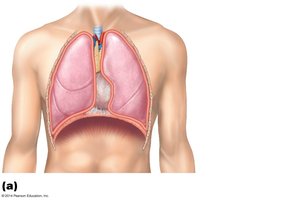
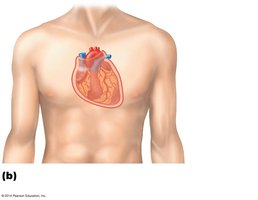
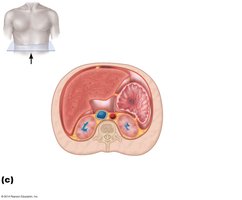
Abdominal Quadrants
Division of the Abdomen
The abdomen is divided into four quadrants for clinical reference:
Right Upper Quadrant (RUQ)
Left Upper Quadrant (LUQ)
Right Lower Quadrant (RLQ)
Left Lower Quadrant (LLQ)
These quadrants help localize pain, injuries, or abnormalities to specific regions.
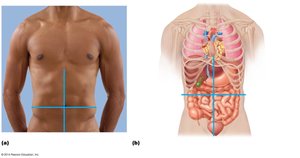
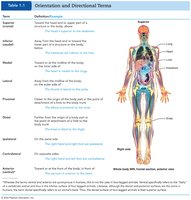
Table: Orientation and Directional Terms
Term | Definition/Example |
|---|---|
Superior (cranial) | Toward the head end or upper part of a structure or the body; above. Example: The head is superior to the abdomen. |
Inferior (caudal) | Away from the head end or toward the lower part of a structure or the body; below. Example: The navel is inferior to the chin. |
Anterior (ventral) | Toward or at the front of the body; in front of. Example: The breastbone is anterior to the spine. |
Posterior (dorsal) | Toward or at the back of the body; behind. Example: The heart is posterior to the breastbone. |
Medial | Toward or at the midline of the body; on the inner side of. Example: The heart is medial to the arm. |
Lateral | Away from the midline of the body; on the outer side of. Example: The arms are lateral to the chest. |
Proximal | Closer to the origin of the body part or the point of attachment of a limb to the body trunk. Example: The elbow is proximal to the wrist. |
Distal | Farther from the origin of a body part or the point of attachment of a limb to the body trunk. Example: The knee is distal to the thigh. |
Superficial (external) | Toward or at the body surface. Example: The skin is superficial to the skeletal muscles. |
Deep (internal) | Away from the body surface; more internal. Example: The lungs are deep to the skin. |
