 Back
BackIntroduction to Physiology and Homeostasis
Study Guide - Smart Notes
 Tailored notes based on your materials, expanded with key definitions, examples, and context.
Introduction to Anatomy and Physiology
Definitions and Relationship
Anatomy is the study of the internal and external structures of the body and the physical relationships among body parts. It can be divided into gross anatomy (structures visible to the naked eye) and microscopic anatomy (structures requiring magnification). Physiology is the study of how organisms perform their vital functions. These two sciences are closely related, as physiological functions are performed by specific anatomical structures.
Anatomy: Structure and organization of living things
Physiology: Function and processes of living things
Relationship: Structure determines function; for example, the shape of a bone influences its strength and movement capabilities.
Introduction to Physiology
Levels of Physiological Study
Physiology can be studied at multiple levels:
Molecular and Cellular Physiology: Examines processes at the smallest scale, such as enzyme activity and cell signaling.
Organ System Physiology: Focuses on the function of entire organ systems, such as the cardiovascular or respiratory systems.
Pathological Physiology: Studies how disease alters normal physiological processes.
Homeostasis
Definition and Importance
Homeostasis is the maintenance of a relatively stable internal environment despite changes in the external environment. It is a dynamic process, meaning that physiological variables fluctuate within a normal range rather than remaining constant. Homeostatic regulation is essential for survival and proper function.
Dynamic Equilibrium: Internal conditions are maintained within a narrow range.
Examples: Regulation of body temperature, water balance, blood pressure, oxygen and carbon dioxide levels, and blood glucose.
Components of Homeostatic Regulation
Homeostatic regulation involves three main components:
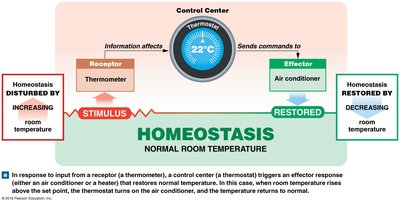
Receptor: A sensor that detects changes in the environment (stimulus).
Control Center: Processes information from the receptor and determines the appropriate response.
Effector: Produces a response that restores the internal environment to its set point.
Types of Homeostatic Regulation
Extrinsic Regulation: Involves the nervous or endocrine system, which sends signals to multiple parts of the body to coordinate a response.
Autoregulation (Intrinsic): Local cells, tissues, or organ systems sense environmental changes and adjust their activity independently, typically resulting in a localized response.
Feedback Mechanisms in Homeostasis
Negative Feedback
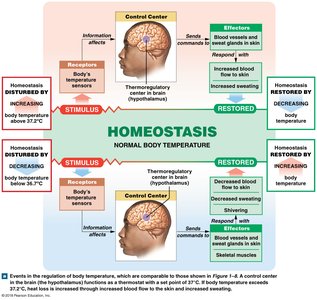
Negative feedback is the most common mechanism of homeostatic regulation. It works to correct deviations from a set point by producing a response that opposes the initial stimulus.
Process: A receptor senses a stimulus (change), the control center processes the information, and the effector produces a response to restore balance.
Example: Regulation of body temperature. If body temperature rises, mechanisms such as sweating and vasodilation are activated to cool the body. If temperature falls, shivering and vasoconstriction help warm the body.
Positive Feedback
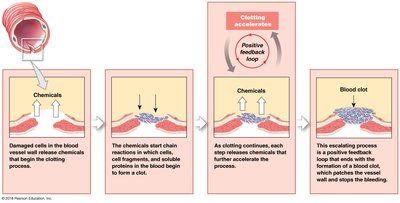
Positive feedback is less common and amplifies the initial stimulus, leading to an enhanced response. This mechanism is typically used when a rapid or decisive outcome is needed.
Process: A receptor senses a stimulus, the control center activates the effector, and the effector's response further increases the stimulus.
Example: Blood clotting. When a vessel is damaged, chemicals are released that initiate clotting. As clotting proceeds, more chemicals are released, accelerating the process until the vessel is sealed.
Homeostasis and Disease
Failure of Homeostatic Mechanisms
When homeostatic mechanisms are overwhelmed or fail, the result can be disease or even death. Causes of homeostatic failure include infection, injury, or genetic abnormalities. The healthy human body is usually very effective at maintaining homeostasis, but persistent or severe disturbances can lead to pathological conditions.
Possible Causes: Infection, injury, genetic abnormality
Possible Results: Disease, organ dysfunction, death
