 Back
BackIntroduction to Physiology and Homeostasis: Structured Study Notes
Study Guide - Smart Notes
 Tailored notes based on your materials, expanded with key definitions, examples, and context.
Introduction to Physiology
Definition and Scope
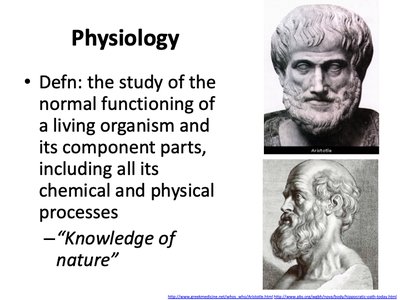
Physiology is the scientific study of the normal functioning of living organisms and their component parts, including all chemical and physical processes. It is an integrative science, meaning it examines how different systems interact to produce complex behaviors and functions.
Physiology: The study of how organisms, organ systems, organs, tissues, and cells carry out life processes.
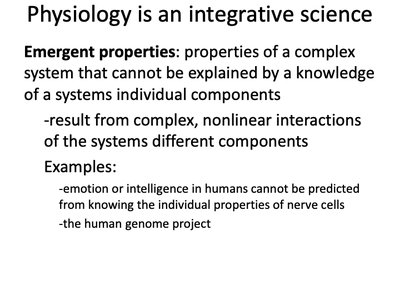
Emergent properties: Characteristics of a complex system that cannot be explained solely by understanding its individual components. These arise from nonlinear interactions among system parts.
Examples: Human intelligence and emotion, which cannot be predicted from nerve cell properties alone; insights from the human genome project.
Levels of Organization in Physiology
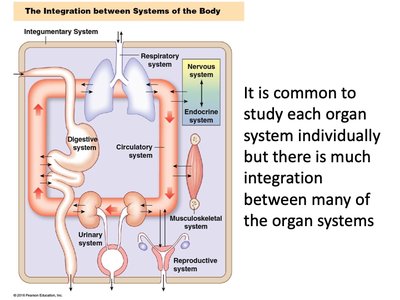
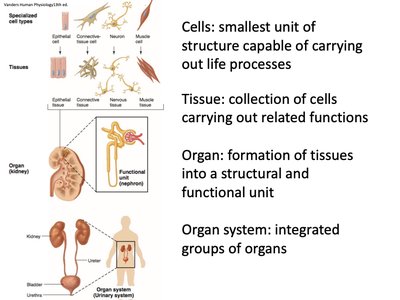
Physiology studies the hierarchical organization of life, from molecules to cells, tissues, organs, and organ systems. Each level builds upon the previous, with increasing complexity and integration.
Cells: Smallest unit capable of carrying out life processes.
Tissues: Collections of cells performing related functions.
Organs: Formed from tissues into structural and functional units.
Organ systems: Integrated groups of organs working together.
Homeostasis
Concept and Importance
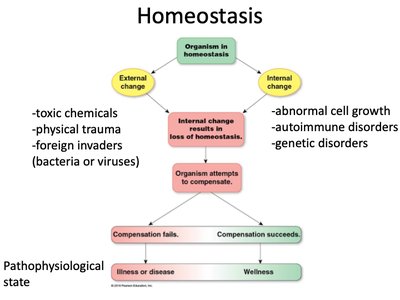
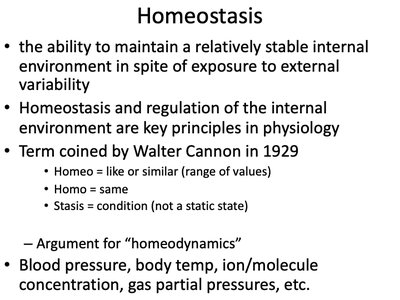
Homeostasis is the ability to maintain a relatively stable internal environment despite external variability. It is a central principle in physiology, ensuring optimal conditions for cellular function.
Key principle: Regulation of internal environment is essential for health.
Term origin: Coined by Walter Cannon in 1929.
Homeodynamics: Recognizes that internal conditions fluctuate within a range, not a static state.
Examples: Blood pressure, body temperature, ion concentrations, gas partial pressures.
Homeostasis vs. Equilibrium
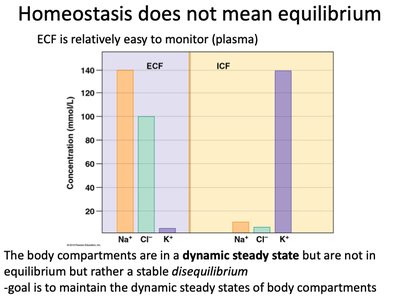
Homeostasis does not imply equilibrium. Instead, the body maintains a dynamic steady state, or stable disequilibrium, where concentrations of substances differ between compartments but remain constant over time.
ECF (Extracellular Fluid): Easy to monitor; contains high Na+ and Cl-.
ICF (Intracellular Fluid): Contains high K+.
Stable disequilibrium: Levels are stable but not equal between compartments.
Mass Balance in Homeostasis
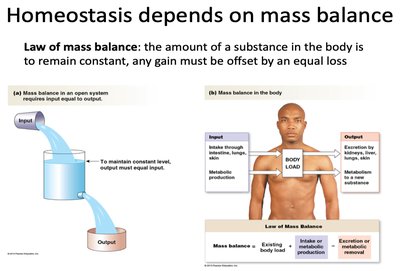
The law of mass balance states that the amount of a substance in the body remains constant if input equals output. This principle is crucial for maintaining homeostasis.
Input: Intake through food, air, or metabolic production.
Output: Excretion via urine, feces, sweat, or metabolic consumption.
Equation:
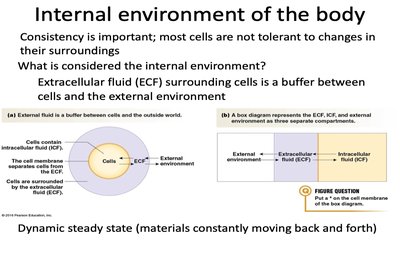
Internal Environment of the Body
Consistency in the internal environment is vital, as most cells are sensitive to changes. The extracellular fluid (ECF) acts as a buffer between cells and the external environment, maintaining a dynamic steady state.
ECF: Surrounds cells, providing a stable environment.
Dynamic steady state: Materials constantly move back and forth, but overall conditions remain stable.
Control Systems and Homeostasis
Types of Control Systems
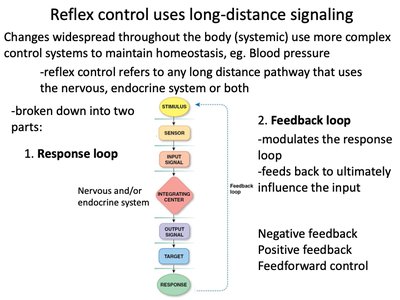
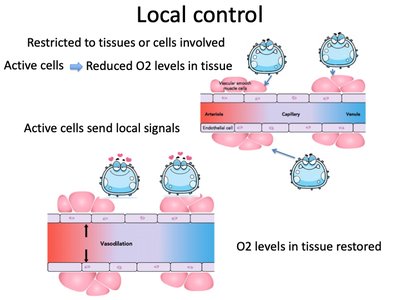
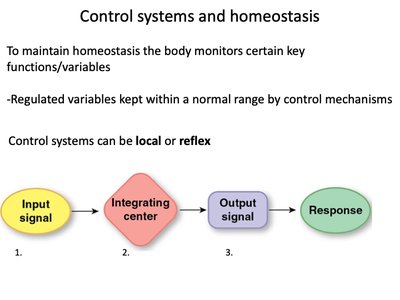
To maintain homeostasis, the body uses control systems to monitor and regulate key variables. These systems can be local (restricted to a small area) or reflex (systemic, involving long-distance signaling).
Local control: Limited to tissues or cells involved; active cells send local signals to restore conditions.
Reflex control: Uses nervous and/or endocrine systems for long-distance regulation.
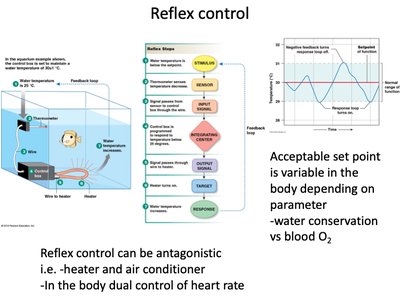
Components: Input signal, integrating center, output signal, response.
Feedback Loops
Feedback loops are mechanisms that help regulate homeostasis. They can be negative (stabilizing) or positive (reinforcing).
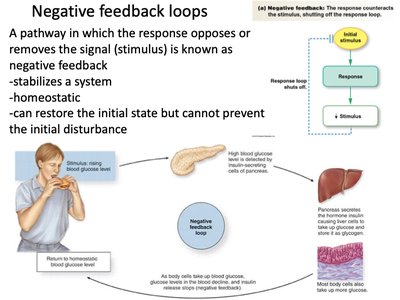
Negative feedback: Response opposes or removes the stimulus, stabilizing the system. Most homeostatic processes use negative feedback.
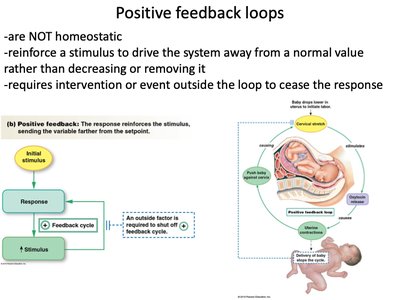
Positive feedback: Response reinforces the stimulus, driving the system away from normal values. Requires external intervention to stop.
Example (Negative feedback): Regulation of blood glucose by insulin.
Example (Positive feedback): Childbirth, where contractions increase until the baby is delivered.
Reflex Control and Set Points
Reflex control can be antagonistic, with dual regulation of parameters such as heart rate. The acceptable set point for a variable can change depending on physiological needs.
Antagonistic control: Two systems regulate a parameter in opposite directions (e.g., heater and air conditioner analogy).
Dual control: Heart rate regulated by both sympathetic and parasympathetic nervous systems.
Biological Rhythms and Feedforward Control
Biological Rhythms and Set Point Changes
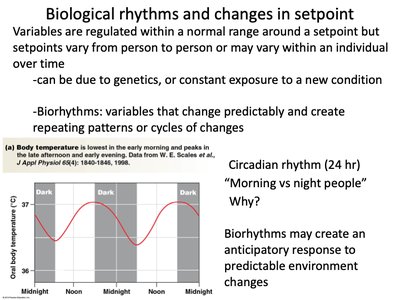
Variables are regulated within a normal range, but set points can vary between individuals or change over time due to genetics or environmental exposure. Biological rhythms, such as circadian rhythms, create predictable cycles of change.
Biorhythms: Variables that change predictably, creating repeating patterns (e.g., body temperature).
Circadian rhythm: 24-hour cycle affecting physiological processes.
Morning vs. night people: Differences in body temperature regulation and alertness.
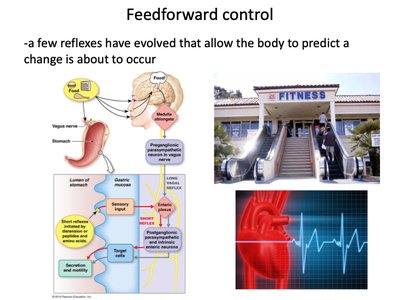
Feedforward Control
Feedforward control involves anticipatory physiological changes before a requirement arises. This allows the body to prepare for predictable events, such as eating or exercise.
Example: Saliva production in response to the thought or smell of food; increased heart and respiratory rate before exercise.
Proprioceptors: Sensors in muscles that trigger anticipatory changes.
Additional info: Feedforward and biological rhythm mechanisms are essential for adapting to environmental changes and maintaining optimal function. Most control systems in physiology are negative feedback loops, but positive and feedforward controls play important roles in specific contexts.
